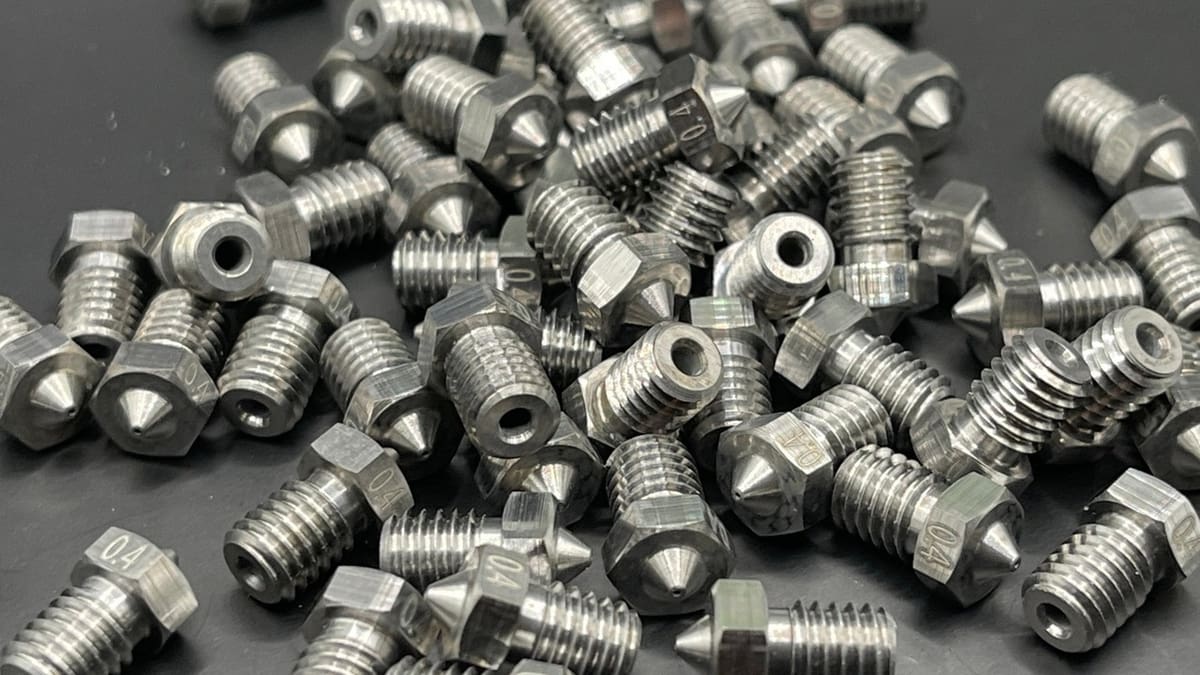
Say Goodbye to 3D Printer Nozzle Wear: Print Longer with Tungsten Carbide

The 3D printer nozzle market is full of interesting materials, but tungsten carbide frequently comes up in community forums. Read on to learn why!
3D printer nozzle degradation leads to a loss in print quality. Abrasive filaments can accelerate the wear and tear on your printer’s nozzle, but even common materials, given enough time, could lead to serious nozzle decay. While simply replacing the nozzle fixes the issue, upgrading to a more durable nozzle decreases how often you’ll have to replace it.
There are many alternatives to brass – some more expensive than others. On the luxurious end of the spectrum, ruby- and diamond-tipped nozzles are advertised as one nozzle for every filament, one nozzle for a lifetime of printing. That also means, one nozzle goes for over $90.
Many makers turn instead to hardened steel nozzles for printing more abrasive materials. They’re incredibly strong, and reputable brands sell them for around $20-$25. The only catch is, steel is less thermally conductive than brass. Without print temperature adjustments, you may experience poor layer adhesion, if not outright delamination. Therefore, switching to a hardened steel nozzle typically requires some experimentation with higher temperature settings to accommodate for the lower thermal conductivity.
Hardened steel nozzles are likely the most cost effective solution for makers who occasionally print abrasive materials. But for those of us who have fallen in love with carbon fiber filled filament or some of the novelty PLAs with abrasive additives, we’ll definitely need to upgrade to a better nozzle.
The Upgrade Option
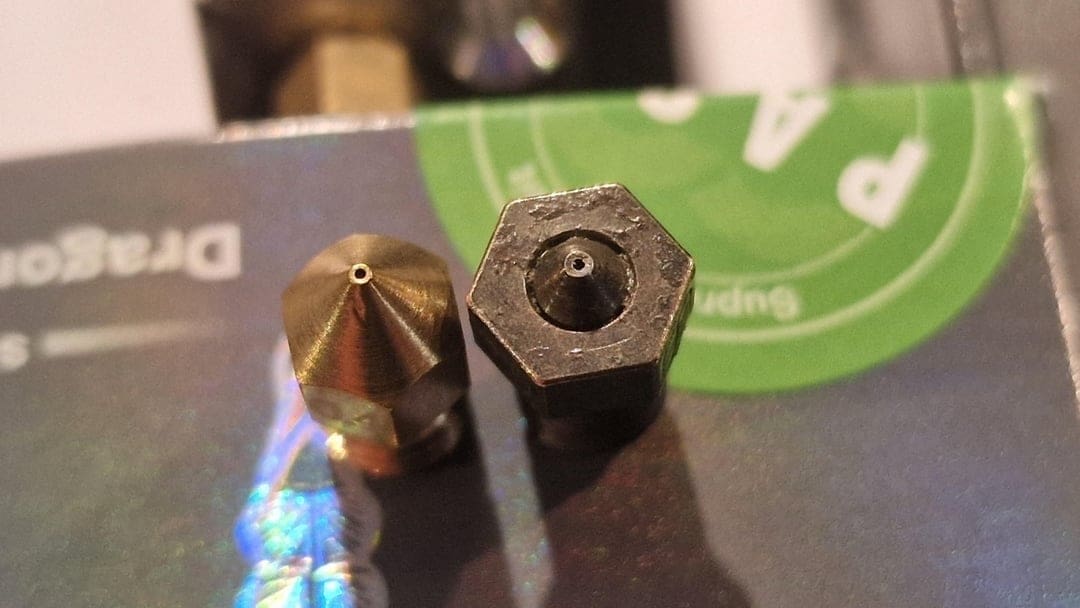
For around $50, you could get a tungsten carbide nozzle that’s incredibly wear resistant and thermally conductive. Its superior material properties are thanks not only to the tungsten and carbon compound but also the metal used as binder.
Looking at its hardness, you’ll see that some sites will compare tungsten carbide with synthetic gems based on gigapascals (GPa), a unit of measure related to pressure and is used to measure stiffness, compressive strength, as well as tensile strength. When assessing a material’s ability to withstand abrasive materials, the Mohs scale of hardness may be more useful: It measures resistance to scratching.
On the Mohs hardness scale, we find that tungsten carbide – not to be mistaken with simple tungsten – has a hardness of 9. For comparison, brass has a Mohs hardness of 3, hardened steel can reach up to 8, and diamond, 10.
While the difference in Mohs hardness between hardened steel and tungsten carbide is nominal, makers and nozzle manufacturers tell us the difference is more substantial when it comes to thermal conductivity. Steel measures around 45 W/(m K), but research finds that hardening steel lowers its thermal conductivity even more.
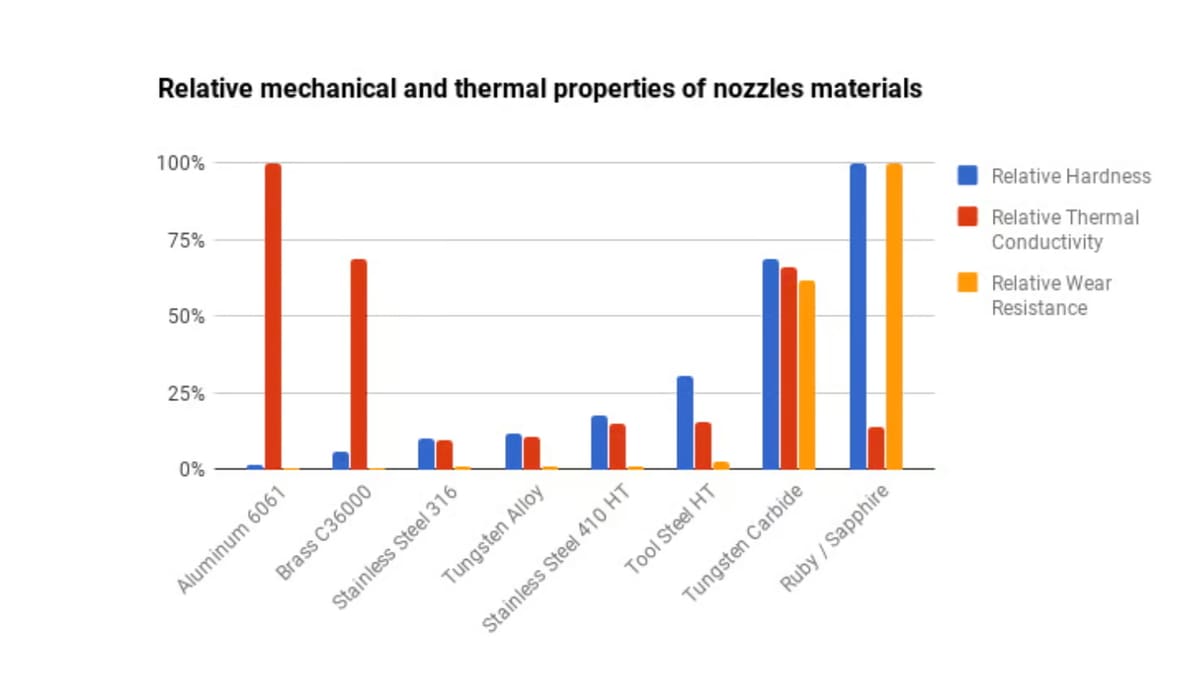
You’ll often hear that tungsten carbide is as thermally conductive as brass, which measures around 117 W/(m K). However, checking the data of material manufacturers presents a murkier picture. According to Thermtest’s material database, tungsten carbide alone (without a binder) measures around 42 W/(m K). However, its thermal conductivity increases when combined with a binder metal – with some grades reaching as high as 121 W/(m K).
Various manufacturers of K20 grade tungsten carbide – which is used for 3DMaker Engineering’s nozzles – report thermal conductivity values ranging from 84 to 92. That’s not quite as high as brass, but still double the value of steel.
Regardless of the measurements though, makers’ experiences matter the most and we have to admit, their feedback has been overwhelmingly positive.
Where to Buy One
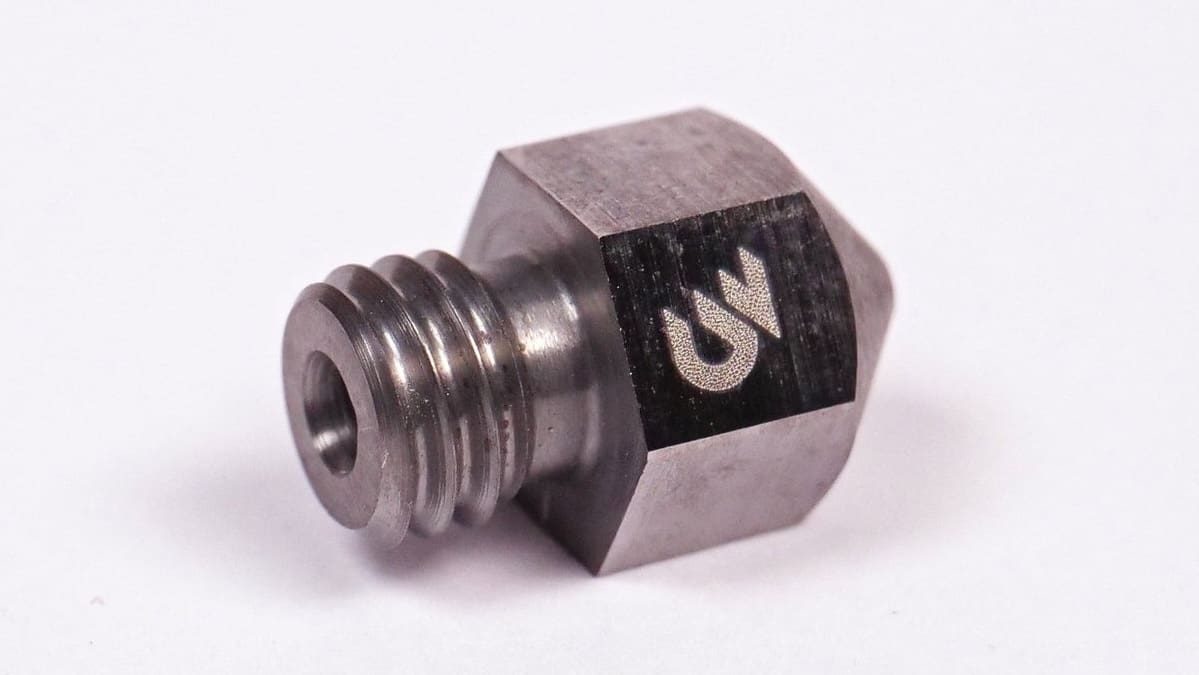
Several trustworthy retailers sell tungsten carbide nozzles in various designs at different price points. The following are a couple of noteworthy examples; both are fully made from K20 grade tungsten carbide:
- West3D’s Undertaker is a favorite among makers. It’s priced at just under $50 and is available in V6, MK8, Volcano, and Creality K1 Volcano styles. The available diameters range from 0.4 to 1.2 mm.
- 3DMaker Engineering’s NozzleOne is available in V6, MK8, and Volcano compatibilities as well as 0.4 mm and 0.6 mm diameters. The NozzleOne will set you back about $60.
There are more options available but make sure to read the fine print. Some nozzle designs are bimetallic, with only the tip made of tungsten carbide and the nozzle’s body made from something else. Others are actually made of tungsten steel, a different material altogether.
License: The text of "Say Goodbye to 3D Printer Nozzle Wear: Print Longer with Tungsten Carbide" by All3DP is licensed under a Creative Commons Attribution 4.0 International License.