Xometry Alternatives: Better Options in 6 Categories

We looked for better Xometry alternatives in terms of instant quotes, better pricing, transparency, color options, and faster delivery.
If you’re a small or medium manufacturer, an inventor, or an entrepreneur who needs prototypes, spare parts, or small batches of products 3D printed, machined, or injection molded, you have more choices than ever before.
Between cost pressures, supply chain diversification, and the rise of new competitors, there are a surge of new options in the manufacturing space. Especially in the US and Europe, there is a focus to reshore manufacturing, build more predictable supply chains, and get innovative products to market faster. These are just some of the reasons on-demand manufacturing is surging and becoming more specialized.
You’re no longer limited to a few large companies that set the price and process. In this guide, we’re not picking on Xometry; they’ve serviced thousands of customers well since they launched in 2013 and reported record gross profit ($59 million) in Q4 of 2024. However, it’s important to point out that you may have a lot more choices today that offer features and services that weren’t previously on your radar.
For example, Xometry doesn’t offer an instant quote 100% of the time. If you need more than one part or a part in an uncommon material, you may have to wait days or longer for an engineer to get back to you. The service offers a lot of 3D printing technologies, but their offerings and materials are not exhaustive. And, because it subcontracts your order to a network of partners, you don’t know who exactly is doing the 3D printing or on what type or brand of 3D printer.
Let’s dive in.
Get an Instant Quote
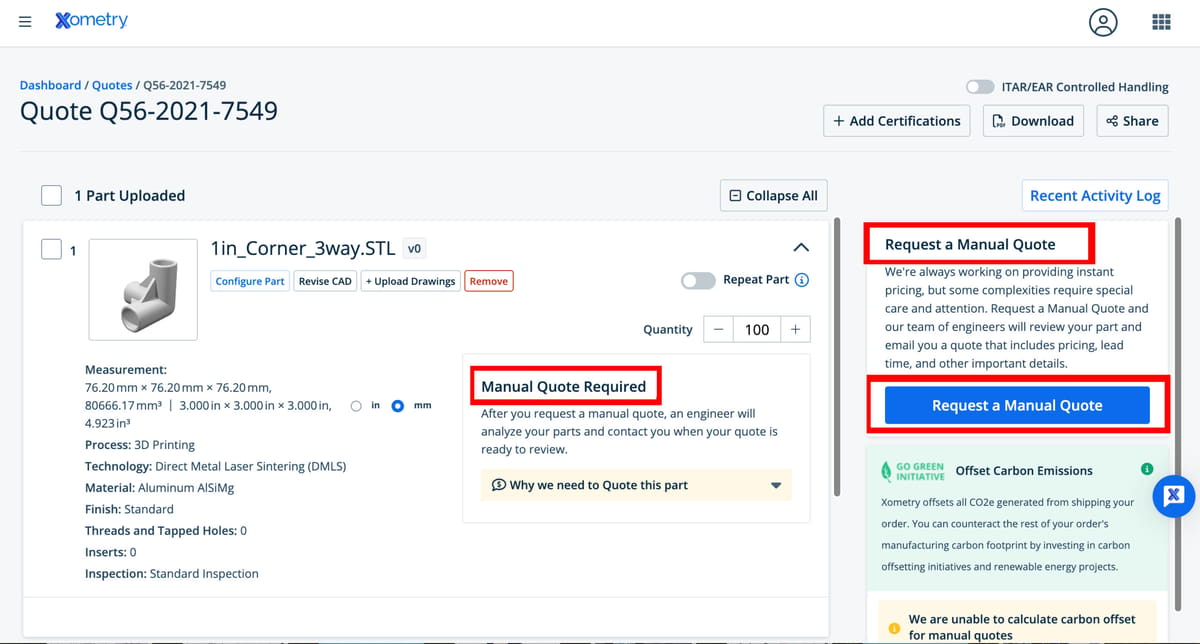
When you’re comparing services, you want to know the price. Xometry will offer an instant quote most of the time; the only exception we found is that requesting high quantities (100+) of certain builds might trigger a manual quote. If you’re looking for quick high-volume pricing, expect to wait at least 24 hours for a quote.
On Xometry, you may also encounter the “other” category when trying to select the material you need. There are hundreds of materials listed on the website, but in the ordering process platform itself, there’s a smaller menu and “other” at the end where you need to type in a material. This is another instance that will trigger the manual quoting process, and someone will get back to you about whether it’s available or not.
Get More Affordable Parts
If you put Xometry to the test against other 3D printing services, it’s unlikely to come out as the most affordable, especially for small orders. It’s a big company focused on manufacturing, and it doesn’t even offer a lot of affordable material options. Plus, one-offs are not where it makes its record profits.
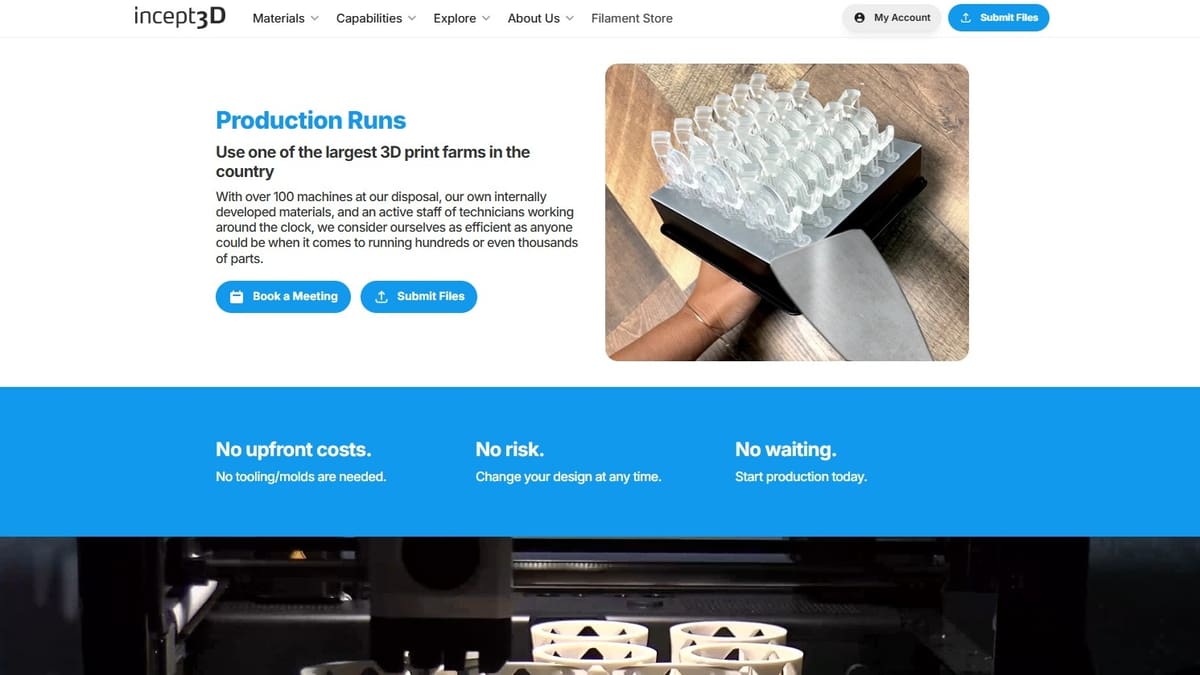
Instead, look at local providers and other networks. For example, if you’re in San Diego, there’s a great local 3D printing business called Incept3D. Here you can get an instant quote, order your part, and opt to pick it up there and avoid any shipping charges. You can build a relationship with this service provider and potentially even get advice.
When it comes to networks, for example, Craftcloud is a better option in terms of price transparency and pricing. On Craftcloud, you can compare prices from hundreds of manufacturing partners in real time and will most likely find more affordable options, and there is no minimum order value.
3D Printing Service Price Comparison Charts
We’ve also done some price comparison shopping ourselves among the 3D printing services. We’ve loaded models to many of the top players and asked for quotes for MJF and metal 3D printing projects. Read our findings in the articles linked below:


Know Exactly Who Is Making Your Part
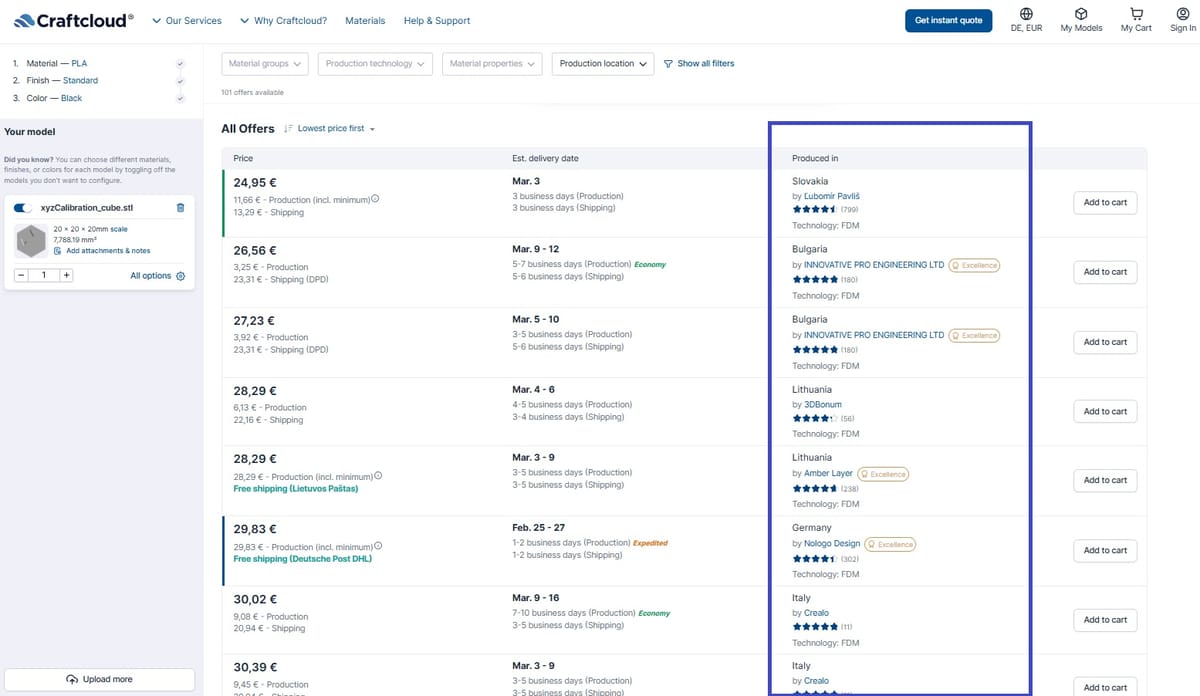
Although there is likely no reason to worry about your intellectual property being unprotected at the major 3D printing services since they follow data security best practices and can offer you an NDA if required, still, it’s good to know who is actually 3D printing your part and where.
Xometry will let you know if the manufacturing partner assigned to your project is in the US, but, other than that, it’s a secret. For repeat orders you might get a different partner every time, which can make it hard to ensure the same quality and materials, although Xometry does say it will work with you to line up the same supplier if required.
At networks like Craftcloud, you not only get the name and location of the specific company that will manufacture your part, but you can see their reviews from actual customers. Craftcloud reviews often feature photos of the actual parts and useful comments on quality and delivery. They also manage all aspects of customer service so you don’t have to work with a separate company every time.
Recently, Craftcloud began offering a feature to circumvent tariffs and other international trade barriers with their new “Best Local Price” feature. Because Craftcloud has a global network of production partners, they can provide options for producing a part in the buyer’s home country. As an added bonus, opting to produce parts locally reduces transportation costs as well as environmental impact. In an era of uncertain international tariffs, this is an extremely useful tool to have in your belt.
Of course, many 3D printing services, large and small tell you exactly where their facilities are. If you want to work with an American manufacturer, for example, turn to Fathom with 11 manufacturing sites in the US or Florida-based Addman, with locations across the US. If you want your parts manufactured in the EU turn to Sculpteo, based in France, or FIT, based in Germany.
Get it in Color
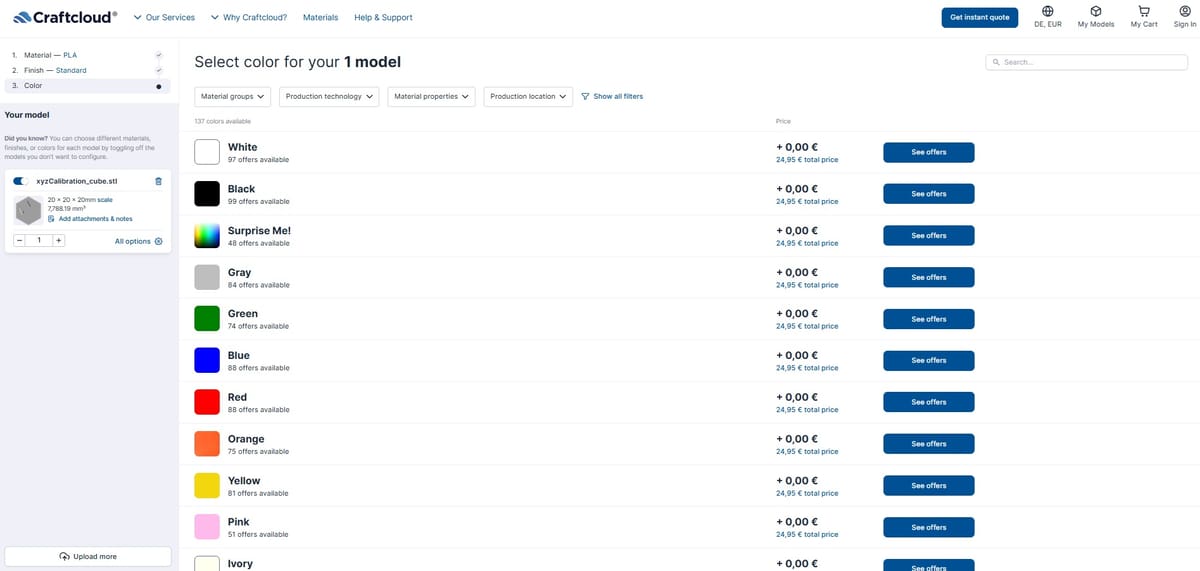
Have you ever noticed when shopping for a coat that most options come in black or brown? It’s because these are the most popular colors and anything outside of this ordinary could risk not being sold. Some 3D printing services also only stock the most popular colors of filament – black, white, gray – and don’t offer painting or dying of polymer powder bed parts.
Xometry’s color options are limited to variations of gray or off-white for FDM, SLS, and SLA. The only exception is selecting its PolyJet technology and you can get your powder bed polymer parts dyed one of 5 basic colors.
Notably, Craftcloud’s options for SLS Nylon increased by over 37% since our last update.
If you want more choice of color, you’ll need to head elsewhere. We looked at nearly a dozen 3D printing services and no one comes close to Craftcloud for color options across a range of technologies except for maybe Treatstock.
Get It Faster
As you may already know, 3D printing can be an incredibly fast manufacturing method, especially for small batches of product that can all be printed in the same print run of an SLS or MJF machine, for example. For polymers, it’s certainly faster than injection molding since you don’t have to first create the mold, and for metal parts, it can be quicker than CNC machining.
So if your goal is to get that spare part for a broken piece of essential equipment fast or that product prototype to present to clients on time, you’ll want a service with guaranteed speed options.
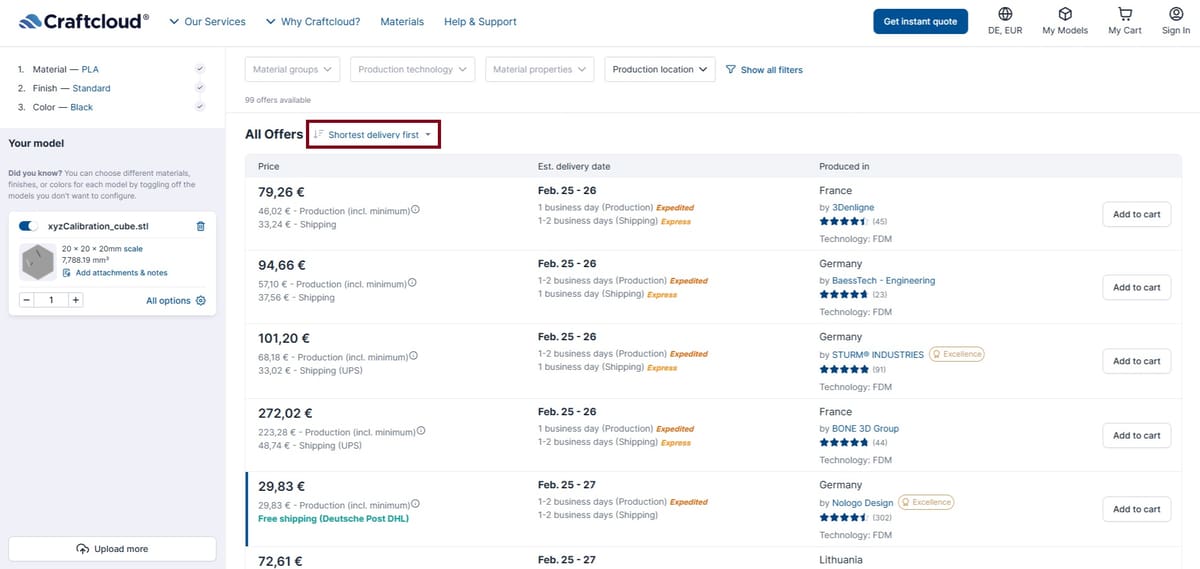
Xometry does offer three levels of delivery service on most parts: Economy, Standard, and Expedite but you’ll pay a lot for speed. We uploaded the same file to Xometry and Craftcloud. The Xometry option could take just two days but the one part is more than $500. Craftcloud’s fastest option for this part is four days, but the part is only $158.
From the 3D printing services we explored several offer a 48-hour service, such as Quickparts, and Protiq. Expedited service at SyBridge is four days. Ficitv can produce your part in seven days or just 3 days for double the price.
Technology Options
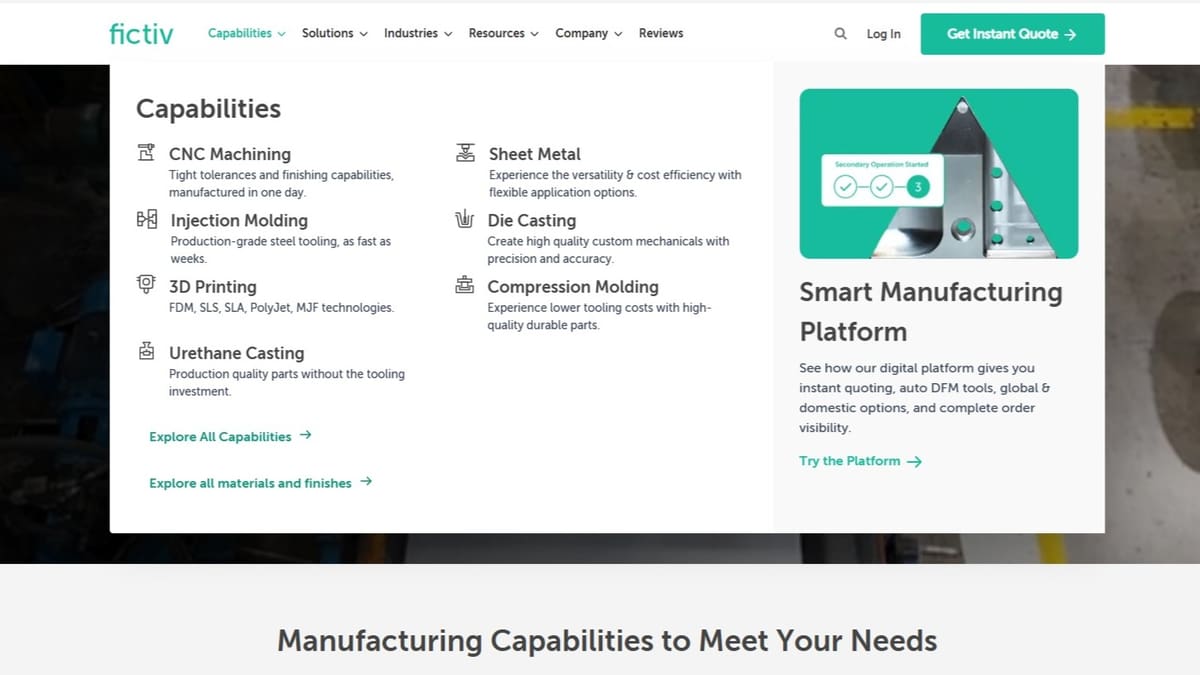
Whether you need something specific, or you’re looking for a service that can handle multiple technologies for all your projects, these are the options offered (and not offered) by five popular, reliable 3D printing and machining services.
Craftcloud
Craftcloud offers 31 different 3D printing technologies, as well as CNC machining. These, combined with over 100 different materials and arrays of finish and color options, makes creativity easy and endless. Because Craftcloud aggregates partners from all over the world, it offers an extremely broad portfolio of options.
Xometry
Xometry connects you with a network of over 10,000 suppliers to provide customers with a wide range of options and pricing. Xometry also works with over 130+ materials, including a wide range of metals and plastics.
Shapeways
Shapeways went through bankruptcy in 2024, but relaunched under new ownership, and its portfolio of services continues to evolve and grow. Shapeways mainly focuses on polymers and metals, but doesn’t currently support FDM, CNC, or molding.
Fictiv
Fictiv offers a pretty broad range of services, comparable to Xometry, which includes additive, molding, and casting services.
SyBridge
SyBridge holds a narrower focus on high-volume, high-performance industrial parts rather than everyday consumer prototyping. It’s worth noting that SyBridge’s FDM capabilities are only through Stratasys printers, and the colors and materials are engineering grade. SyBridge can print in PolyJet indirectly through their partners.
Here’s a quick chart to compare the methods you need.
License: The text of "Xometry Alternatives: Better Options in 6 Categories" by All3DP Pro is licensed under a Creative Commons Attribution 4.0 International License.