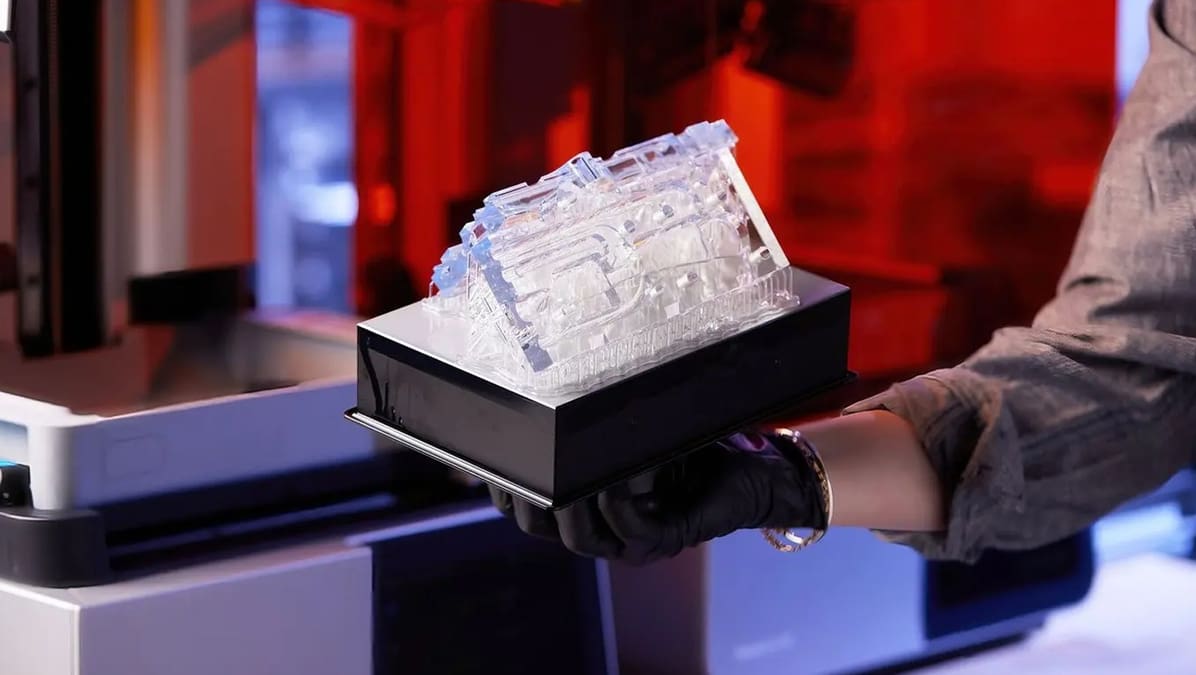
Stop Overpaying for Resin 3D Prints: We Tested 5 Services on Price and Speed

Of the top resin 3D printing services, who has the best price, options, and easy online ordering? We found out.
Whether you need to print a toy model for your kids or a heart valve model for your patients, ordering from a 3D printing service company is the fastest and most affordable way to get custom-made objects. All you need is a digital model and a little bit of knowledge on the different types of 3D printing.
Resin 3D, which is a broad category of several technologies, offers finely detailed parts of practically any size. Prints can have realistic surface texture and true-to-life colors. You would choose resin 3D printing over other technologies when the look and finish of your part is more important than the strength or durability, generally speaking.
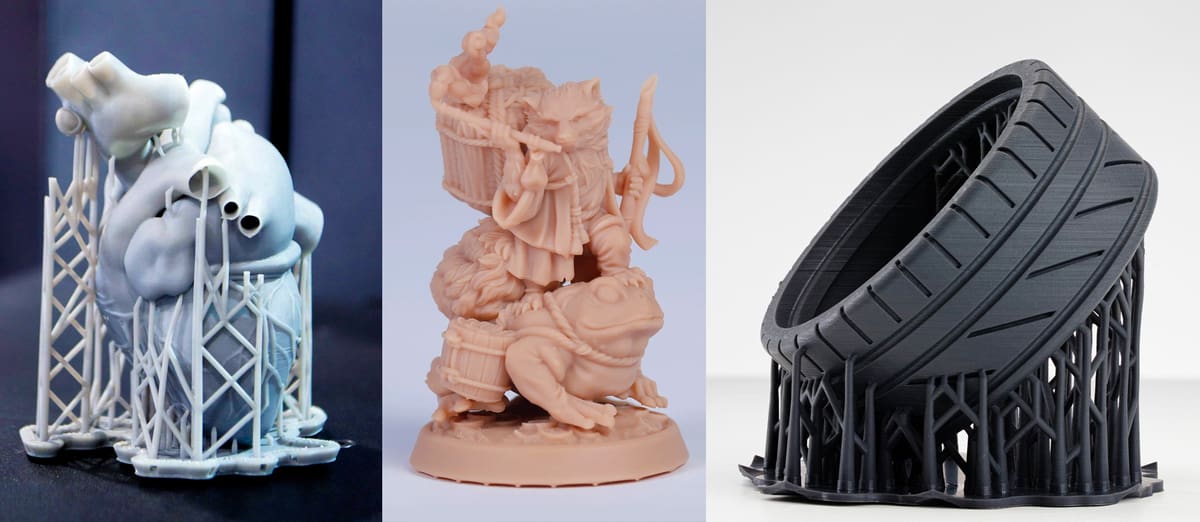
In other words, it’s for a model, not a tool – with some notable exceptions when it comes to industrial resin 3D printers, which we cover below.
Today’s wide range of 3D printing services can guide you through the options and materials available, but some may leave you on your own to figure out the best option. Whether your project involves one unique gift for a friend, several jewelry molds, or hundreds, even thousands, of parts for your business, we’ve collected and reviewed the top resin 3D printing services providing a range of material and technology options to help you choose the best one.
If you don’t know DLP from PolyJet, skip down to the end section where we detail each resin technology and what they’re used for.
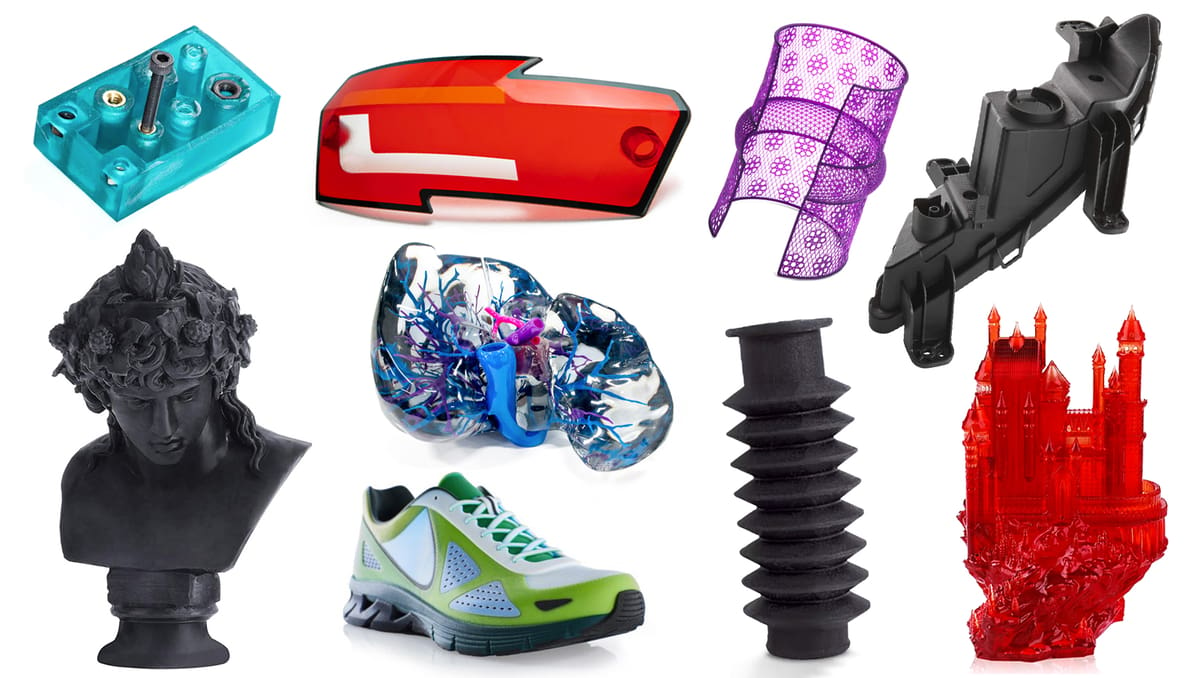
We personally put each of the following 3D printing services to the test to explore their user interface, customer service, available materials, and cost effectiveness for 3D printing in various resins.
5 Services Put to the Test
Sculptural Object
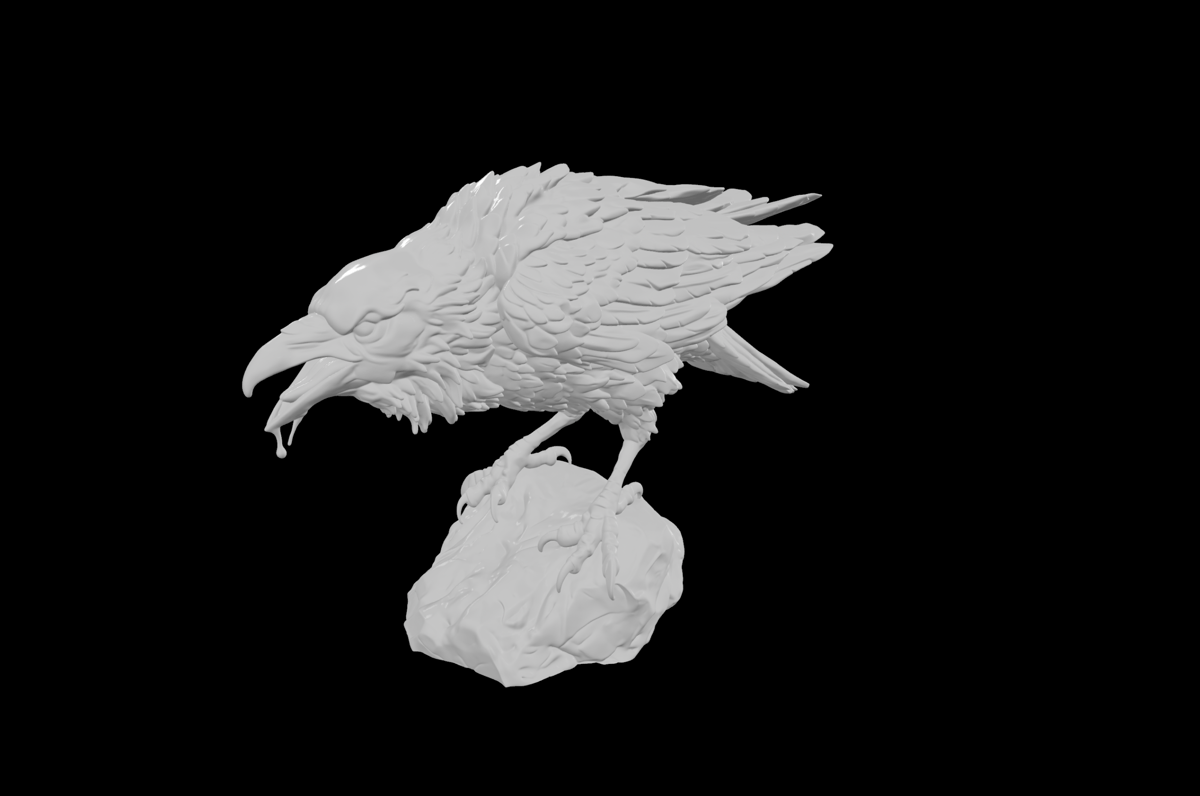
Using a detailed figurine of a crow, we tested the online quoting services of five companies to compare their offers for resin 3D printing using vat polymerization technologies, including SLA, DLP, and LCD. Not every company offers all three, but we selected the most affordable resin options for each one.
For a detailed figurine or display model like this, resin should be the material of choice due to its smooth surface (without the need for much post-processing), as it can be easily painted or stand alone. Industrial resin isn’t necessary for a display model, since although standard resins can be brittle, the finished product is not meant to be handled excessively.
*RapidObject’s quote was converted from Euros to U.S. Dollars.
Most Affordable: Craftcloud was by far the cheapest option for obtaining standard resin prints using SLA, DLP, and LCD technologies.
Craftcloud
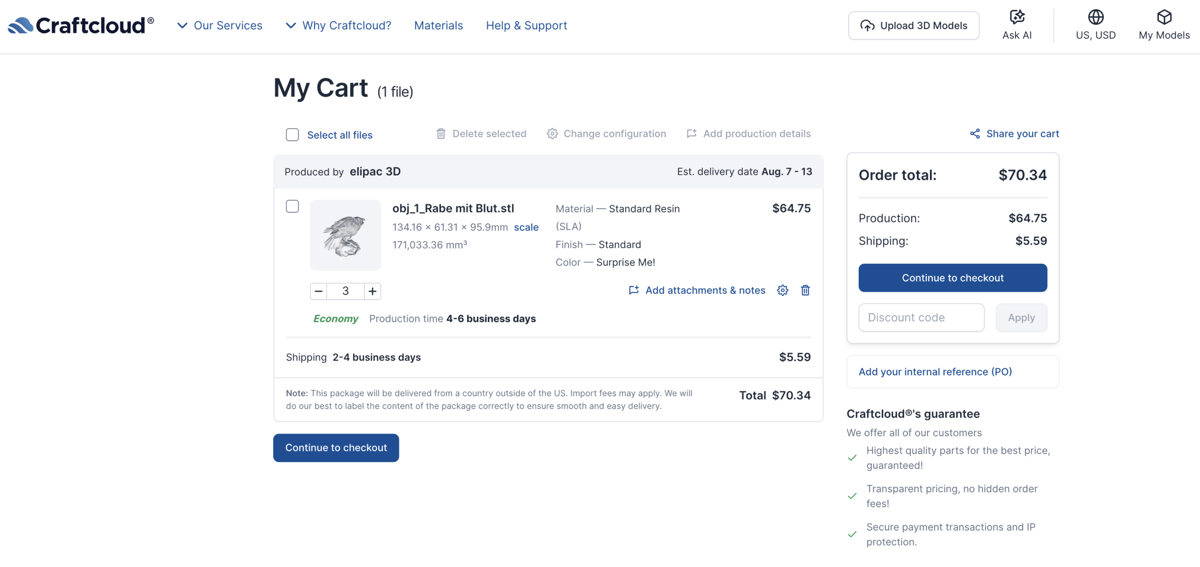
Craftcloud is a user-friendly platform that enables you to compare prices and lead times from manufacturers around the world. Because it partners with more than 150 top manufactures across the globe, Craftcloud often has the widest variety of materials and technologies at dirt cheap prices.
To obtain an instant quote, all you have to do is upload your CAD model, select the resin technology, material, and finish you need, and browse through the list to find a quote that works for you. All quotes are generated within seconds, with no sign-up required.
For resin parts, Craftcloud lists an extensive library of materials. The options include everything from standard, tough, and high-detail resins for display pieces and prototypes to transparent and elastic resins, castable resins for jewelry and metal casting, and even medical, surgical, and Carbon DLS resins.
The service works for both one-off prints, such as gifts or prototype samples, and small batches of fully functional industrial-grade parts. Craftcloud also has an extensive library of material and support documentation to help you choose the right service provider, which are all customer rated.
- Maximum build volume: 3,500 × 3,500 × 5,000 mm
- Available technologies: SLA, DLP, MSLA/LCD, PolyJet, Carbon DLS
- Materials: 20+ options, including tough, transparent, castable, elastic, biomedical, and carbon resins
- Turnaround: 4 days, varies by supplier

Xometry
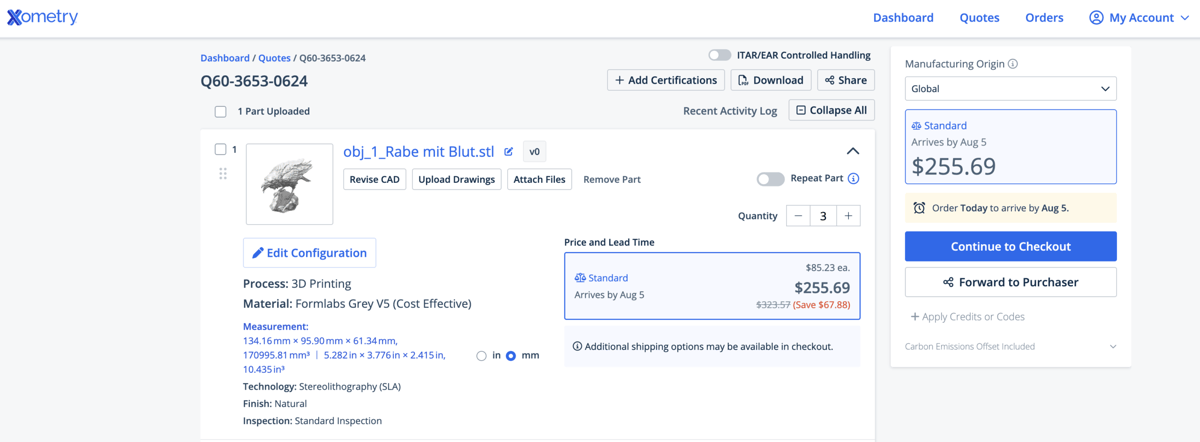
Xometry operates a global network of suppliers for both additive and traditional manufacturing. When it comes to resin printing, Xometry advertises three different resin 3D printing technologies, including SLA, Carbon DLS, and PolyJet. It also offers wide material libraries for each technology. SLA leads the way with 23 materials, but DLS and PolyJet also have many options to choose from.
Like all the services we explored for this article, Xometry offers instant online quotes, with just an email address required to sign up. Depending on the CAD model you upload, your print may trigger a manual quote. Even though we were able to receive an instant quote, Xometry is aimed at volume manufacturing and not so much figurine models.
Xometry has it’s own facilities in the US and production partners in multiple countries. Most orders are eligible for free two-day shipping or ground shipping, and expedited next-day delivery is also available.
- Available technologies: SLA, Carbon DLS, PolyJet
- Maximum build volume: 736 x 635 x 533 mm
- Materials: 17 SLA resins; 7 DLS resins; 4 PolyJet resins
- Turnaround: From 2 business days
Protolabs
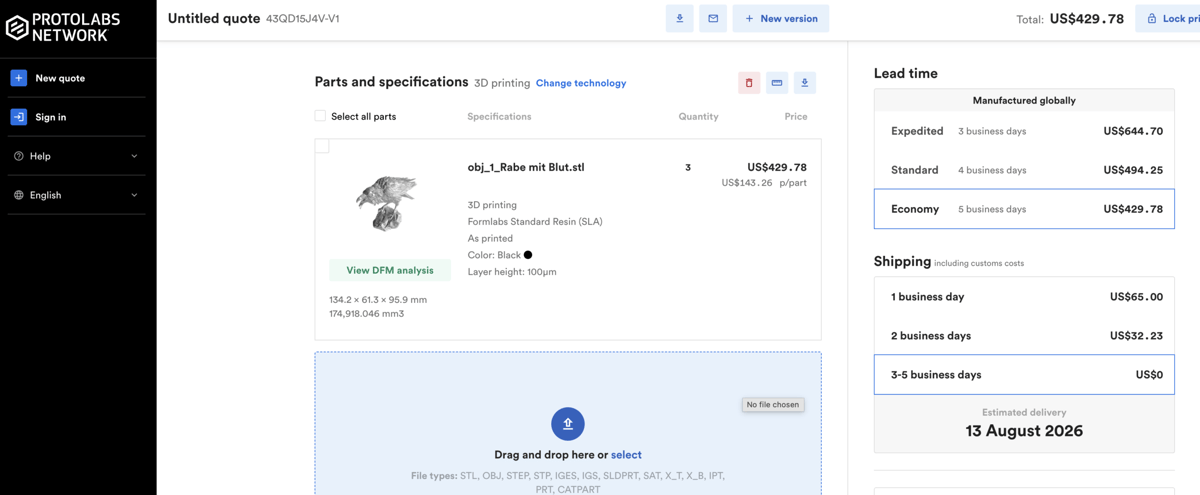
Protolabs launched its 3D printing business in 2014 and has continued to expand. Today, the company operates manufacturing centers in the U.S., Europe, and Japan in addition to a network of manufacturing partners.
We turned to Protolabs Network to test its resin printing capabilities. Currently, only SLA printing is offered for resin, but a variety of resin materials are offered, including standard, clear, tough, rigid, pro, flexible, high-temp, and durable resin. Most of these resins are available in black, gray, or white.
Protolabs offers one of the highest detail levels, making the surface a great choice for intricate, high-accuracy prototypes. Multiple surfacing options are available for resin prints and Protolabs maintains a sizeable collection of design guides for 3D printed parts. Using SLA, it can produce large-format resin parts. However, the size comes at the cost of detail quality.
Unlike many other companies on this list, Protolabs doesn’t offer separate design services. It is, however, able to produce highly detailed parts very fast, which makes it a good prototyping partner. A huge plus when it comes to Protolabs Network is its options for expedited lead times as short as two days, and expedited shipping as short as one day, at an additional cost.
- Available technologies: SLA, PolyJet, Carbon DLS
- Maximum build volume: 736 x 635 x 533 mm
- Materials: Accura Xtreme White 200, Accura Xtreme Gray, Accura 7820, WaterShed XC 11122, MicroFine Gray and Green, Somos 9120, Accura 60, Accura 5530, PerFORM (SLA); 30A-95A, Rigid (PolyJet); Carbon RPU 70, Carbon FPU 50 (DLS)
- Turnaround: From 1 business day
RapidObject
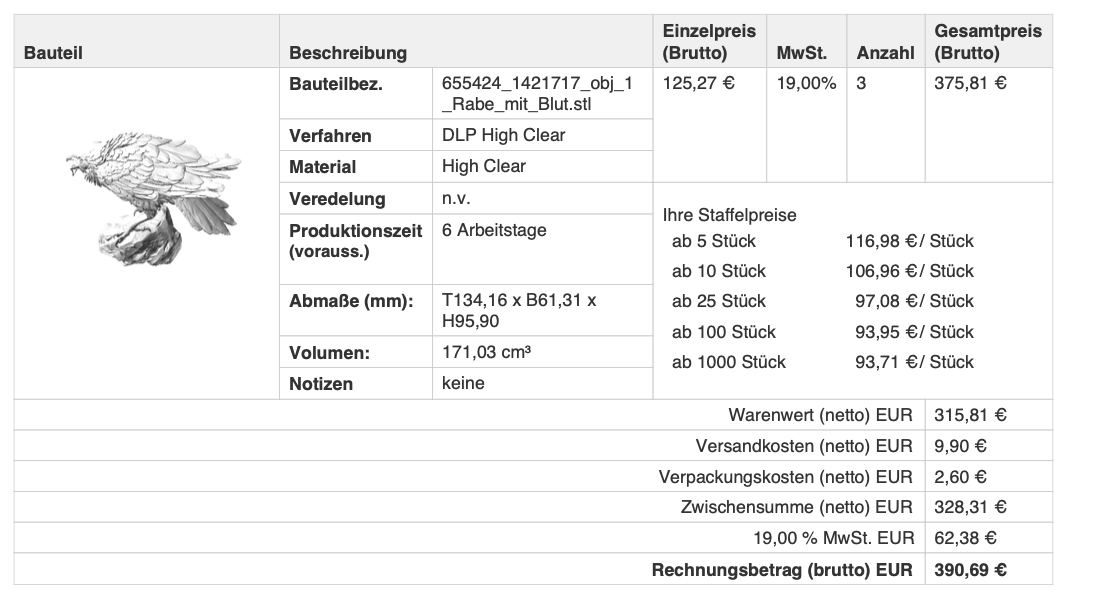
If you’re in the EU or need your parts made there, Germany-based RapidObject offers SLA, DLP, and Polyjet technology for resin prints with a wide range of available materials to choose from, as well 24-hour express turnaround time for certain services.
Most materials are available for instant quoting, but some — for example, Accura Xtreme — are only available by special request, and customers can receive a quote within a few days (in German). We converted the price from Euros to US Dollars for this article.
- Available technologies: SLA, DLP, PolyJet
- Maximum build volume: 2000 x 700 x 788 mm
- Materials: 16 SLA resins, 12 DLP, 6 PolyJet
- Turnaround: From 2 business days
Sculpteo
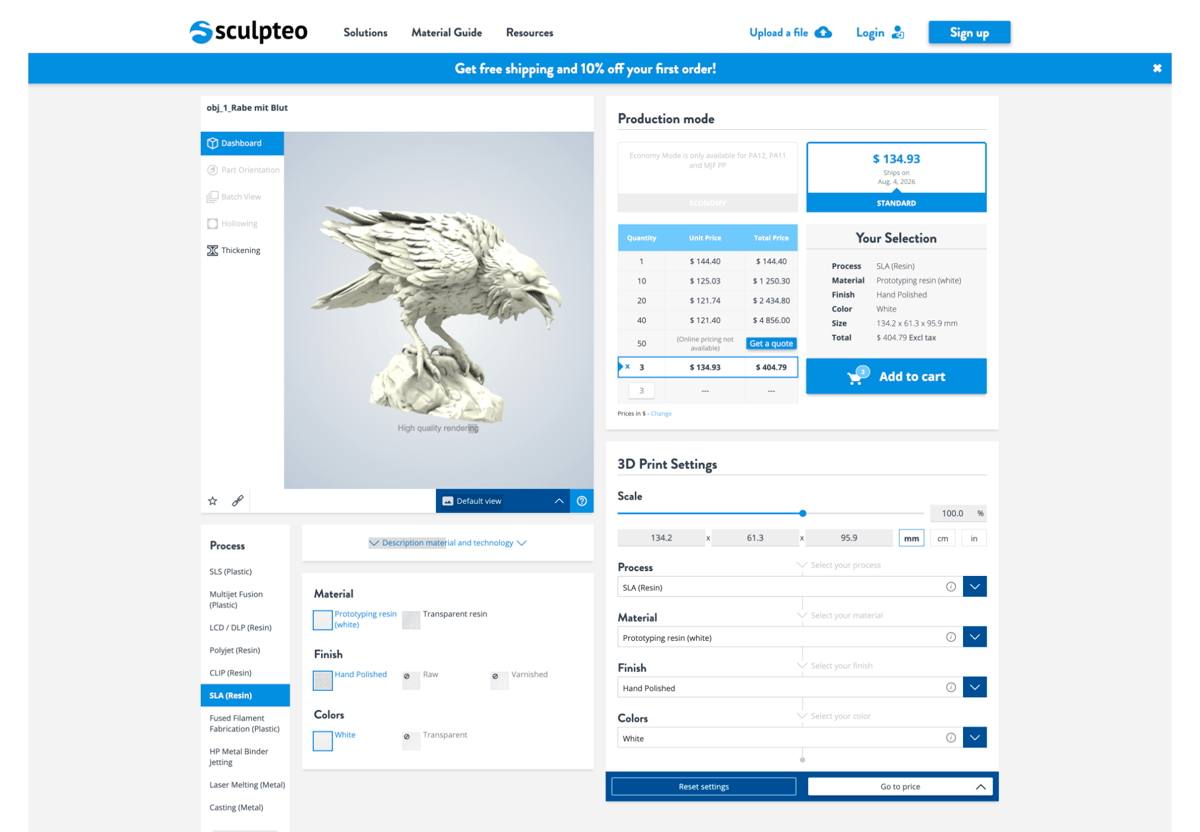
Sculpteo has been in business since 2009 and quickly became one of the biggest names in 3D printing services (it’s also a Craftcloud manufacturing partner). In 2019, the company was acquired by BASF and it has since added a slew of new materials and services to its catalog, with options for practically every industry.
For printing parts in resin, Sculpteo offers four technologies. In addition to standard SLA printers, it offers DLS, DLP, LCD, and PolyJet printers.
Currently, the company only offers Prototyping Resin for SLA printing. For more durable resins, we looked to its LCD offerings, which can print using production-ready Ultracur3D EPD 1086, known for its flexibility and strength.
Sculpteo’s SLA parts are eligible for 24-hour express lead times. The other technologies have lead times starting at five days. The company ships worldwide, but longer distances can affect delivery times.
Sculpteo’s ordering process includes handy CAD analysis and repair tools. It also offers 3D part design and consultation, laser cutting services, and an extensive library of support and educational documents.
- Available technologies: SLA, DLS, DLP, MSLA/LCD, PolyJet
- Maximum build volume: 290 x 190 x 147 mm
- Materials: Prototyping resin (lack, white, clear), Ultracur3D EPD 1086, Ultracur3D RG 3280, VeroWhite, VeroClear
- Turnaround: From 3 business days, 24 hour turnaround possible with SLA
Resin 3D Printing - Simply Explained
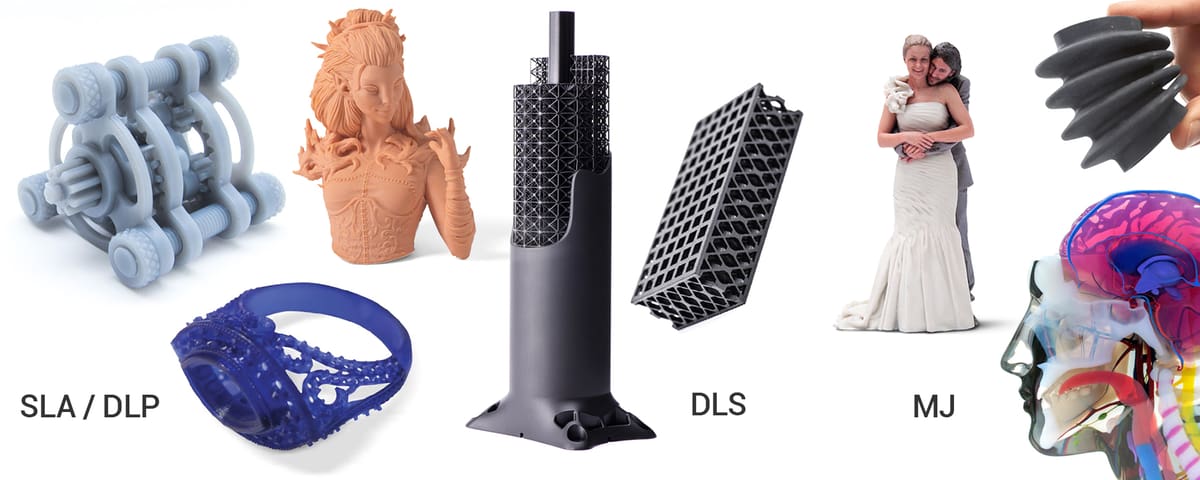
Of all the 3D printing methods for polymer (plastic) parts, resin 3D printing is prized for its fine detail and excellent surface finish, which makes it ideal for product prototypes, molds, casts, display models, architecture models, and art, among many other applications. Some resin materials are also extremely tough, durable, wear-resistant, flame resistant, and even flexible, making the technology popular for auto parts, factory tools, and sports equipment.
When you order a part from a service provider, they’ll usually be using professional- and industrial-level resin printers and materials. Yet, some smaller services set up shop using consumer 3D printers like the ones you may have at home. Many consumer-level resin printers can produce outstanding results for prototypes, visual models, and figurines. For more durable materials you’ll want to understand your resin options.
Vat Polymerization
The most common resin 3D printing technologies are based on using a vat of liquid photosensitive plastic exposed to UV light to build an object layer-by-layer. These technologies are collectively known as vat polymerization. The category is further split into different distinct technologies, such as stereolithography (SLA) and digital light processing (DLP), and liquid-crystal display (LCD) also called masked-stereolithography (mSLA).
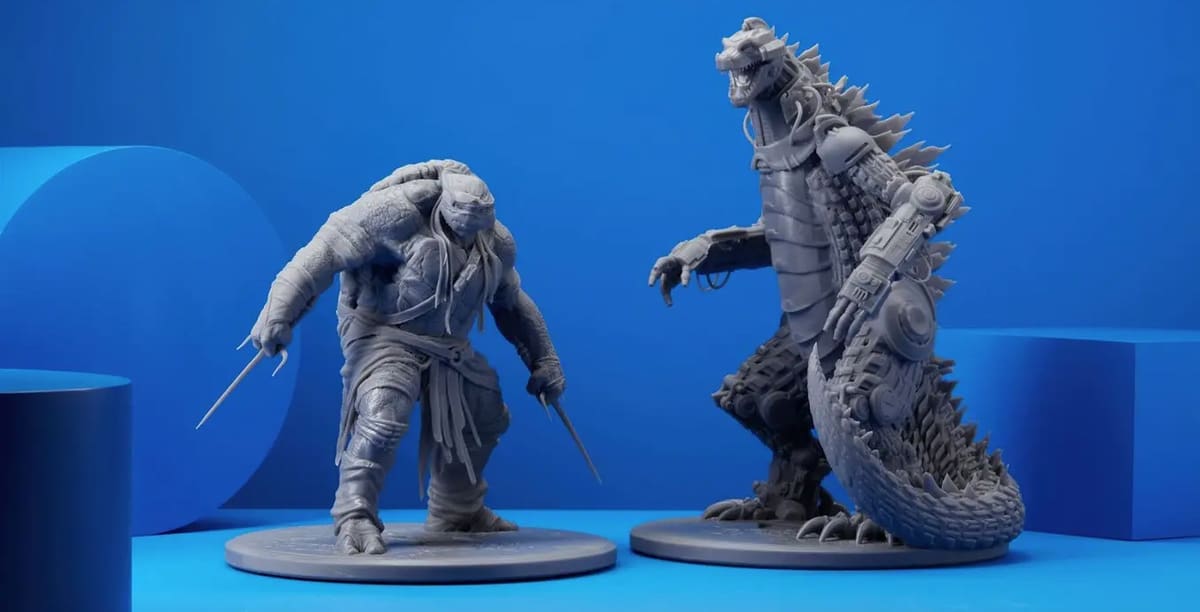
If you were buying a machine, the difference between these three technologies would be more important, but when ordering parts, their attributes are less of a factor. If you’re simply looking for fine detail, either technology is applicable.
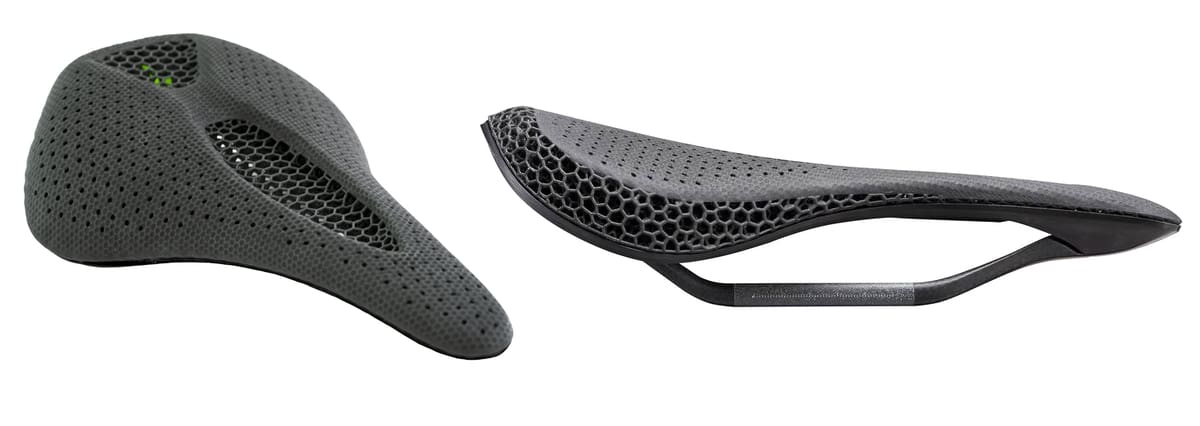
Another vat polymerization process your service provider may offer is called Digital Light Synthesis (DLS), which is only available from a company called Carbon. It’s a version of resin printing that is widely used in manufacturing because it uses a range of engineering-grade durable materials and can produce very high output in terms of quantity. It’s for functional prototypes and end-use parts, such as these bicycle seats sold by Specialized and the midsoles of these shoes by Adidas.
PolyJet
If you need multi-color or multi-material parts with fine detail, such as product prototypes, you’ll want to look for a service provider that offers PolyJet technology from a company called Stratasys. This technology, which is also ideal for volumes of parts, uses inkjet print heads to deposit droplets of resin onto the print platform. The resin is immediately hardened by UV light. As there are multiple print heads, different materials can be printed at once.
PolyJet is probably to top option for multi-color medical models and product prototypes, so much so, that we have an entire service guide devoted to it linked below.

Guide to Terms in 3D Printing with Resin
Resin 3D printing service providers sometimes use a wide variety of terms to describe their technology, often mixing what a brand of 3D printer calls its technology with the more general name for the technology. For example, LFS (low force stereolithography) is what 3D printer maker Formlabs calls its stereolithography. This is important only if you’re looking for parts from a particular brand of printer to evaluate it before purchase or if you’re supplementing your production with an on-demand service and want to match the technology exactly. Otherwise, it’s just confusing.
- Vat Polymerization is a general term for SLA, DLP, & LCD
- Stereolithography (SLA) uses a laser to cure the resin
- Digital Light Processing (DLP) uses a UV light to cure the resin
- Liquid crystal display (LCD) also called masked stereolithography (MSLA) also uses UV light
- Brand-Specific Versions of Vat Polymerization
- Low Force Stereolithography (LFS) from Formlabs
- Digital Light Synthesis (DLS) from Carbon
- Material Jetting (M-Jet) is a rapid and multi-color resin tech
- Polyjet is a type of material jetting from Stratasys 3D printers
- InkJet is a type of material jetting from Mimaki
License: The text of "Stop Overpaying for Resin 3D Prints: We Tested 5 Services on Price and Speed" by All3DP Pro is licensed under a Creative Commons Attribution 4.0 International License.