
Top Desktop Injection Molding Machines: 8 Options to Scale Your Workshop Production

Specs, prices, and trade-offs compared, so you can match the right machine to your workshop and budget.
Your 3D printer can produce a great prototype, but for real production volume, it hits a wall. Desktop injection molding machines pick up where your printer leaves off: workbench-sized, priced for hobbyists, and capable of churning out up to a million parts a year using tougher, cheaper materials that won’t fail at the layer lines. We compared eight of these machines, from $2,200 manual presses to $13,500 automated systems, to help you find the one that fits your workshop.
Volume isn’t the only draw. Injection molding also unlocks a much wider range of tough, cheap, off-the-shelf plastics, and parts that come out stronger than anything you’ll print. If you’ve ever printed a bracket, clip, or enclosure that just wasn’t durable enough for the job, this is the technology that solves that problem.

One word of caution before we get into it: search any e-commerce platform and you’ll find plenty of cheap injection molding machines with little to no information beyond a price tag. Every machine on this list comes from a company with a real web presence — homepages, manuals, technical documentation, and actual support channels included.
We’ll cover what injection molding actually is, and how it works, down below. First, the machines.

| Model | Injection Type | Shot Size | Maximum Temperature | Injection Pressure | Market Price |
|---|---|---|---|---|---|
| LNS Technologies Model 150A | Manual | 1.0 in³/ ~16 cm³ | 500 °F/ 260 °C | - | $2,200 |
| Robot Factory Benchtop Injection Molding | Pneumatic | 32 cm³ | 660 °F/ 350 °C | 1870 N at 0.6 Mpa | ~$2,500 |
| Action Box Injekto 3.0 | Pneumatic | 3.05 in³ / 50 cm³ | 572 °F / 300 °C | 5,800 psi / 400 bar | $2,699 |
| HoliMaker HoliPress | Manual | 16 cm³ & 38 cm³ | 608 °F/ 320 °C | - | ~$3,500 |
| Galomb Model B-100 | Manual | 1.0 in³ / ~16 cm³ | 600 °F/ 315 °C | - | $4,295 |
| Polyverse Nova-60 | Manual | 60 g | 662 °F / 350 °C | ~ $8150 | |
| Manning Innovations Proto-Ject 150HP | Pneumatic | 1.5 oz/ ~ 42 g | 800 °F/ 427 °C | 9300 psi/ 641 bar | $9,000 |
| APSX - PIM | Electric | 1.83 in³/ 30 cm³ | 600 °F/ 315 °C | 5000 psi/ 345 bar | $13,500 |
Desktop & Benchtop Injection Molding Machines
For industrial uses, hydraulic injection is the standard, as it generates by far the highest forces but is only found in the most expensive desktop models such as the Babyplast 6/12. These pricey machines are more suitable for labs or medical device manufacturing plants producing specialty applications than what hobbyists would require.
If the machines on this list are blowing the budget or if you’re up for the challenge of building an injection molding system yourself, be sure to check out our guide on the Best DIY Desktop Injection Molding Machines.
LNS Technologies Model 150A
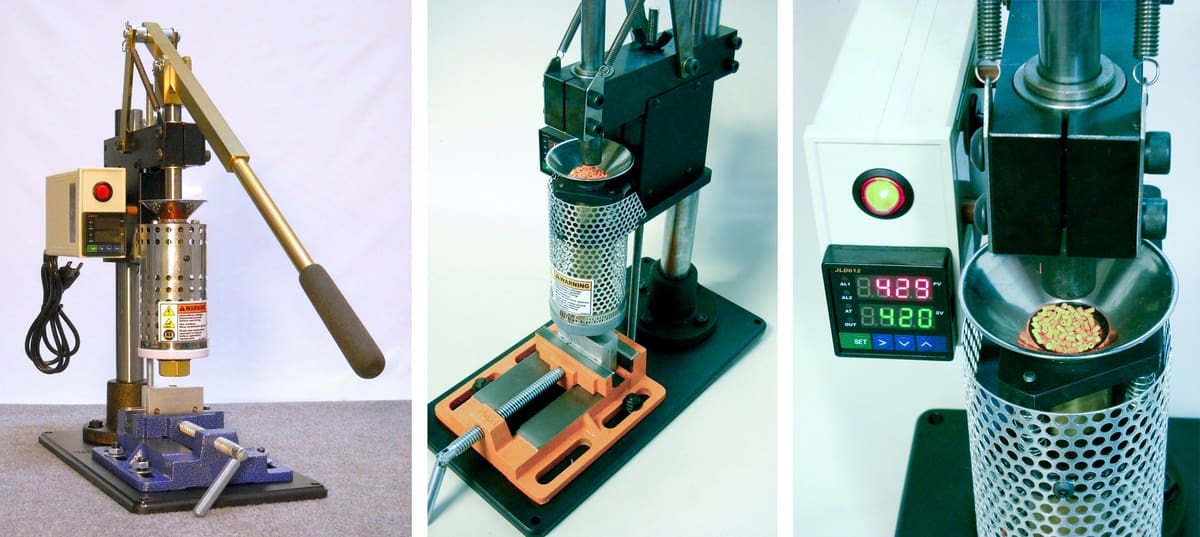
LNS Technologies offers a great, no-frills injection molding machine. Based on a simple manual press, this machine has a relatively small shot size of 1.1 in³. While that’s not a huge amount, 1 cubic inch is fairly standard when it comes to hobby-level injection molding. With a simple vice to hold your aluminum mold, the machine can accommodate a maximum mold size of 8″ x 5″ x 5″. The machine is also compatible with resin-printed molds, as well as epoxy molds.
If you want something more powerful, and your budget allows it, the company also offers Model 300A, which is pneumatically powered. It has twice the shot volume and an injection pressure of 120 psi (8.27 bar), but costs twice the price (and that’s not including the cost of a required air compressor).
LNS Technologies also sells a number of pre-machined molds for items like keychains and fishing lures. In terms of plastics, they stock PP, LDPE, ABS, and TPE in various colors.
Where to find it: LNS Technologies
Robot Factory Benchtop Injection Molding
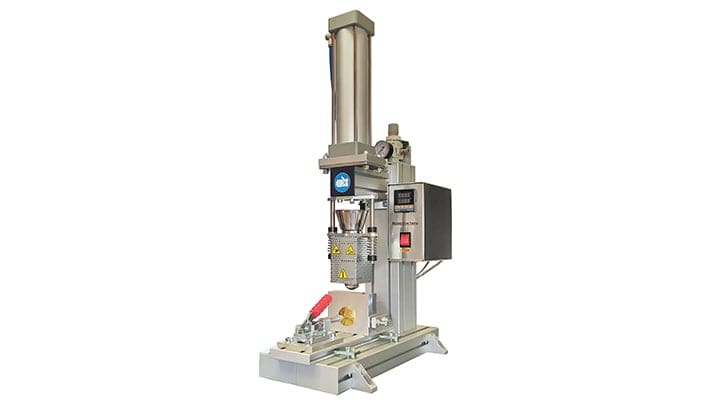
Robot Factory is all about small-scale serial production with its own selection of conveyor belt-type 3D printers and modification kits as well as thermoforming machines. Their latest addition to the portfolio, the “Benchtop Injection Molding”, further expands the company’s plastics processing technology offering.
While a manual version is available upon request, the standard machine comes with a Ø63 mm pneumatic piston that has an optimal operating range between 0.6 and 0.8 Mpa. The base model will set you back roughly $2,500, which includes the pneumatic clamping vice. Depending on the chosen injection system (manual or automatic) and the optional automatic material feeding system, that price can go up by an additional $1,300.
Be aware that a compressed air generator is needed to operate the machine. The company recommends a 50-liter compressor that reaches at least 6 bars of pressure.
Consumables, like a large selection of plastic pellets and raw aluminum molds, are also offered by the Italian company, with custom aluminum mold production possible upon request.
Where to find it: Robot Factory
Action Box Injekto 3.0
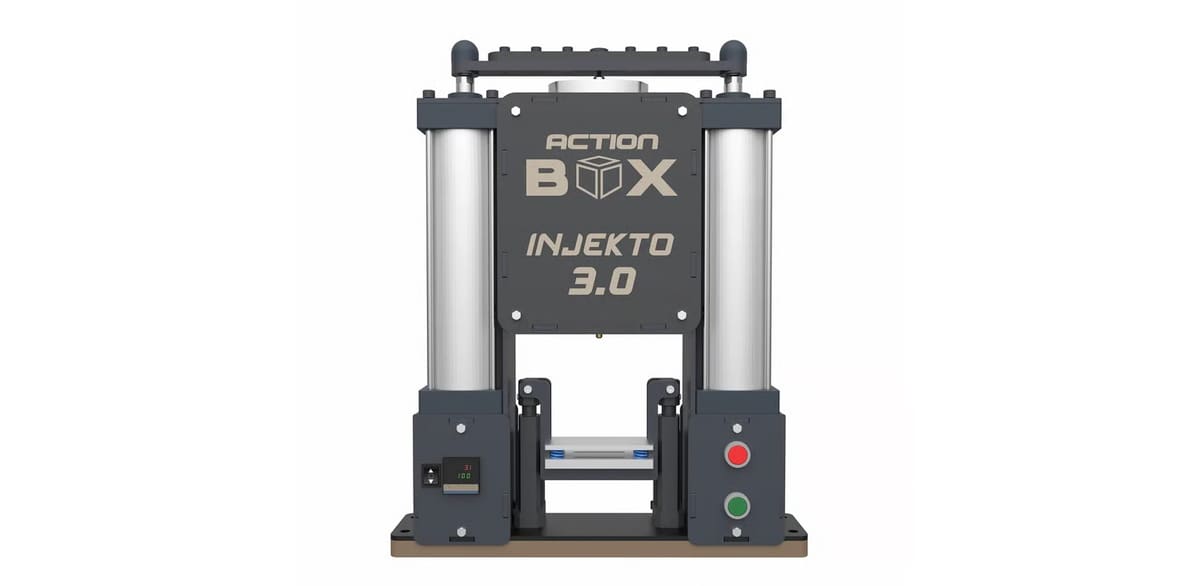
The Injekto 3.0 by Canadian company, Action BOX is a powerful little plastic injection molding machine (measuring just 22 x 6.1 x 27 in) that packs quite the punch.
The machine runs on twin pneumatic cylinders that drive a guided steel ram, reaching up to 40 MPa of injection pressure with a 50 cm³ (roughly 3.0 in³) shot capacity. The base kit costs $2,699 and ships unassembled — Action BOX says most buyers have it built and running in about two hours using the included step-by-step video. Optional add-ons, like mold lifters ($499) and mold backers ($299) for creating parts with more complex internal geometries, are available separately for those who need them.
Be aware that a compressed air source is required to operate the machine. Action BOX recommends a compressor with at least a 6-gallon tank capable of 80 PSI.
The machine works with a wide range of compatible plastics, including high-performance plastics like PVDF and PHA, as well as Fiber-Reinforced plastics such as PLA-CF and PETG-CF. It even comes with a starter jar of PP plastic pellets to get you started.
If you’re interested in working with metal, their Injekto M, priced similarly as the 3.0, comes with everything you need, including a sintering furnace to turn their patent-pending metal paste into pure metal (bronze or copper) after heating.
Where to find it: Action Box
HoliMaker HoliPress
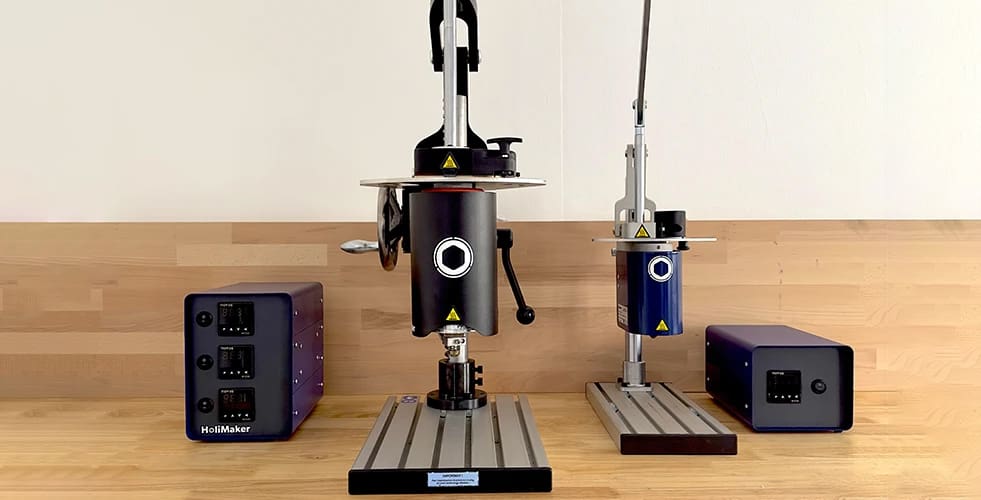
French company HoliMaker claims that their manually operated system, the HoliPress, is up to 20 times faster than FDM 3D printing “with your manual strength,” which clearly depends on how fast you can hustle. Maximum output is 1 piece every 3-5 minutes, the company says.
HoliPress comes in two sizes; an injection volume of 16 cm³ and an injection volume of 38 cm³ and has enough room for molds as tall as 190 mm. Compatible polymers include PP, PEDH, LDPE, PLA, PS, PA, TPU, PUM, ABS, and PMMA.
The company has recently introduced the HoliPress High Temp model for high-performance materials like PEEK, PEI, and PPS if those are what your products demand. The company claims this model has an injection volume of between 35-38 cm³, produces pressures of up to 150 bar, and reaches temperatures of up to 500°C. The price, however, comes in at around $11,700.
The HoliMaker also offers the HoliShred ($1500) for manual plastics pellet production from plastic waste like water bottles and caps. Since PLA and ABS are also listed as processable with the HoliPress, the same goes for old or failed 3D prints that can then be turned into new products rather than landfill waste.
Where to find it: HoliMaker
Galomb Model B-100
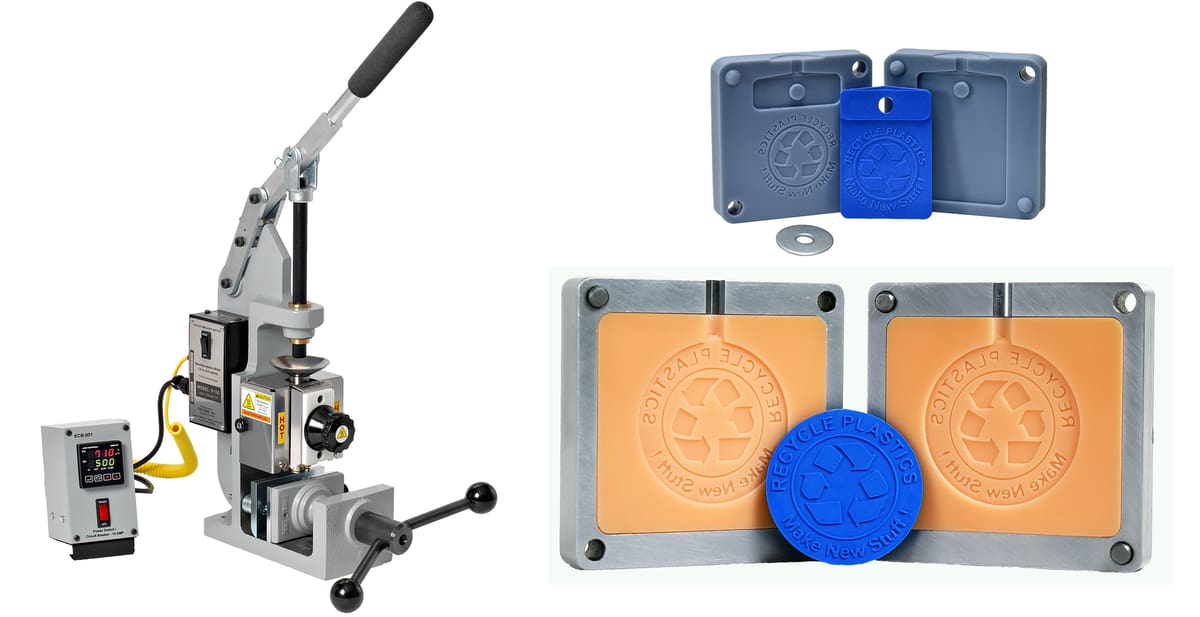
For those who are looking for a sturdy manual injection molding machine, the made-in-America Galomb B-100 is a solid choice. Although the design is relatively similar to the LNS 150A, the Galomb B-100 is made using a solid cast iron frame that you bolt to your benchtop. There’s also a non-stick coating on the injection plunger and an included cleaning kit. An additional electronic control box will set you back another $695, however.
This machine is capable of reaching temperatures of up to 315°C, which opens up the possibility to work with more demanding materials such as nylon and PET.
Galomb has a variety of resources for the DIY injection molding enthusiast on their website, with several pre-made molds available.
Galomb also offers the S-100 model, which is exactly the same as the B-100 except for larger capacity tube (23 cm³) and the ability to be used in combination with their polymer mixing device, Model M-100. The company offers a bundle offer for the two machines and accompanying control boxes for a total of $11,380.
Where to find it: Galomb
Polyverse Nova-60
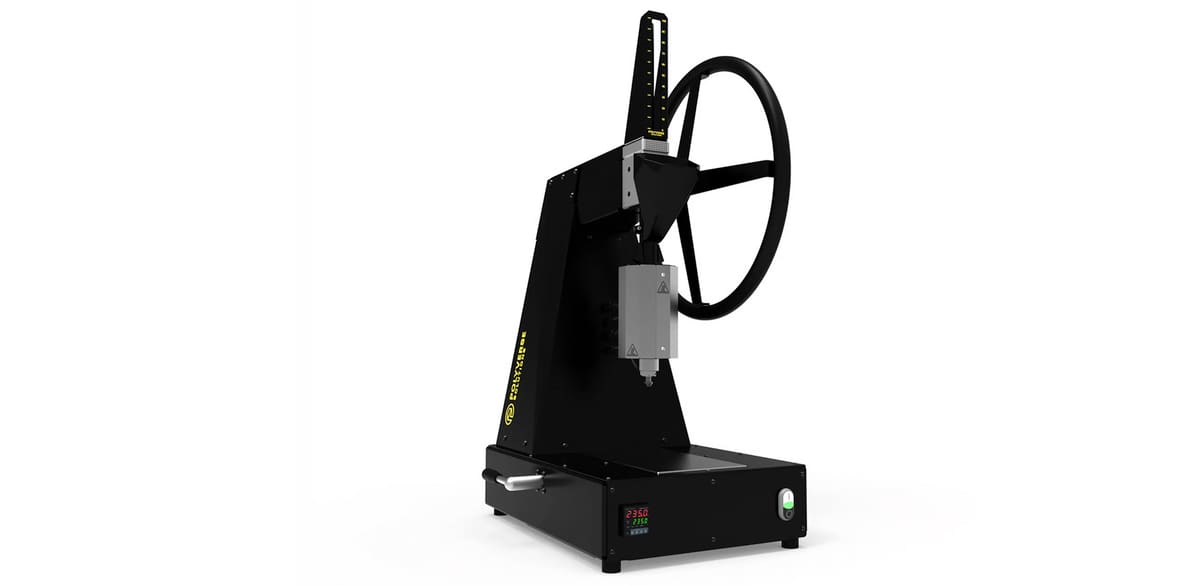
The Nova-60 by Austrian company Polyverse Solutions is a manually operated, electrically heated, injection molding machine that is a perfect accompaniment to any 3D printing workshop as it works together with a universal mold (sold separately) that accepts 3D printed inserts. It also comes with a built-in fume extractor for safer indoor use as well as a heated shot-off nozzle that keeps runnier plastics from leaking out.
At about $8150, the machine ships from Austria with CE and UKCA certification and a one-year warranty. Polyverse also sells a companion desktop granulator (the Vortex-90) for anyone who wants to shred scrap parts or failed prints back into usable feedstock.
Material compatibility is broad: the Nova-60 handles virtually any thermoplastic. The company lists HDPE, PP, PS, PLA, as well as engineered plastics such as PA and PC, and flexible materials like TPU as good options. Polyverse also says glass- and carbon-fiber-reinforced materials run fine too, but at the cost of faster nozzle wear.
For 3D printed mold inserts, the company suggests using PC or PA-CF when printing with FDM machines, or Formlabs Ridgit 10k Resin for SLA.
Where to find it: Polyverse Solutions
Manning Innovations Proto-Ject 150HP
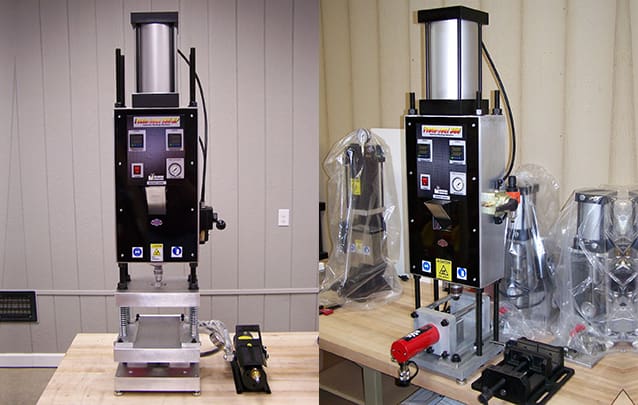
The Proto-Ject 150HP (High Pressure) by Manning Innovations is a considerable step up when it comes to injection pressure. At 9300 psi and a maximum operating temperature of 800 °F, the machine is well-suited for higher molecular weight materials and thus offers a wide material selection for processing. Depending on the material, clamping pressure needs to be considered, as the machine comes in a 10, 15, 25, or 40-ton configuration. This metric also defines achievable maximum dimensions of a part, as mold surface area is limited to available clamping pressure.
Prices for Proto-Ject machines start at $9,000, but add-ons and specialty configurations can pile up to reach $10,000 and higher, so at this price tag you should have a clear idea of what you want to manufacture. Keep in mind also that this unit is not fully automatable. The company states that they sometimes have rebuilt machines available for about $1500, so it’s worth checking with them directly before you decide it’s out of your price range.
For the Proto-Ject 150, Manning Innovations recommends an air compressor of at least 15 gallons capacity with a maximum tank pressure of 175 psi or higher.
Where to find it: Manning Innovations
APSX - PIM
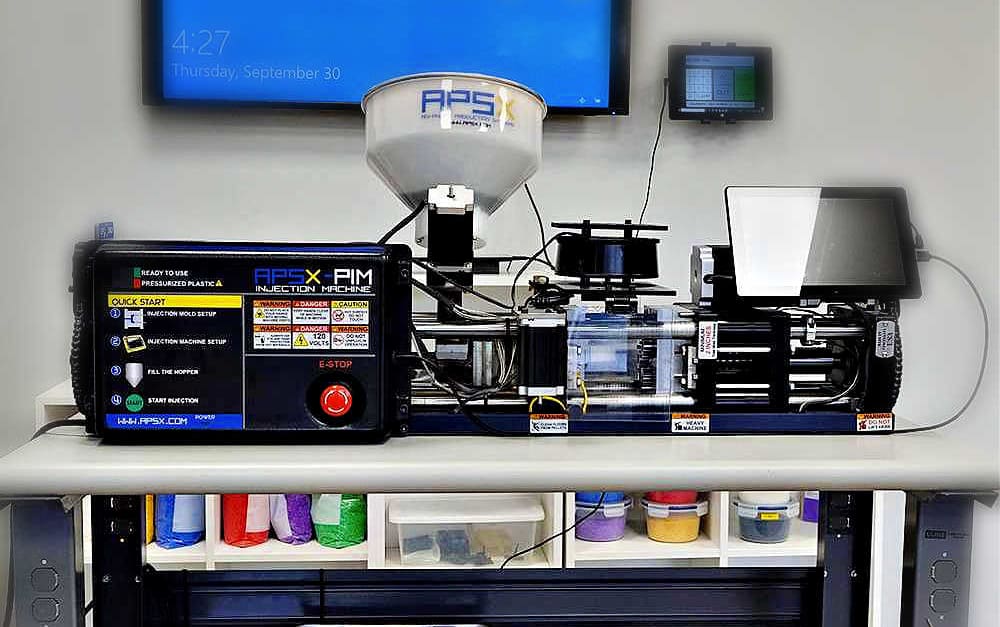
The illustrious-sounding APSX-PIM is an industrial-grade automatic unit that offers a massive number of configurable options to optimize your production line.
Capable of both full-cycle production as well as manual operation, the APSX-PIM works entirely through electric motors, eliminating the need for additional air compressors. On the downside, this means that generated forces are not as high as pneumatic or hydraulic systems but are still impressive at 5,000 psi injection pressure and a 5-ton clamping force.
Coming in at $13,500, this heavy-duty machine is far from cheap, but it’s the best tool for 24/7 continuous parts manufacturing and offers the highest degree of parameter controls for process optimization. Molds that include ejector mechanisms are more challenging to build though, so smaller production runs might still make more sense to be done via manual part ejection. APSX has sold thousands of these little powerhouses worldwide.
Where to find it: APSX
What is Injection Molding? (And Why Should a Maker Care?)
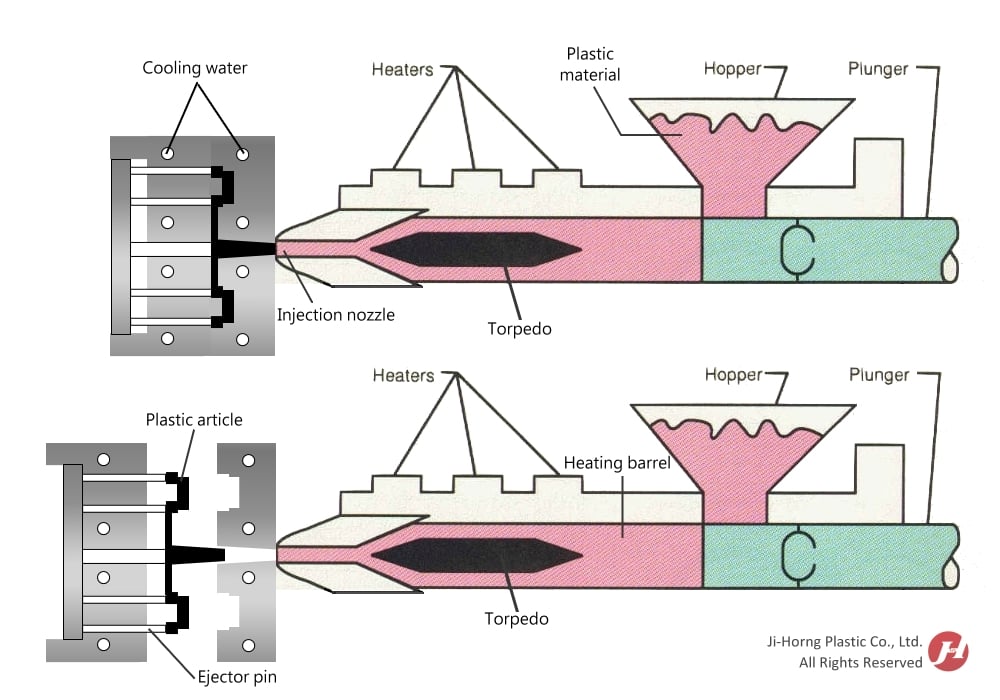
Of course, “melt plastic and push it into a mold” is doing a lot of heavy lifting in that definition. Get any of the details wrong and you’ll end up with a jammed machine, a warped part, or a small puddle of plastic on your workbench. Here’s what actually matters when you’re shopping for (or using) a desktop machine:
Temperature. Every plastic has a melting point, and your machine needs to comfortably clear it, or otherwise the material just won’t flow. Go too hot, though, and you’ll cook the plastic, leaving you with bubbles, discoloration, or a part that’s weaker than it should be. Bottom line: check a machine’s max temperature against the material you want to run before you buy either one.
Injection pressure. Think of this as how hard the machine can shove molten plastic into the mold before it cools and seizes up. More pressure means the plastic can reach thin walls and tricky little channels that a weaker machine would leave half-filled. This is the single biggest gap between a $2,000 desktop unit and a real industrial press. So if your design has fine detail, pay close attention to this spec. Clamping force matters too, since it’s what keeps the mold shut against all that pressure.
Shot Size. This is simply how much plastic the machine can melt and inject in one go. For desktop machines, this is usually under 50 grams. That number sets a hard ceiling on how big your part can be. And because most benchtop machines inject with a manual plunger rather than a screw, you’ll actually want your shot size to be about 1.5x your part’s weight as some plastic always gets “wasted” heating up the next batch of pellets and letting trapped air escape.
Usability. Don’t sleep on this one. Molten plastic that leaks or sprays is a real burn hazard, not just a mess. in this case, build quality and basic safety features are definitely worth paying more for. As a rule of thumb, price tracks quality here. If you’re aiming for something close to continuous production, look for automatic part ejection, but expect to pay a premium for it.
So, When Does This Actually Make Sense for a Hobbyist?
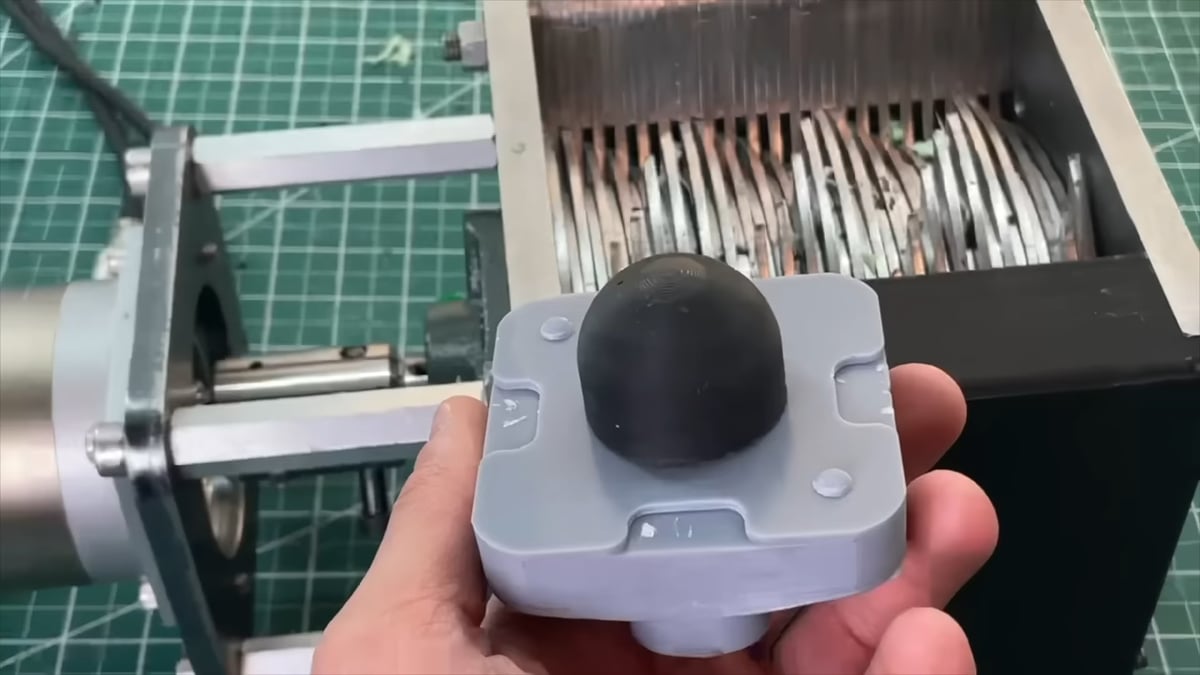
Injection molding is worth considering if you need to manufacture parts faster than your 3D printer can produce, but only in the range of hundreds or thousands of parts, not a one-off prototype and not a factory run of parts. It’s also a great way to pressure-test a design or to validate a prototype before sending the file off to a manufacturer.
It is also considered the gold standard when it comes to plastics manufacturing, and offers a wide range of cheap, tough materials — polypropylene, ABS, TPU, PET, polystyrene, even your failed prints — with great physical properties that your printer might not be able to match, especially since they don’t face the same layer-adhesion challenges.
The 3D Printing + Injection Molding Combo
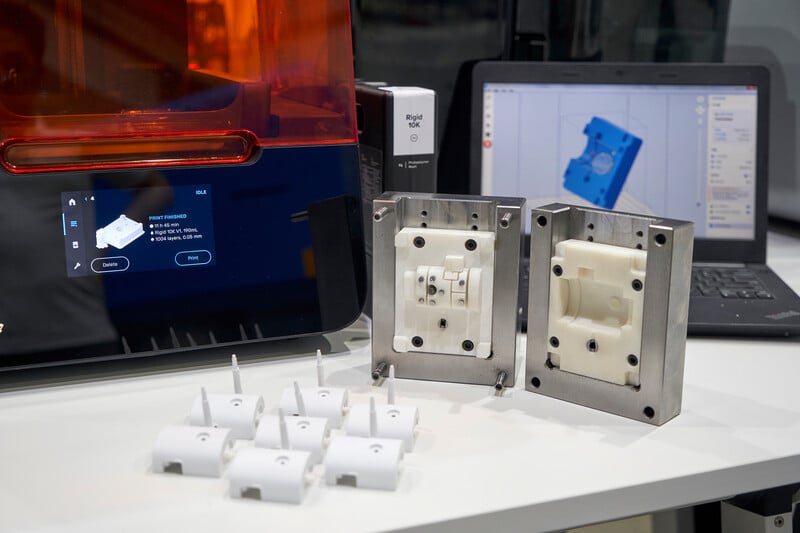
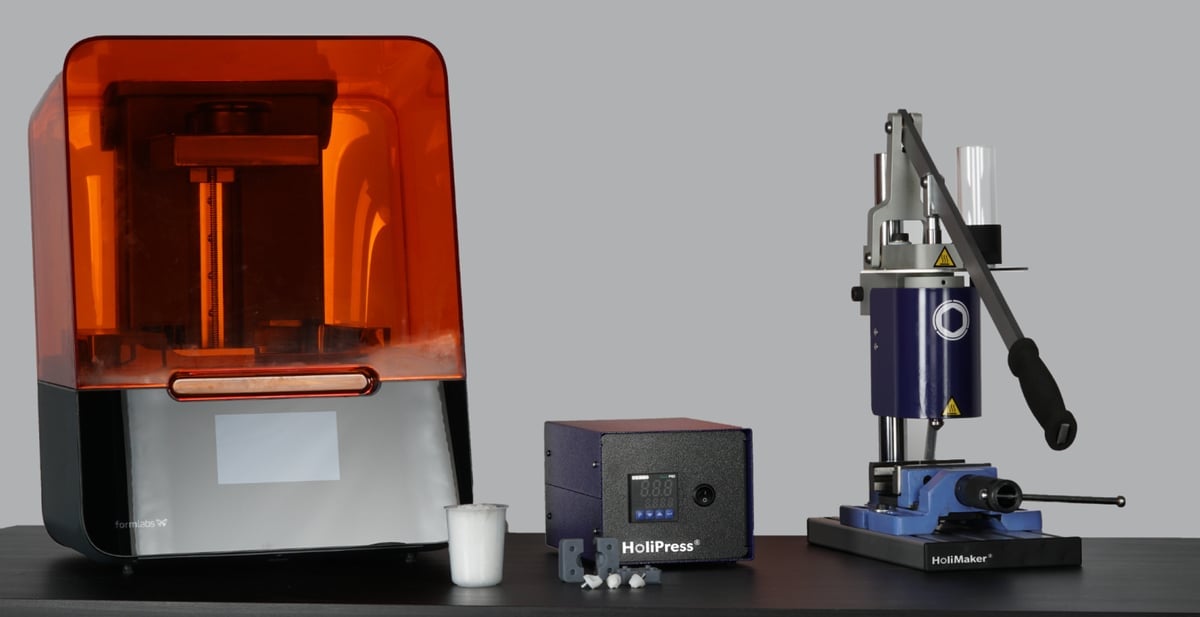
Injection molding isn’t trying to replace your 3D printer, but it’s actually a great companion tool. Modern resins (Formlabs’ High Temp and Rigid 10K, for example) can survive the heat and pressure of low-volume molding, which means you can now 3D print your molds instead of machining them.

That’s a big deal for hobbyists specifically, because it means you no longer need a CNC machine and machinist know-how just to get started. A resin printer will get you a mold good for anywhere from a few dozen to a couple hundred shots. It won’t match machined aluminum for surface finish or long-term durability, but for small runs, it’s an entirely accessible alternative.
A 3D printed injection mold comes with its own design considerations and will not replace machined aluminum or steel in terms of surface finish and longevity, so having a CNC machine on hand will still greatly improve your experience. Luckily, the CNC world is witnessing a similar miniaturization trend with affordable unit prices for any maker or small engineering shop.
License: The text of "Top Desktop Injection Molding Machines: 8 Options to Scale Your Workshop Production" by All3DP Pro is licensed under a Creative Commons Attribution 4.0 International License.