Why This Japanese Plan to 3D Print City Infrastructure from Waste Could Become a Global Model

What if your city’s next park bench was 3D printed from morning coffee grounds and discarded household plastics?
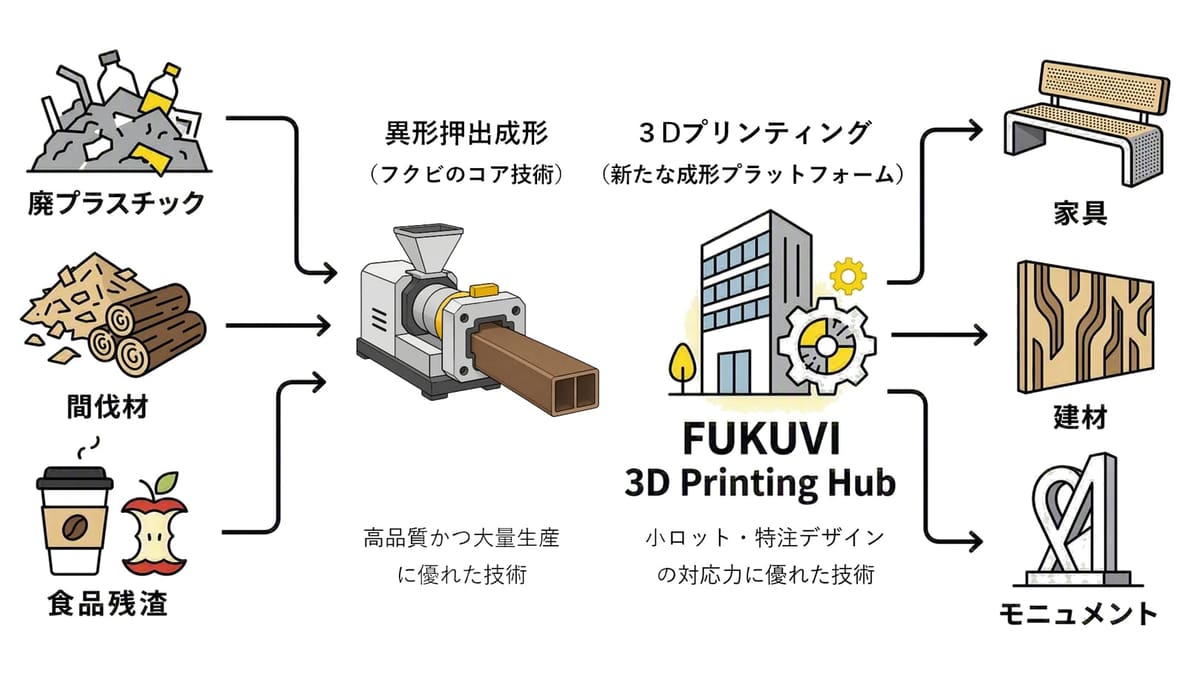
Many municipal 3D-printing recycling projects stall at the demonstration stage due to material inconsistencies. Now, Japan’s Fukuvi is building a highly scalable alternative that handles the entire pipeline from sorting end-of-life plastics and food waste to printing certified street furniture and monuments.
It isn’t the first project to turn a community’s waste into benches and planters, but what may give it more legs, is the combination behind it: an established industrial materials company, in-house resin expertise, and a national policy environment pushing plastics circulation.
That mix could give the Japanese initiative a better chance of moving beyond the initial proof of concept toward a sustainable circular and scalable program.
Fukuvi wants to take waste streams including discarded plastics, wood powder, biomass, and food-industry residues and develop them into printable materials, then turn those materials into furniture, building products, monuments, and other custom objects. It has already experimented with wood-filled filament and pellets incorporating spent coffee grounds.
The more important part is the model itself.
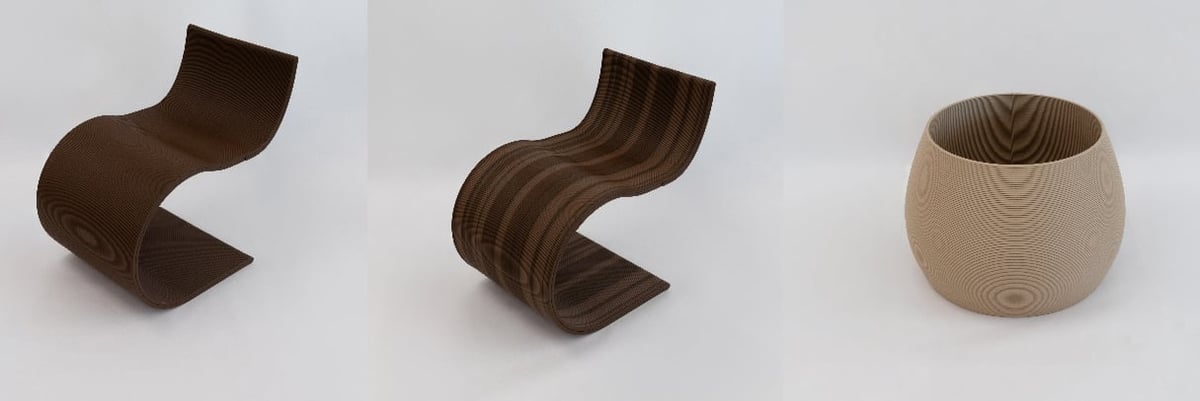
Many similar projects began with design studios, research groups, startups, or municipal pilots. Fukuvi begins as an established manufacturer with existing expertise in plastics formulation and profile extrusion.
Fukuvi is proposing an end-to-end service: take a company or municipality’s waste, formulate a printable material around it, design a suitable product, print it, and evaluate the result. Rather than simply operating a large-format printer with recycled pellets, it is positioning itself as the industrial link between a waste stream and a finished product.
All3DP has covered similar concepts for years.
One of the best-known examples is Print Your City, developed by Rotterdam studio The New Raw. The project showed how locally collected household plastic could be turned into 3D printed public furniture, first in Amsterdam and later in Thessaloniki, Greece.
In Thessaloniki, residents contributed plastic waste and helped choose designs and locations for the resulting street furniture. The project ultimately turned hundreds of kilograms of plastic into benches and other urban objects.
Other initiatives across Europe have followed the same broad formula, using recycled plastics to print bins, planters, sculptures, and architectural components.
The technical idea is proven. The harder part is building a durable business around it.
Fukuvi’s Hub is intended to cover material formulation, design, programming, printing, and evaluation, giving it the ability to adapt materials to specific waste streams rather than forcing those streams into a fixed process.
For customers, the pitch becomes simpler: bring us material you currently discard, and we will determine what useful products it can become.
Green-Focus Could Give It Another Advantage
Japan’s policy environment may strengthen that proposition.
Its Plastic Resource Circulation Act, in force since 2022, is designed to encourage reuse and recycling across the full lifecycle of plastic products. The country has also backed municipal collection schemes, recycling demonstrations, and partnerships between local governments and industry.
That does not make recycled 3D printing automatically economical. Collection, sorting, transport, print speed, finishing, and certification can still undermine the business case.
But policy can help create reliable feedstock streams and willing institutional customers.

A municipality, for example, could collect plastic waste, supply it to an industrial partner, and then purchase benches, planters, signage, or other infrastructure made from that same material.
That closed-loop model has long been part of the promise behind projects such as Print Your City. Fukuvi may be better positioned to industrialize it.
The World May Be Watching Japan
There is still plenty to prove.
If Fukuvi produces only a few showcase objects from unusual waste streams, it will remain one more interesting recycling project.
The real test is whether companies and municipalities return with new materials, order useful products in meaningful quantities, and turn the process into routine procurement.
If that happens, the implications could extend well beyond Japan.
Distributed large-format 3D printing has long promised a way to turn local waste into local products, but most examples have remained project-based. Fukuvi is notable because it puts that idea inside an established manufacturer and connects it to a policy framework already built around material circulation.
Print Your City showed what the concept could look like.
Japan may help show whether it can become infrastructure.
You May Also Like:

License: The text of "Why This Japanese Plan to 3D Print City Infrastructure from Waste Could Become a Global Model" by All3DP Pro is licensed under a Creative Commons Attribution 4.0 International License.