The Creality K3 Aims to Cut Multicolor Waste by 85% with 5-Second Nozzle Swaps

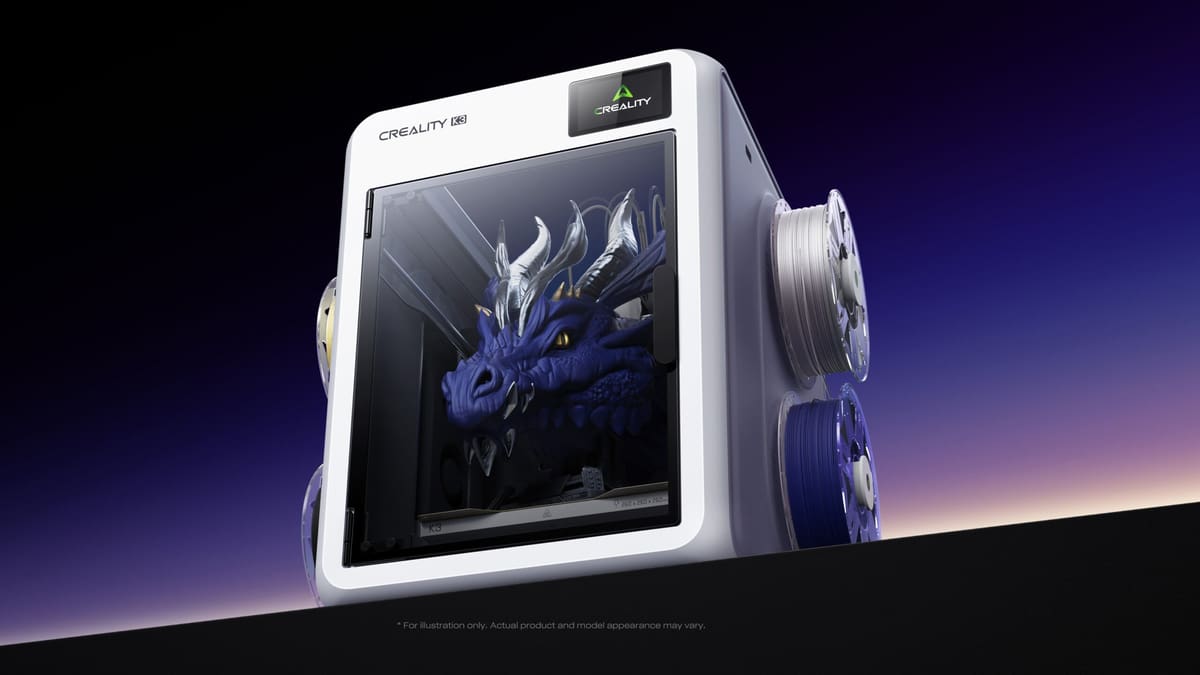
Featuring four independent nozzle paths, 20,000 mm/s² acceleration, and physical CMYK color blending, the $849 Creality K3 targets the biggest bottlenecks in multicolor 3D printing.
Single-nozzle multicolor printing has a well-known bottleneck, in which continuous cutting, retracting, and purging wastes hundreds of grams of filament and turns a day-long job into a week-long ordeal.
Now available for pre-order at $849, the Creality K3 bypasses standard toolhead purging entirely, using four independent, quick-swap nozzles to deliver full multi-material printing with up to 85% less waste.
The Multicolor Bottleneck & 5-Second Nozzle Swaps
Anyone who has run a multicolor job on a single-nozzle printer knows the routine of cut, retract, load, purge, repeat. Every color change leaves purged filament behind and adds minutes, which can easily accumulate thousands of costly tool changes on detailed models.
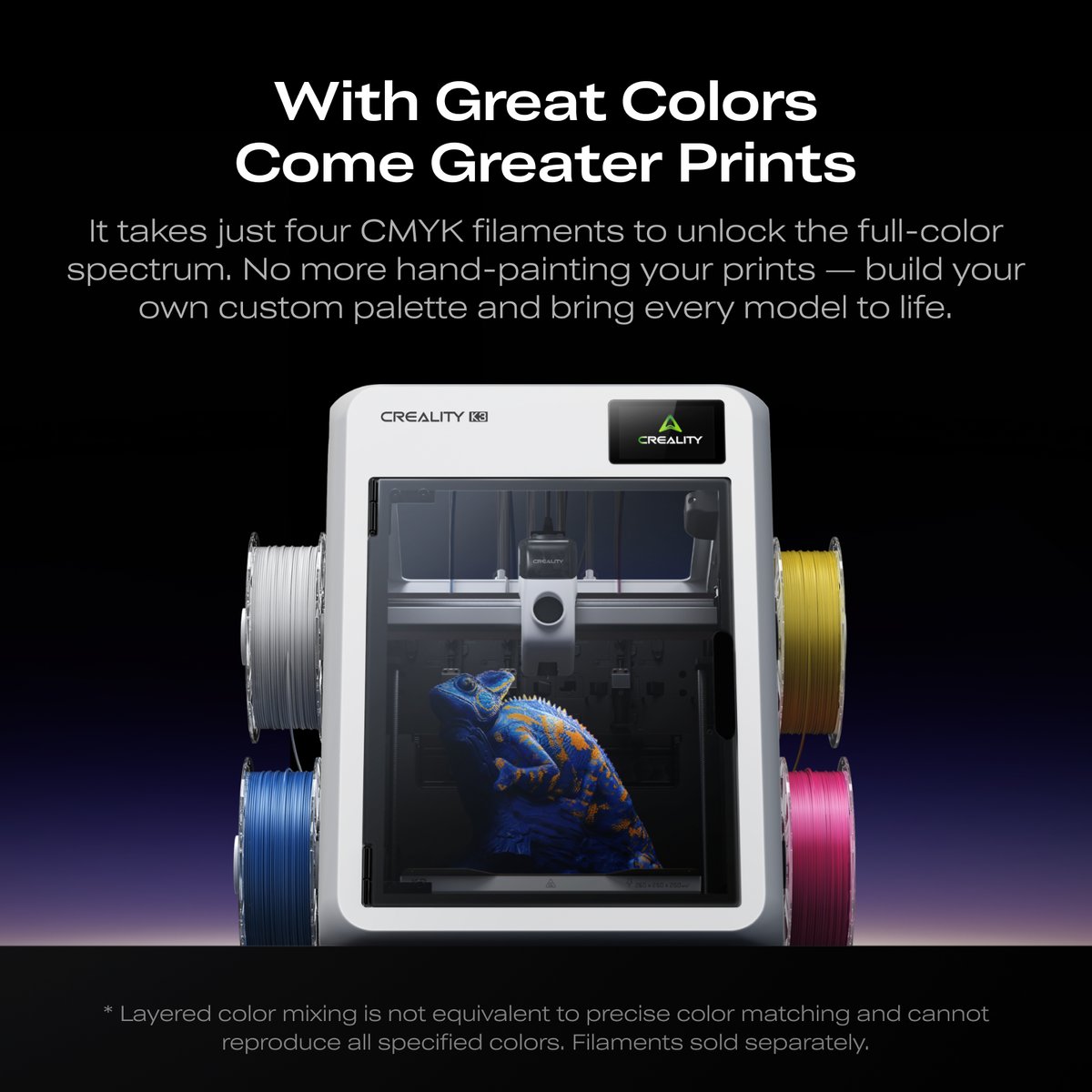
Building on the automation and speed of the K2 series, the K3 keeps four filaments loaded across four independent paths, each feeding its own nozzle. When the print calls for a new color or material, the KliTek tool-swapping system swaps only the lightweight nozzle assembly. Creality says active nozzle swaps take approximately 5 seconds, material changes take under 15 seconds, and overall color switching is up to 5 times faster than conventional single-channel, single-nozzle multicolor 3D printers. Compared to single-nozzle workflows, the system achieves up to 80% shorter total print times and reduces material waste by up to 85%.
Build Quality, Hardware Specs, and Precision
The Creality K3 features a 260 x 260 x 260 mm build volume, print speeds of up to 500 mm/s, 20,000 mm/s² acceleration, a 300 °C hot end, and a 100 °C heated bed. To ensure consistent alignment during high-speed printing, the chassis delivers a 30% increase in structural rigidity and torsional resistance while operating 7 dB quieter.
Tool-changing reliability is backed by a network of 37 sensors, 12 of which are dedicated strictly to nozzle changes. The other sensors monitor latch engagement, homing alignment, positional offset, and locking status in real time. In Creality’s lab testing, the system maintained repeatability under 25 μm across more than 800,000 nozzle swaps.
Mixed Nozzle Sizes, Flexible Filaments, and CMYK Blending
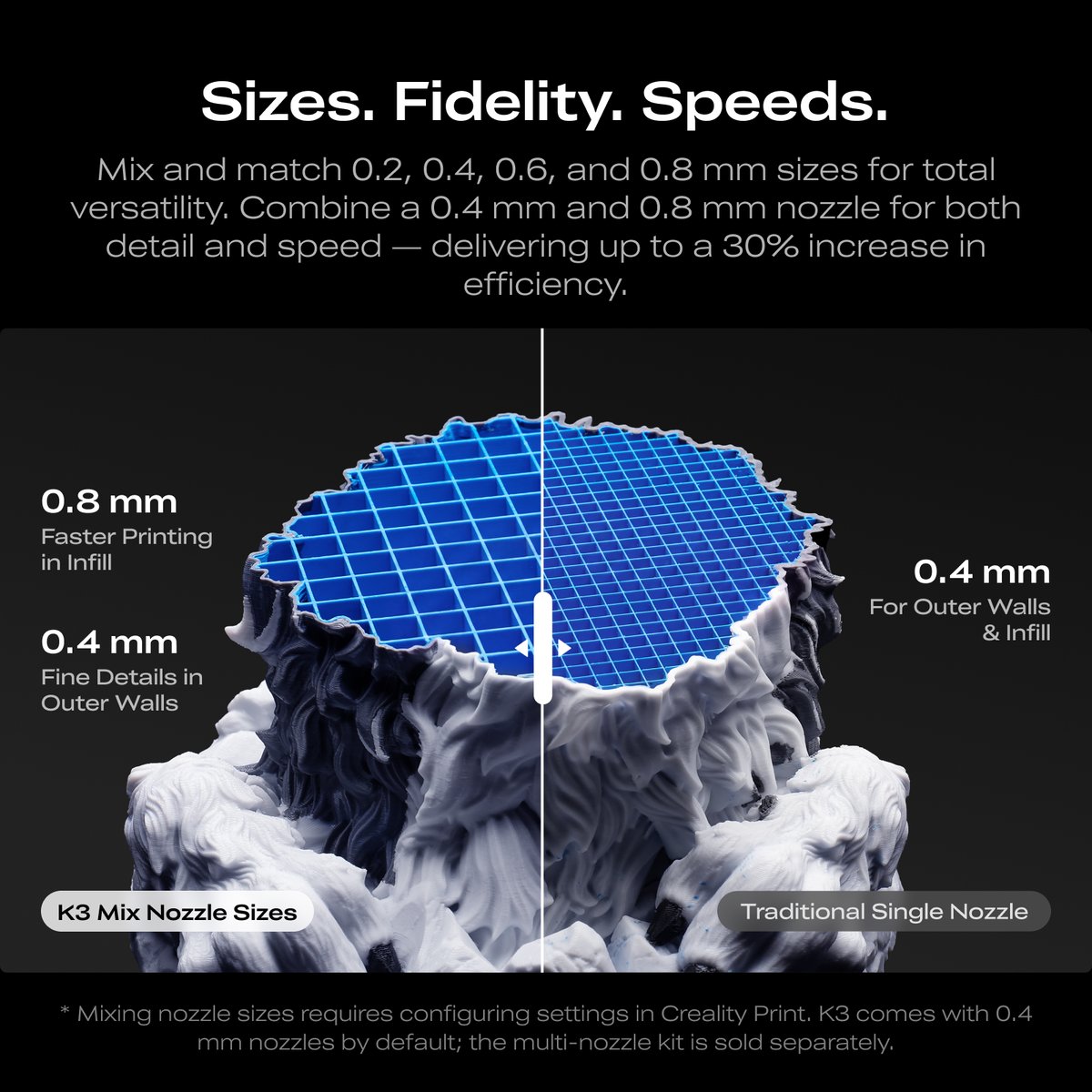
The K3’s four nozzles do not need to be identical. With optional add-on accessories, the printer can simultaneously run 0.2, 0.4, 0.6, and 0.8 mm nozzles in a single job. Creality Print automatically assigns nozzle sizes to specific model zones, deploying a fine 0.2 or 0.4 mm nozzle for crisp outer walls and a high-throughput 0.6 or 0.8 mm nozzle for internal infill, improving overall print efficiency by up to 30%. The slicer manages line width constraints, layer coordination, and interlocking structures where different nozzle sizes or materials intersect.
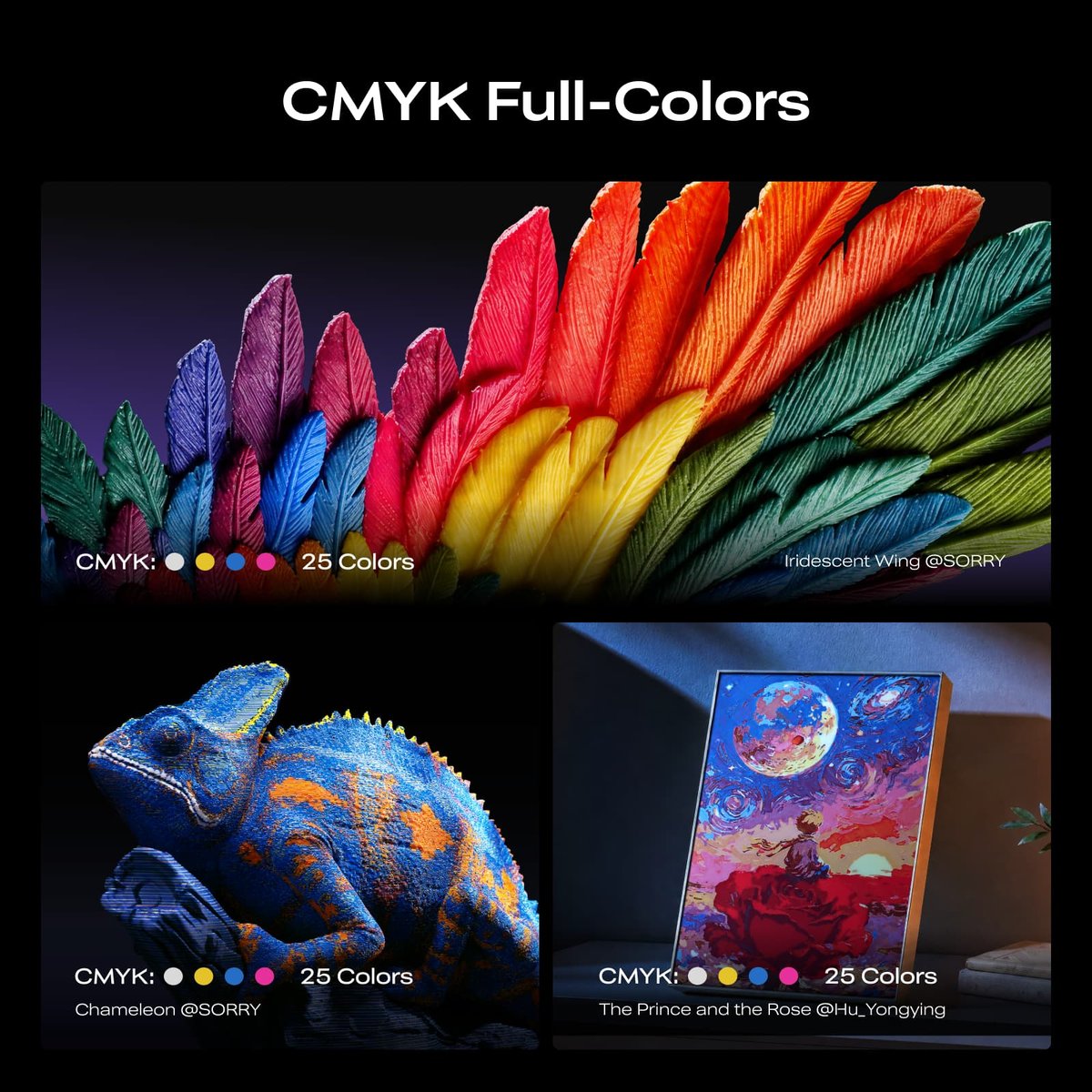
For flexible materials, the K3’s S-Drive Dual-Drive feed system grips soft filaments securely for consistent extrusion, reaching a maximum flow rate of 15 mm³/s with TPU 95A, which is up to 7 times faster than standard consumer machines, although TPU printing requires additional accessories that are sold separately. Additionally, the system uses calibrated translucent CMYK filaments to blend colors physically by layer thickness and stacking order, while USB-C quick-swap nozzle assemblies reduce maintenance costs by up to a third compared to full toolhead replacements.
Pricing, Material Support, and Availability
Out of the box, the Creality K3 handles PLA, PETG, PCTG, and carbon- or glass-filled engineering blends. An optional top cover unlocks ABS, ASA, PC, PA, and PP, while the multi-material kit enables support for BVOH, PVA, and TPE.
The Creality K3 is available for preorder in the US starting Oct. 12, priced from $849, with official sales beginning Nov. 2. Orders placed through Creality’s official store before Nov. 30 include four free rolls of Hyper PLA and free shipping.