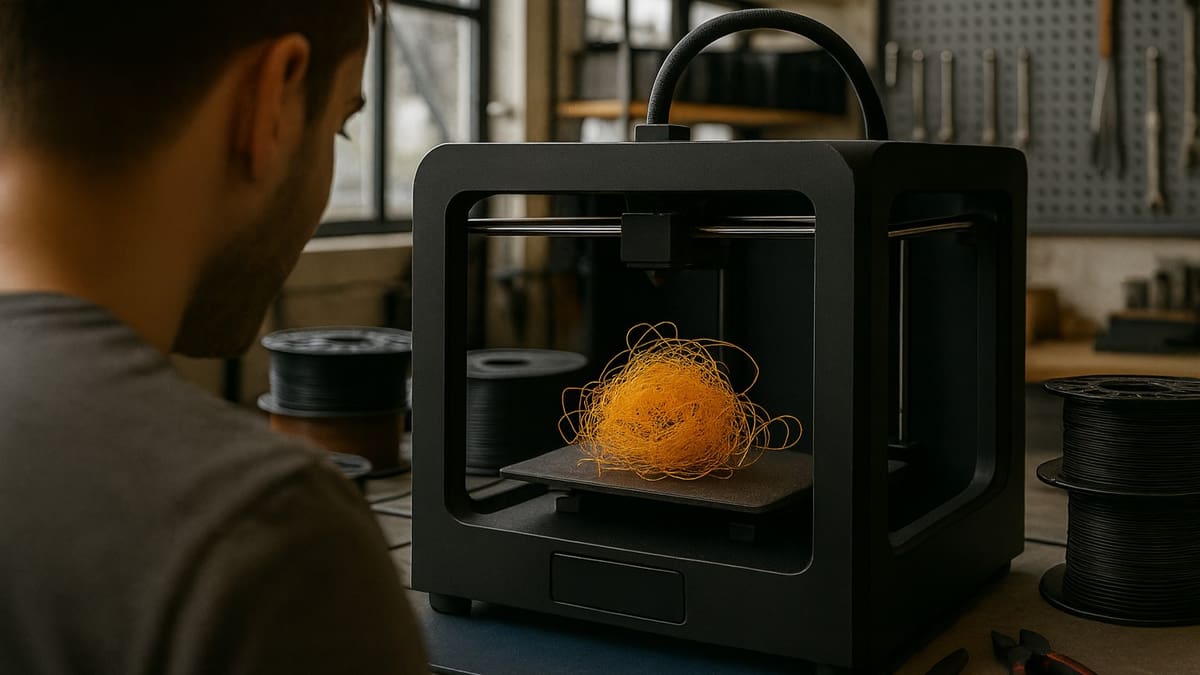
The 3D Printing Reality Check: Why Many Companies in Germany Pay Up to 70% Too Much

Wait six weeks or test in 48 hours? Behind the scenes of German workshops, something has quietly shifted.
3D printed functional parts bring unprecedented speed, device protection and audit suitability, but procurement practice and quotation logic are often stuck in old patterns. Our analysis of typical industrial orders shows how the cost trap arises, where it can be avoided, and how a focused approach pushes the curves of price and time forward.
Three Case Histories – Three Learning Curves
Three practical examples from Stefan Klaußner – materials engineer and founder of 3D Druck München, one of Germany’s leading online 3D printing service and a manufacturer and supplier of functional plastic parts – show how companies benefit significantly from external prototyping in terms of time and money.
Automotive Industry: SOP (Start of Production) Without Idle Time
A major supplier needed custom-fit cable holders for the start of series production. Instead of waiting for the manufacturer’s samples, CAD data was digitally transferred, additively produced, and documented in an audit-proof manner. The parts were available after 48 hours.
The Result: Compared to conventional single-part production, prototype costs fell by 60-70% (approximately €180-300 printed vs €600-1,000 milled including set-up and express costs). The SOP schedule gained two to three weeks, and early fit checks avoided late, expensive change loops.
Health Sector: No More Improvisation
One clinic replaced small-series parts with additively manufactured brackets. The service provider selected the appropriate polymer thanks to material expertise – it is impervious to moisture, easy to disinfect, and proven in practice.
The Result: 50-70% lower unit costs (€25-45 3D printed vs €90-150 conventionally manufactured) available 1-2 weeks faster, meaning less downtime. Every avoided delay saved on rental or replacement equipment costs in the three-digit range and relieved the staff. The online calculator for Germany-wide 3D printing of functional parts (including final prices and delivery time windows in seconds) helped to ensure transparent planning without quotation ping-pong.
Start-ups: Pilot Series Without Tooling Costs
A young company launched outdoor sensor housings made of ASA: The requirements were UV, rain, and frost stability as well as flush screwability.
The Result: Injection moulding tool costs of €8,000-20,000 were eliminated. Three design iterations cost under €500 in total and were completed in 5-7 days (instead of 6-8 weeks to the first series sample). In the pilot phase, unit costs were €30-45 instead of €120-180 for machined small batches. Savings of 60-75% plus time-to-field advantage were achieved. Calculating and ordering many variants in one piece was done via the project upload (bulk calculator) for variants, series and assemblies.
What at first glance can appear to be isolated cases actually show a trend: 3D printing service providers are shifting the cost and time curve forward through saved tools, fast iterations, reproducible processes, and clear documentation. This is how speed, quality, and reliability are redefined in the industry.
Behind many of these projects is 3D Druck München – one of Germany’s leading online 3D printing services and a manufacturer and supplier of functional plastic parts. What began life as a local startup has grown to become a nationwide component partner that reliably handles demanding industrial orders. The 3D printing company is led by materials engineer Stefan Klaußner. His approach demonstrates that in the majority of applications, established plastics can be used in a targeted manner instead of constantly choosing exotic polymers – they’re easier to document faster and more robustly.
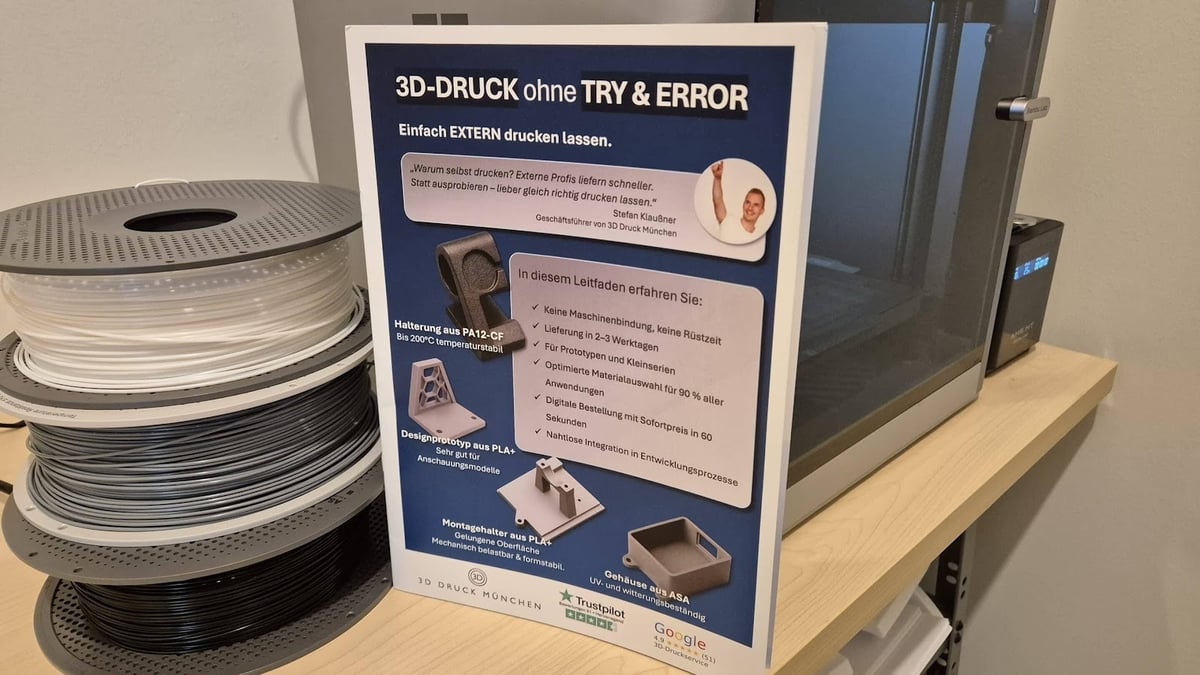
With the guide, which can be ordered free of charge, 3D Druck München seeks to convince those who are unsure about the jungle of processes and materials (Source: 3D Druck München)
The Pattern Behind The Cost Trap
The real cost driver for many 3D printing service providers is often a procedural firework. There are providers who present a total of nine processes (SLA, SLS, MJF, DMLS, and more) plus 40 different materials from ABS to TPU. To the outside world, this seems like high-tech competence, but internally it creates a fog of decision-making. It becomes problematic when customers are asked to choose the process and material themselves – a task that belongs in the hands of service providers who are experts in materials.
And that’s exactly where the problem lies. Customers reported that they had to try out several processes and plastics for one and the same component. The more complicated and expensive, the better – that’s what many customers thought until they came to 3D Druck München where it was demonstrated that it can also be both cheaper and faster.
Example: A customer’s simple electronic housing has, for several years, always been ordered in PA12 with the SLS process for €180 per piece with 2 weeks delivery time, because “powder process” sounds more professional. The long delivery time is also due to the process (long preparation and follow-up, as well as waiting until the service provider has filled the installation space).
Functionally identical, stable, and temperature-resistant, the part could be produced in FDM printing with PA12-CF for around €25 with a 3 day delivery time.
The Result: The same part could be produced faster and cheaper.
Customer Testimonials Instead of Promises
In a market full of promises and glossy marketing, decision-makers are primarily looking for evidence. Professional quality has long been a prerequisite – trust is now built through experience. That’s exactly why buyers and developers first look at real customer voices.
Public reviews on Google and Trustpilot are more than just nice words, they are the fastest “quality replacement indicator” for adherence to deadlines, clear communication and clean execution – exactly the points where projects often fail in practice. Anyone who reads such positive experiences reduces their own uncertainty and prefers to award contracts to a provider who has already proven that they deliver. In this way, 3D Druck München positions itself as a parts supplier for functional plastic parts verifiable references throughout Germany.
The Way Out: Clarity & Reliability
The counter-strategy that works is simple: fewer “high-tech” procedures, but reproducible processes, transparent gross prices, and clear delivery time windows before commissioning. This is exactly the focus offered by 3D Druck München as a Germany-wide online 3D printing service.
Purchasing Security in 90 Seconds: Mini-check Before Commissioning
Those who have functional parts manufactured externally want one thing above all: clarity before the order instead of unpleasant surprises afterwards. With this checklist, you can see at a glance how to recognize a reliable 3D printing service provider:
- Gross price including shipping immediately visible and transparent: No recalculation, no hidden surcharges – the final price is fixed.
- Justifiable material recommendations: No guessing games. Clear and justifiable recommendations (such as suitability for indoor, outdoor, or high loads) included before ordering.
- Guaranteed reproducibility: Parameters and production methods are stored with the service provider in such a way that repeat orders arrive of the same quality.
- Clear delivery time instead of vague commitments: Transparent timescales provided before ordering provide planning security.
- All parts can be calculated and ordered in a single process: No single upload, no games of e-mail ping-pong. Bundled project uploads for variants, product series, and assemblies.
- A reputable provider with publicly accessible terms and conditions, as well as cancellation and privacy policies: Legal certainty and transparent framework conditions from the very beginning.
- Public references: Verifiable customer voices on adherence to deadlines, communication, and execution reduces procurement risks.
Summary
The myth “the more complex, the better” persists – but costs time and budget. Anyone who recognizes the pattern uses the simple equation: save tools, iterate faster, manufacture reproducibly, and document cleanly. For companies that want to do just that, 3D Druck München offers a consistently transparent process: calculate in seconds, upload projects collectively, and have them delivered in a predictable manner – without trial and error.
About The Author
Stefan Klaußner, Master of Science in Materials Science (University of Erlangen-Nuremberg), is the founder and director of 3D Druck München. He has worked for BMW, Siemens, Fraunhofer Institute and REHAU Automotive. His focus is clear material selection and reproducible FDM production for functional plastic parts.