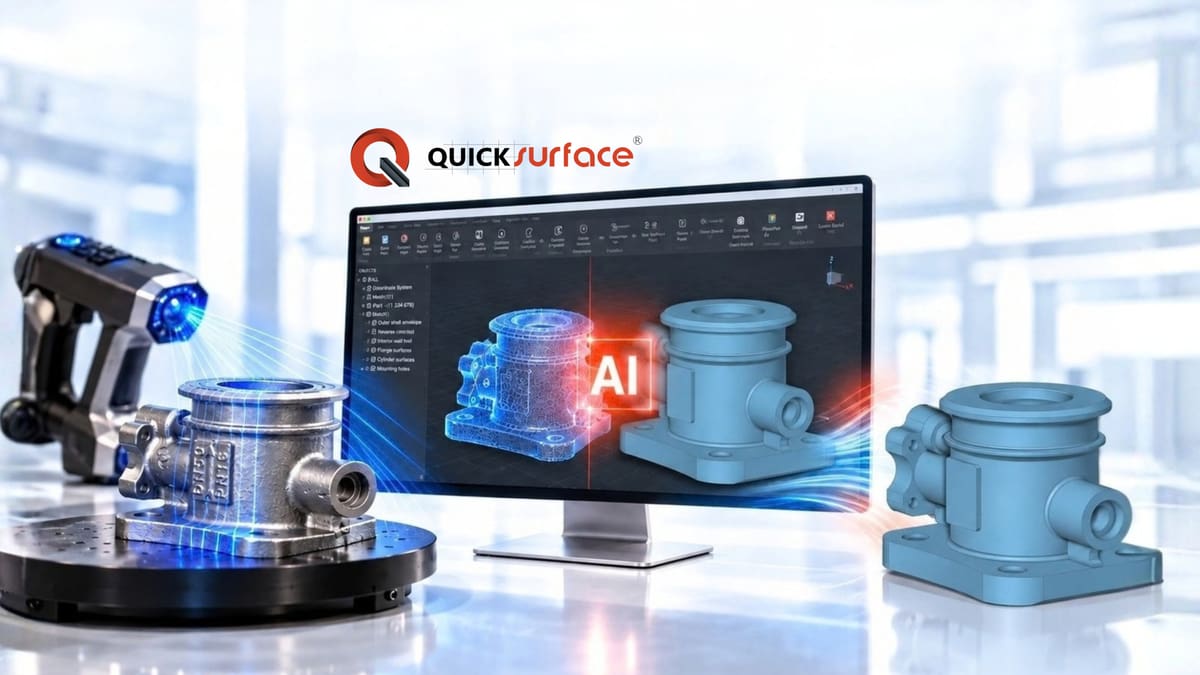
QUICKSURFACE AI is About to Change 3D Reverse Engineering

QUICKSURFACE is introducing QUICKSURFACE AI to revolutionize the Scan-to-CAD workflow, transforming 3D scan data into fully editable CAD with the click of a button.
AI is beginning to change the way engineers work with 3D data, and 3D reverse engineering could be one of the areas where its impact is most significant.
3D scanning has already transformed how engineers capture physical objects. Modern scanners are faster, more accurate and capable of digitizing complex components in minutes.
But capturing an object is only the beginning.
A 3D scan provides a point cloud or polygon mesh – not an editable CAD model. For many engineering applications, that scan still needs to be interpreted and reconstructed into useful CAD geometry. This transition from scan data to editable CAD is the challenge QUICKSURFACE has been focused on for more than eight years.
Consider a worn or damaged mechanical component with no original CAD model. A scanner can accurately capture its current shape, but it cannot tell us how the part was originally designed. Repeated features may have shared dimensions or symmetry, while damaged areas may need reconstruction rather than reproduction.
Reverse engineering therefore involves more than reproducing the scan. The engineer needs to recover the design intent behind the physical part.
QUICKSURFACE was developed around this principle: helping engineers reconstruct scan data as useful, editable CAD rather than simply reproducing the measured geometry.
Once reconstructed, the CAD model can be modified, redesigned or used to manufacture a replacement through 3D printing, CNC machining or other production processes.
Building Tools for Scan-to-CAD
Turning scan data into editable CAD requires a different approach from conventional CAD modelling. Instead of starting with sketches and dimensions, the engineer starts with measured geometry from a physical object.
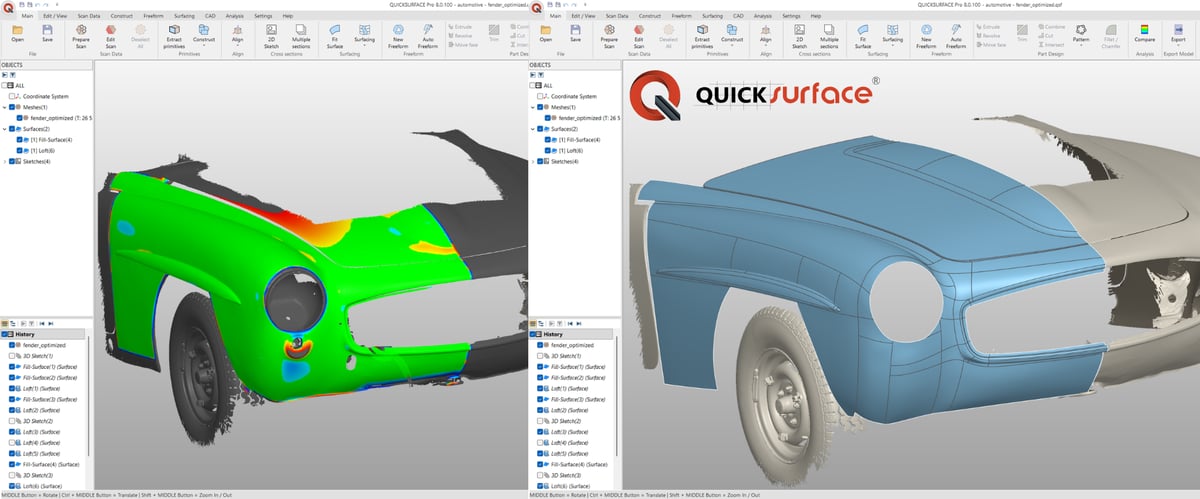
QUICKSURFACE provides tools to extract reference geometry directly from mesh data and use it to build sketches and CAD features. For more complex or organic shapes, freeform tools allow engineers to reconstruct geometry that cannot easily be represented with standard CAD features.
Throughout the process, deviation analysis allows the reconstructed CAD model to be compared with the original scan. This helps the engineer identify where the two differ and decide whether those differences should be corrected, retained or intentionally redesigned.
The goal is not simply to create a model that looks like the scan. It is to turn scan data into useful, editable CAD geometry that can continue into design, modification and manufacturing.
What If the Software Could Do More?
Today, the engineer still controls each stage of the reconstruction process.
The engineer studies the scan, decides how the part should be reconstructed, selects the appropriate tools and progressively builds the CAD model.
That control is important because reverse engineering requires engineering judgement.
But does every reconstruction step need to be performed manually?
Could some of the repetitive work be reduced? Could engineers reach editable CAD geometry sooner? And could the software take a more active role while still allowing the engineer to inspect and modify the result?
These are the questions behind the development of QUICKSURFACE AI.
Rather than simply adding AI alongside the existing workflow, we have been exploring how AI can become an active part of the Scan-to-CAD process itself – taking on more of the reconstruction work while keeping the resulting CAD accessible to the engineer.

Engineering Judgement Still Matters
A scan represents the physical object as it exists today. The CAD model may need to represent something different: the original design, a corrected component or a redesigned version.
A worn cylindrical feature may need to be restored to its intended diameter. A damaged surface may need reconstruction. Repeated features may need to share dimensions even when the scan contains small variations.
These decisions still belong to the engineer.
Whatever technology is used to make Scan-to-CAD more efficient, the resulting geometry needs to remain editable, inspectable and available for the engineer to validate and refine.
For workflows involving replacement parts, product development, tooling, 3D printing and manufacturing, reducing manual reconstruction work could shorten the path from a physical component to usable CAD.
A New Approach to Scan-to-CAD
For some time, the QUICKSURFACE development team has been investigating whether part of the Scan-to-CAD process could be approached differently.
The result is QUICKSURFACE AI.
The idea is not simply to add another modelling command or another tool to the software. It changes the role the software can play in the reconstruction process.
Instead of AI simply acting as an assistant that explains commands or suggests what the engineer should do next, QUICKSURFACE AI is being developed as an active part of the Scan-to-CAD workflow itself.
The objective is to let the software take on more of the reconstruction work and help engineers move from real-world scan data towards useful, editable CAD with fewer manual steps.
But the principle behind QUICKSURFACE remains the same: the engineer stays in control, and the result remains editable CAD that can be inspected, modified and refined.
So how much of the Scan-to-CAD process can AI take on?
That is what we are preparing to demonstrate.
See QUICKSURFACE AI in Action at Formnext 2026
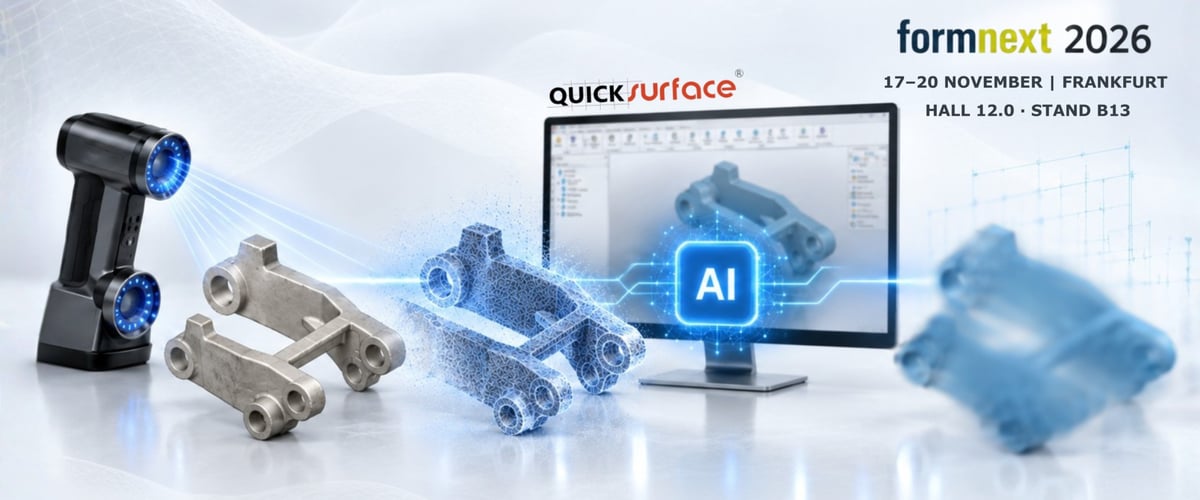
On November 17, 2026, QUICKSURFACE will officially release QUICKSURFACE 2027 and demonstrate its new AI technology at Formnext in Frankfurt.
The new release will introduce further developments to the Scan-to-CAD workflow, combining new and improved reverse-engineering tools with QUICKSURFACE AI.
At Formnext, we will demonstrate the technology using real 3D scan data, showing how AI can take a more active role in the reconstruction process and help move from scan data towards editable CAD with fewer manual steps.
For engineers working with 3D scanning and reverse engineering, the demonstration will be an opportunity to see the new workflow in practice, understand what AI can take on, and see where engineering judgement remains essential.
QUICKSURFACE will be at Formnext, Nov. 17-20, 2026 in Frankfurt, hall 12.0, booth B13.