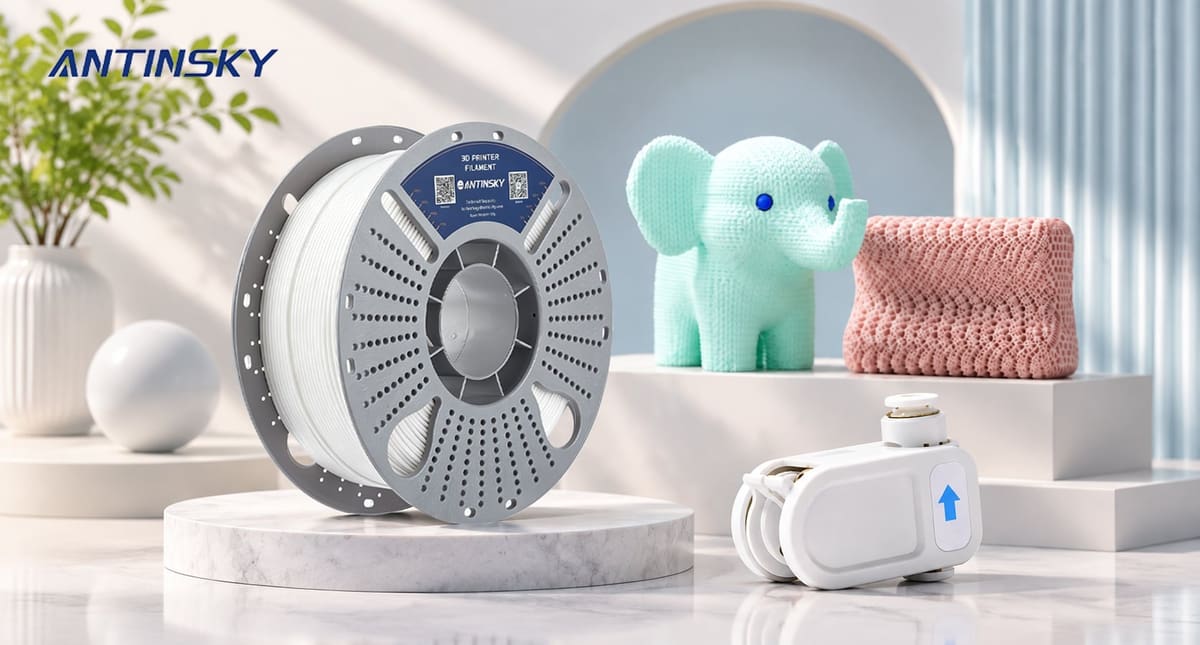
Optimized for Bambu Lab H3C: ANTINSKY Launches Ultra‑Flexible TPE‑65A, Alongside PBST & Filament Tangle Cutter

Beyond TPU 75A: ANTINSKY unveils softer TPE‑65A, a new flexible 3D printing filament option for Bambu Lab H3C users. Visit the ANTINSKY booth at Formnext (12.1‑F29) to learn more about it!
With Bambu Lab releasing its brand‑new H3C printer, a prioritization of flexible‑material applications can be noted. Most flexible filaments currently on the market are TPU‑based, featuring high water absorption that demands continuous drying, alongside relatively firm tactility which compromises wear comfort.
ANTINSKY TPE 65A (~$20) fills this market gap. Boasting a Shore 65A hardness, it is softer than 75A‑grade materials. It also has a 2.85-mm diameter, which makes it compatible with a Bambu Lab H3C. Its raw material complies with food‑contact requirements and delivers excellent skin‑friendly touch. The low‑moisture‑absorption formulation largely eliminates the mandatory continuous‑drying requirement typical for TPU and PEBA. With a density of merely 0.95 g/cm³, finished parts weigh 20‑30% less than equivalent models printed with conventional TPU.
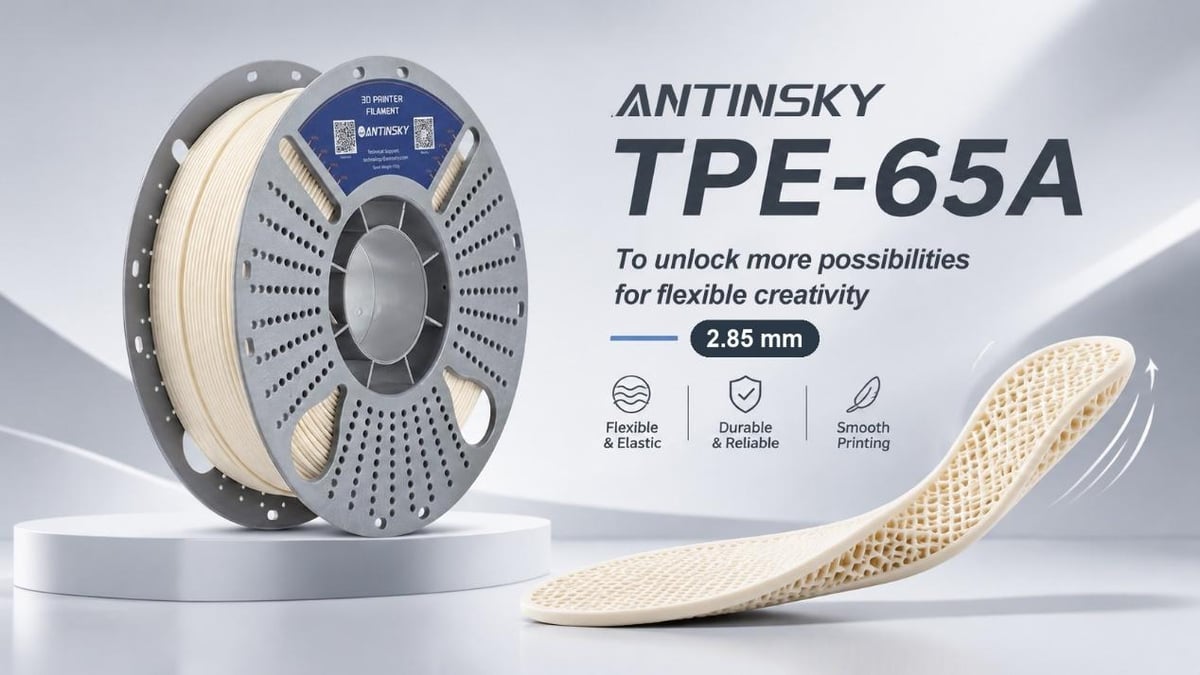
Key material properties include:
- Elongation at break > 500%
- Tear strength of 48 kN/m
- Tensile strength of 7.1 MPa
- Over 200,000 bending‑resistance cycles
- Resilience > 50%
TPE 65A retains elasticity across -40 ℃ to 50 ℃, features weathering and UV resistance, and is 100% thermoplastically recyclable. It supports high‑speed printing at 50‑200 mm/s and works with 0.4‑1.0 mm nozzles. It performs exceptionally well for random lattice‑structure printing. These characteristics suit parts requiring soft tactility, elastic deformation, and repeated‑bending durability. The material also exhibits good wear resistance, slip‑proof performance under both dry and wet conditions, plus moderate weathering and anti‑UV capability.
Target applications include full 3D printed footwear, custom insoles, prosthetic liners, non‑slip tool grips, wearable components, shock‑absorbing buffers, and soft‑robotics parts.
PBST New Biodegradable High‑Toughness 3D Printing Filament: PLA‑Level Printing Speed, Native Compatibility with Bambu Lab AMS
Alongside TPE 65A, ANTINSKY introduces PBST ($9), a 3D printing filament built on modified PBST aliphatic‑aromatic co-polyester.
It balances moderate flexibility, high toughness, and print‑friendliness. Users can print directly using default PLA slicer profiles, with speed reduced by 50% for fine contours. It delivers PLA‑level volumetric throughput up to 20 mm³/s without extensive parameter tuning, and it can be directly printed using a low-temperature printing plate.
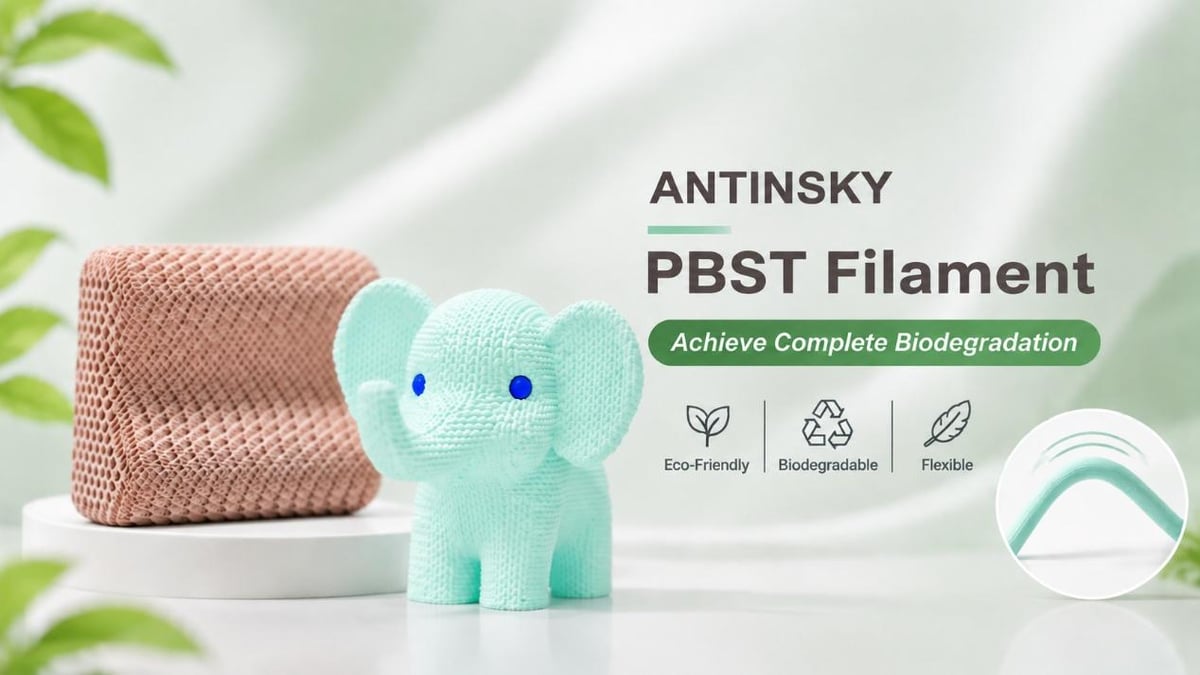
Unlike most TPU 3D filaments, this material runs stably inside the Bambu Lab AMS for multicolor and multi‑material workflows.
It features high toughness, with 213% elongation at break. Printed parts resist drop‑impact and fracture, mitigating the brittleness common to PLA. The product has a bio‑based content above 60% and fully biodegrades under industrial composting conditions without generating microplastics. Low odor and low‑VOC emissions during printing make it ideal for enclosed spaces such as homes, classrooms, and offices.
Well‑balanced stiffness and flexibility persist down to ‑15 ℃. Suitable use‑cases include living hinges, snap‑fit assemblies, children’s educational toys, designer collectible figurines, wearable prototypes, and low‑temperature functional components.
PBST offers creators a practical eco‑friendly alternative: it combines PLA‑grade print throughput and AMS multi‑material compatibility with blended toughness and flexibility. It avoids PLA’s fragility while bypassing slow print‑speeds and AMS incompatibility seen in conventional flexible filaments.
Filament Tangle Cutter: Fully‑Mechanical Solution Against Tangling‑Induced Failed Empty‑Printing
During long‑duration print jobs, filament spools often develop tangled filament that obstructs material feeding. The printer keeps extruding without incoming material, yielding total print failure and wasting filament and time. Numerous desktop printers lack built‑in tangle‑detection and rely on manual operator supervision.
To improve filament‑feed reliability, ANTINSKY presents the Filament Tangle Cutter ($9), a mechanically‑actuated accessory addressing feed anomalies triggered by filament tangling.
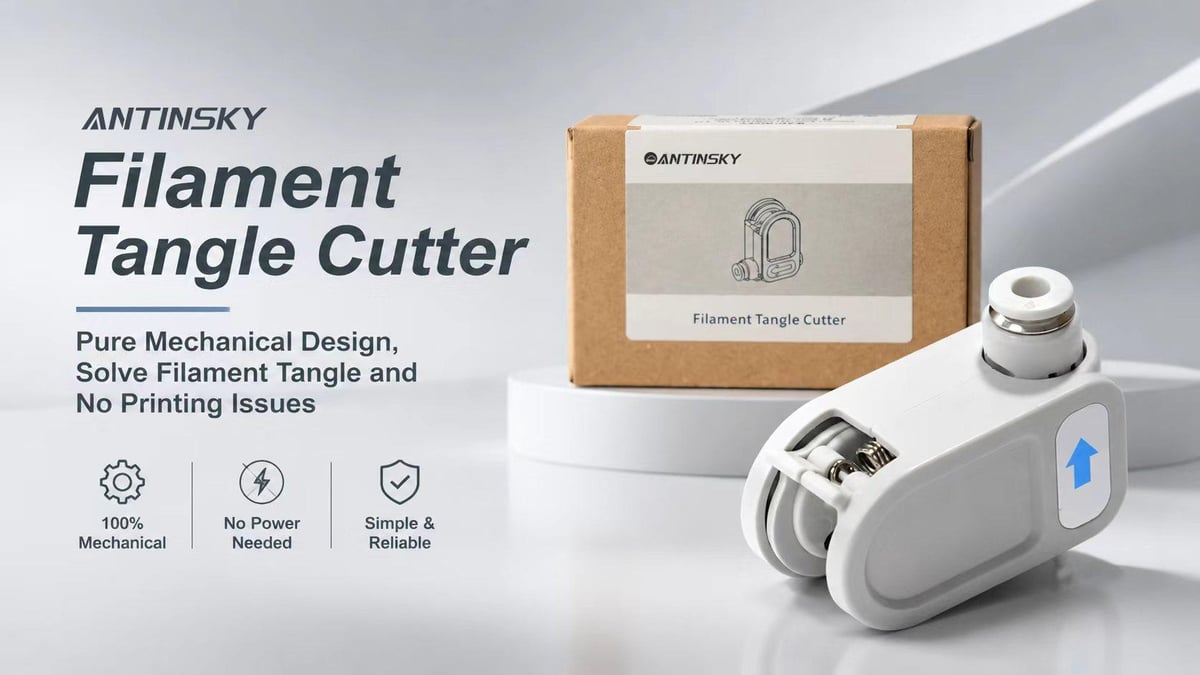
Requiring no circuit board or external power supply, its mechanical trigger automatically severs filament instantly once feed resistance hits the 20 N threshold caused by jamming from tangles. It delivers clean flat cuts and drastically reduces empty‑print failures from spool tangles. It can also automatically trim leftover tail filament. Compatible with most FDM desktop 3D printers, it works with rigid filaments including PLA, ABS, and PETG. Its housing is manufactured from POM polyoxymethylene for high rigidity and wear‑resistance ensuring long‑term service‑life.
For everyday desktop printing or high‑uptime FDM production workflows, the ANTINSKY Filament Tangle Cutter delivers a simple practical tool for filament‑feed management.
Expanding Product Portfolio: More Filaments & Print Accessories
Beyond the above‑mentioned new releases, ANTINSKY showcases additional new filaments and hardware accessories. On the engineering‑material front, the PPS, PPA-CF ($59), PPS‑CF ($59), and PPS‑GF ($35) series provide outstanding heat‑resistance, chemical‑resistance and low‑moisture‑absorption for functional tooling and high‑temperature components. For aesthetic‑oriented creative projects, new filaments include Silk TPU ($12), Sparkle PETG (~$6), and Thermochromic PLA (~$11), balancing print performance with special visual effects for designer toys, cultural‑creative goods, and display models.
New hardware accessories comprise a cold‑printing‑platform plate adapted for Prusa machines ($10-$20). It enables low‑temperature printing, improves bed adhesion, minimizes warpage, and broadens the range of printable materials for Prusa systems.
Meet Us at Formnext 2026 – Visit the ANTINSKY Booth
ANTINSKY is pleased to confirm participation in Formnext 2026. We welcome you to visit Booth 121-F29 to discuss product applications, learn about our latest material developments, and receive exclusive complimentary gifts (limited stock, while supplies last).