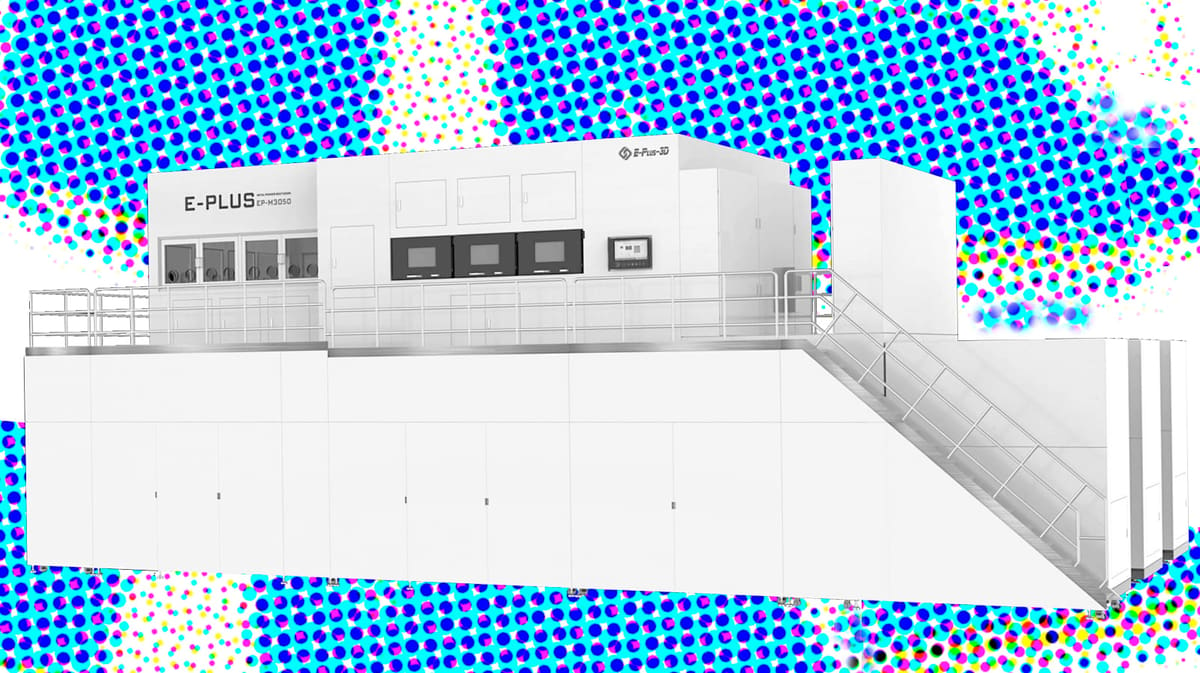
Metal LPBF’s 3-Meter Build Volume Barrier is Broken: Meet Eplus3D’s New 100-Laser Platform

By coordinating 100 lasers across a massive 3,050 mm build plate, this ultra-large-format system for titanium, aluminum, steel and more, eliminates the need for welding rocket thrusters or structural aerospace parts.
Eplus3D just launched the EP-M3050, an ultra-large-format metal powder bed fusion 3D printer in its Atlas Line that the company says pushes the practical limits of metal additive manufacturing beyond the three-meter threshold.
With a build volume of 3050 x 3050 mm, with a Z-axis configurable up to 5000 mm, according to Eplus3D, the machine is designed to produce ultra-large structural components, such as rocket thrusters or machinery components, in a single build rather than assembling them from smaller printed or conventionally manufactured sections. Eplus3D claims the system “breaks through” a long-standing 3-meter size barrier in metal PBF, albeit by a hair. Still, the headline specification is striking.
EP-M3050 appears to be the largest publicly specified metal LPBF printer on the market among systems from EOS/AMCM, Velo3D, Nikon SLM Solutions, Farsoon, and BLT. Yet, since there’s so much more to today’s metal LPBF workflow than size, industry leaders aren’t likely worried. However, its scale does signal where competition may intensify next: not only around larger build envelopes, but around the process control, gas-flow management, recoating consistency, thermal stability, powder handling, monitoring software, qualification support, and post-processing infrastructure needed to make parts of that size repeatably and economically.
In other words, the EP-M3050 may not immediately threaten established LPBF leaders in their core production niches, but it raises the ceiling for what customers may begin to expect from large-format metal additive manufacturing.
The EP-M3050 is built around a multi-laser architecture. In its standard configuration, the system includes 100 lasers (yes, one hundred), while Eplus3D says the platform can scale up to 256 fiber lasers at 500 W, with optional 700 W and 1000 W laser configurations. Eplus3D lists a 70-120 μm spot size, 8 m/s maximum scan speed, 20–120 μm layer thickness. There’s a theoretical print speed of up to 3500 cm³/h under typical process conditions, but no independent validation of that performance claim yet.
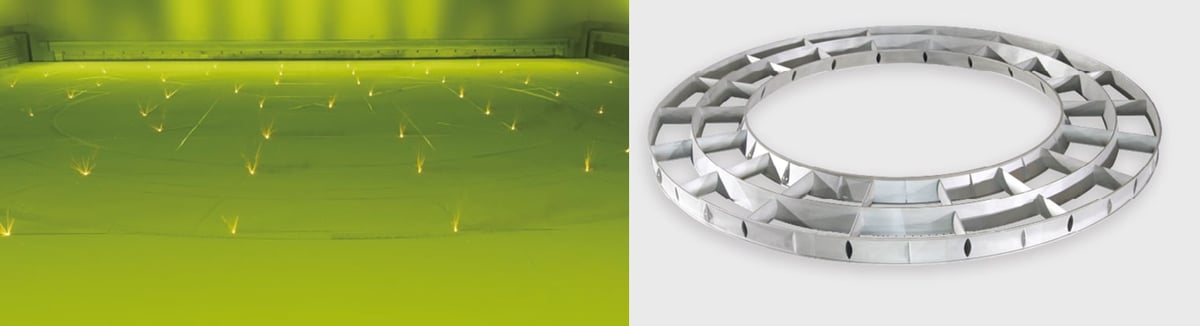
Scaling metal PBF to this size is not simply a matter of enlarging the machine frame. According to Eplus3D, it has addressed airflow stability across the build chamber, fume and spatter management during long-duration prints, and optical cleanliness across the system’s large working area.
The company says the EP-M3050 can be configured with square, cylindrical, or optional ring-shaped build chambers. Eplus3D positions this flexibility as a way to improve material use for large parts, such as casings and ring-like structures. As an example, the company cites a 2.8-meter casing printed integrally on the EP-M3050 — though it does not provide build time, material, weight, or mechanical-property data for that part.
Eplus3D says the EP-M3050 is compatible with titanium alloy, aluminum alloy, nickel alloy, maraging steel, stainless steel, cobalt chrome, and copper alloy, among other materials. The system requires argon or nitrogen gas, with oxygen content specified at ≤100 ppm, and a listed power supply of 380 V, 50/60 Hz, 135 kW.
Eplus3D is pitching the printer at demanding industrial sectors, including aerospace and aviation, energy, oil and gas, machinery, and advanced manufacturing. The company says one-piece production of large metal components could reduce assembly work, shorten production cycles, and improve part performance, as we’ve seen with smaller parts.
The EP-M3050 also builds on Eplus3D’s existing large-format metal AM portfolio, including the EP-M1250, EP-M1550, and EP-M2050. Eplus3D says that it can go even larger through custom-build metal PBF systems with build volumes up to 5 m × 10 m × 5 m.
Whether the EP-M3050 becomes a new reference point for large-format metal additive manufacturing will depend on the details not included in the announcement: repeatability data, material qualifications, part-quality results across the full build area, machine pricing, delivery timelines, customer installations, and long-build reliability.
For now, Eplus3D has made a bold claim: metal PBF can move beyond three meters. The next test will be proving, in production environments, what that scale can do.
Technical Specifications
You May Also Like:

License: The text of "Metal LPBF’s 3-Meter Build Volume Barrier is Broken: Meet Eplus3D’s New 100-Laser Platform" by All3DP Pro is licensed under a Creative Commons Attribution 4.0 International License.