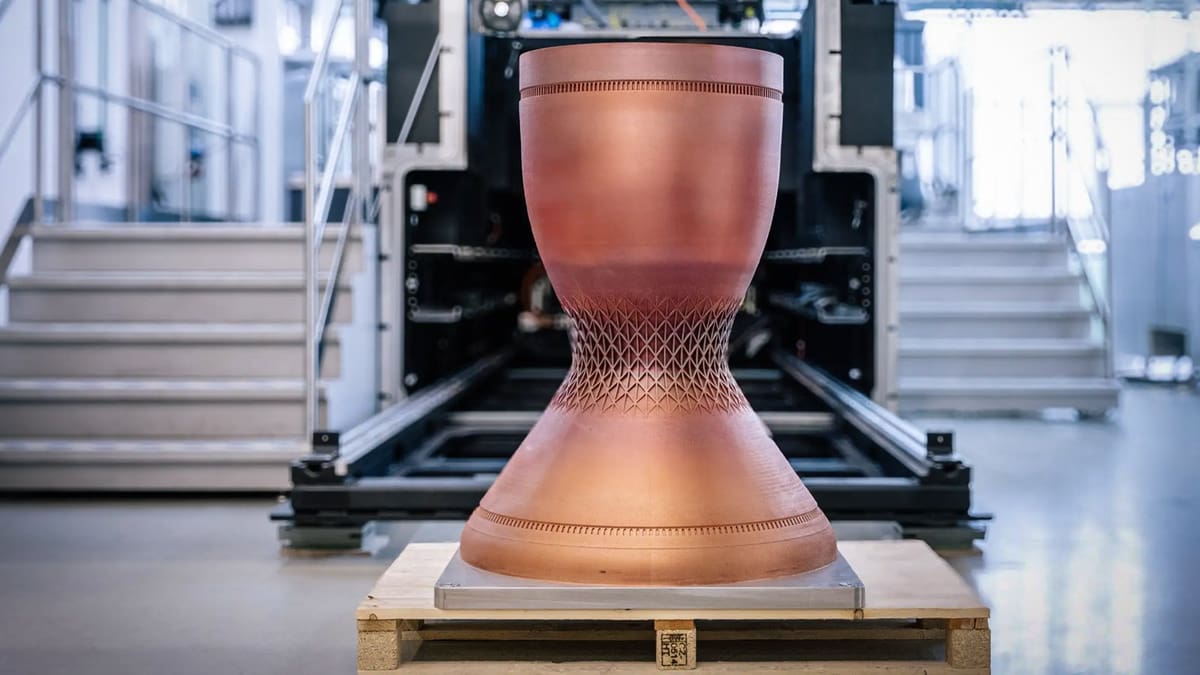
Metal 3D Printing Is About to Get a Lot Bigger, Thanks to New Chamber Air Flow Tech

A new 'AirSword' system from EOS AMCM clears the air — literally — inside the build chamber of soot and debris to enable metal prints on an unprecedented scale.
AMCM, large-scale metal 3D printer manufacturer developed as a spin-off from EOS, launched what it’s calling “a breakthrough in large-scale metal additive manufacturing.” It’s a novel gas flow system dubbed AirSword enables ultra-large laser powder bed fusion (LPBF) printing without sacrificing precision or part quality, the company says.
Additive manufacturing technologies like LPBF and other powder-laser based methods face significant scaling challenges. Although LPBF is known for delivering high-detail parts, expanding its build area beyond 1 m × 1 m has historically been constrained by inadequate gas flow, according to AMCM, which leads to turbulence, smoke and soot accumulation, and interference with the laser path.
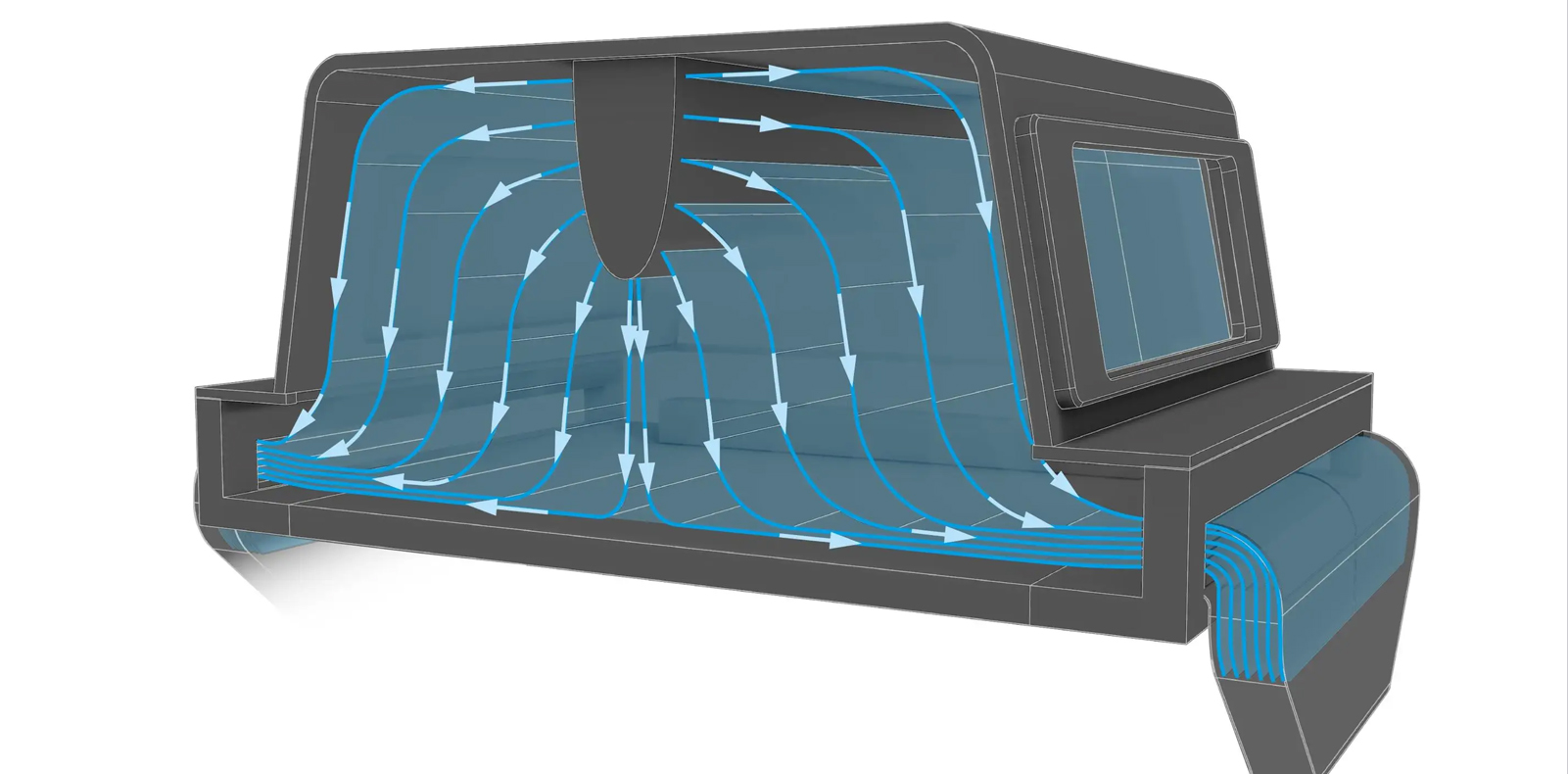
AMCM’s AirSword concept is engineered to overcome those constraints. In large-format LPBF machines such as the new company’s M 8K and the planned M 10K, the system delivers a dynamic, multi-layered gas flow that spans the full build envelope. A central gas emitter splits flow into two opposite streams along the chamber axis, pushing smoke and spatter sideways toward exhausts. This prevents smoke from drifting across the chamber and interfering with the laser beam path, even during long prints.
“We designed the AirSword concept using extensive computational fluid dynamics simulations to optimize flow patterns for large LPBF chambers,” says Georg Fey, team manager of application & innovation at AMCM. “These simulations guided the design of the flow nozzle outlets and overall flow dynamics. The device itself is manufactured on our M 4K system, leveraging LPBF’s design freedom to create a highly efficient, custom-fit gas flow solution.”
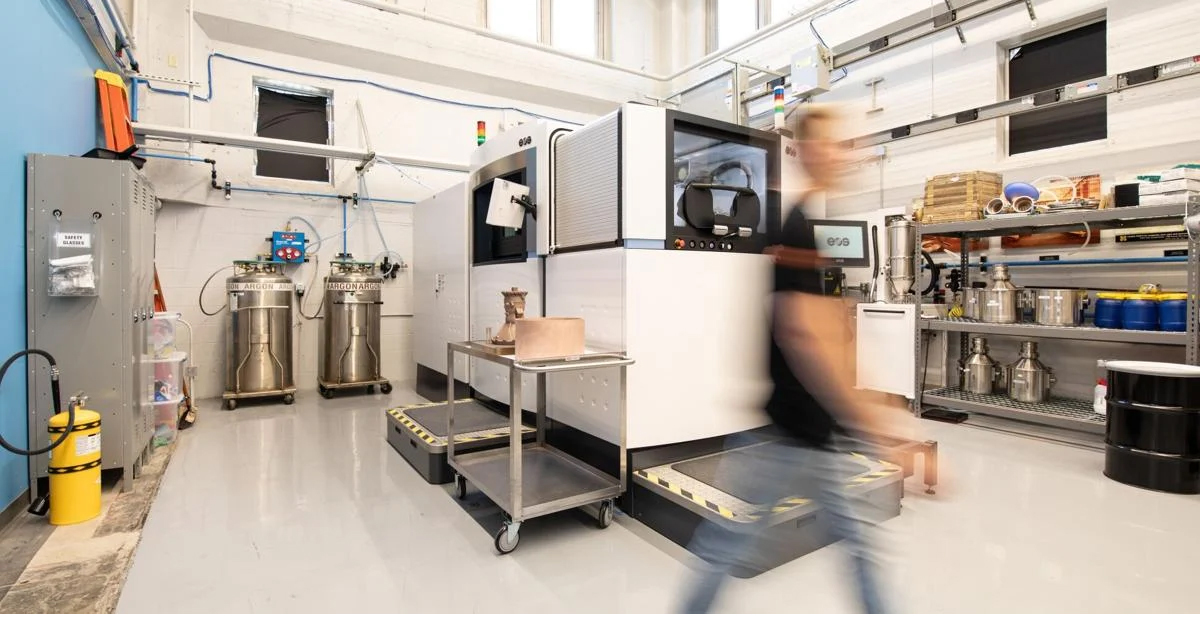
One standout benefit of AirSword is its ability to keep the glass and laser optics clean by continuously directing flow against soot accumulation—an issue that frequently degrades print fidelity in extended-duration builds.
According to AMCM, the M 8K system already features eight 1 kW lasers with a 0.7 m² powder bed and an 800 × 800 × 1,200 mm³ build volume. The design is built for industrial throughput, handling up to five tonnes of powder while maintaining precision along the Z axis. The forthcoming M 10K expands the floor plan to a full 1,000 × 1,000 mm build surface.
Complementing AirSword is AMCM’s integration of advanced process control modules such as SmartFusion and EOState Exposure OT, which the company says help reduce post-build quality checking and enhance in situ monitoring.
AMCM argues that by minimizing moving parts in the gas management subsystem, AirSword delivers reliable, low-maintenance operation—preserving the speed, accuracy, and robustness that make LPBF a preferred method for precision metal parts.
“Designing a system of this size involves a whole range of challenges,” says Martin Bullemer, managing director of AMCM. “Integrated with advanced process control technologies like SmartFusion and EOState Exposure OT, AirSword enhances in-process quality assurance, reducing the need for extensive post-build testing.”
With the introduction of AirSword and the scaling up to M 8K / M 10K systems, AMCM aims to deliver ever-larger metal components without compromising on surface quality or throughput.
You May Also Like:


Never Miss Any Additive Manufacturing News, New Printers, or Guides:

License: The text of "Metal 3D Printing Is About to Get a Lot Bigger, Thanks to New Chamber Air Flow Tech" by All3DP Pro is licensed under a Creative Commons Attribution 4.0 International License.