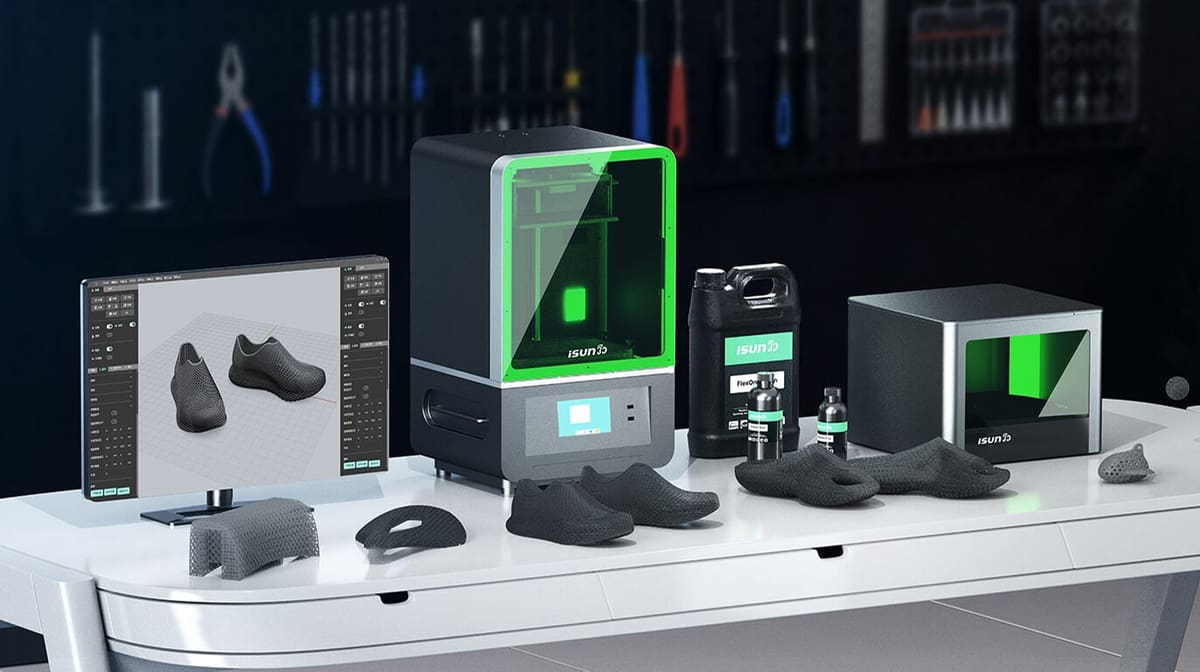
iSUN’s Single-Component Resin Can Make 3D Printed Shoes Scalable

iSUN3D, a wholly-owned subsidiary of Shenzhen eSUN Industrial Co., Ltd. (eSUN), announces the global launch of its single-component elastic resin 3D printing solution.
As 3D printed footwear gains unprecedented traction in 2025, manufacturers still face persistent bottlenecks. Most commercial elastic footwear components rely on two-component (2K) resins, which require precise mixing, have a limited pot life, and introduce constraints across production, post-processing, and supply chain coordination.
iSUN3D’s new solution addresses these challenges with a unified, production-grade workflow that spans design, printing, post-processing, and delivery – optimized end-to-end for both performance and manufacturing efficiency. It is designed to accelerate the transition of 3D printed footwear from niche applications to true mass production. The solution debuted at Formnext 2025 (Hall 11.1, Booth D29), with live demonstrations.
1. An Integrated, Production-Ready Workflow
This fully integrated workflow – from design to finished product – unifies materials, hardware, and post-processing. It addresses the core issues of cost, efficiency, and quality in elastic photopolymer printing and, through the example of monolithic 3D printed footwear, provides a practical and scalable model for the industry.
2. FlexOne™ Series: The Single-Component Elastic Resin
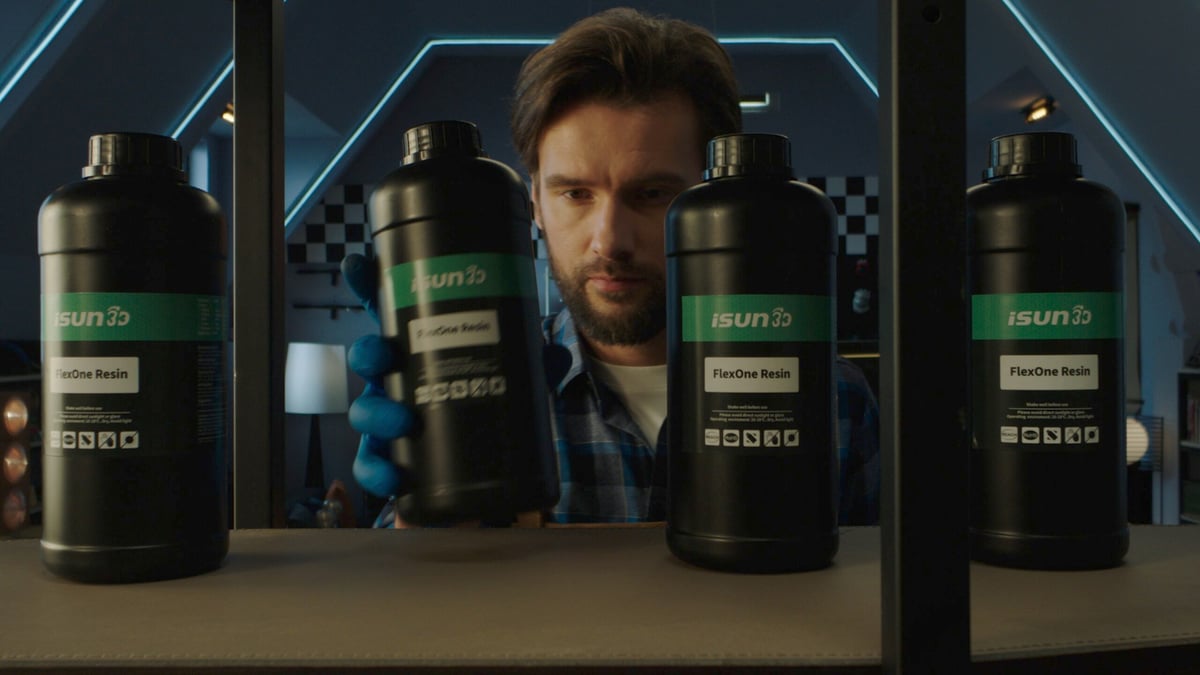
At the core of the solution is FlexOne™, which redefines the standard by outperforming traditional dual-component materials in usability, cost-effectiveness, and performance, catering to diverse flexible product manufacturing applications.
-
Ready-to-Print, No Mixing Required
Unlike dual-component resins that require precise ratio mixing, FlexOne resin can be poured directly into the printer upon opening. This eliminates pre-mixing time and completely avoids waste caused by mixing errors.
-
Extended Pot Life & Reusability
FlexOne resin overcomes the 8-hour pot life limit of dual-component materials. It remains stable and printable even after 8+ hours of exposure, preventing waste due to premature curing. Additionally, residual resin collected during post-processing can be reused in printing, reducing material consumption and lowering production costs.
-
Low Viscosity & Easy Cleaning
The optimized low-viscosity formula allows easy removal of residual resin from printed parts. A standard centrifugal + ultrasonic cleaning process is sufficient, eliminating the need for complex steps. Compared to traditional elastic resins, FlexOne significantly shortens post-processing time and labor, supporting high-volume continuous production.
-
Skin-Safe & Hypoallergenic
Rigorously tested and certified to be non-irritating, non-toxic, and free of heavy metals, ensuring safety for prolonged skin contact.
FlexOne™ also delivers exceptional mechanical properties for diverse soft and elastic applications:
- Tear Strength: > 50 kN/m (2x ordinary elastic resin, ASTM D624)
- Tensile Strength: > 20 MPa (3x ordinary elastic resin, ASTM D412)
- Elongation at Break: > 250% (fully recoverable, suitable for frequent bending, ASTM D412)
- Ross Flex: > 1,000,000 cycles (6-30x service life extension, SATRA TM92)
3. iSUN3D HSL 100 / 100MAX: High-Speed Elastic Resin Printers
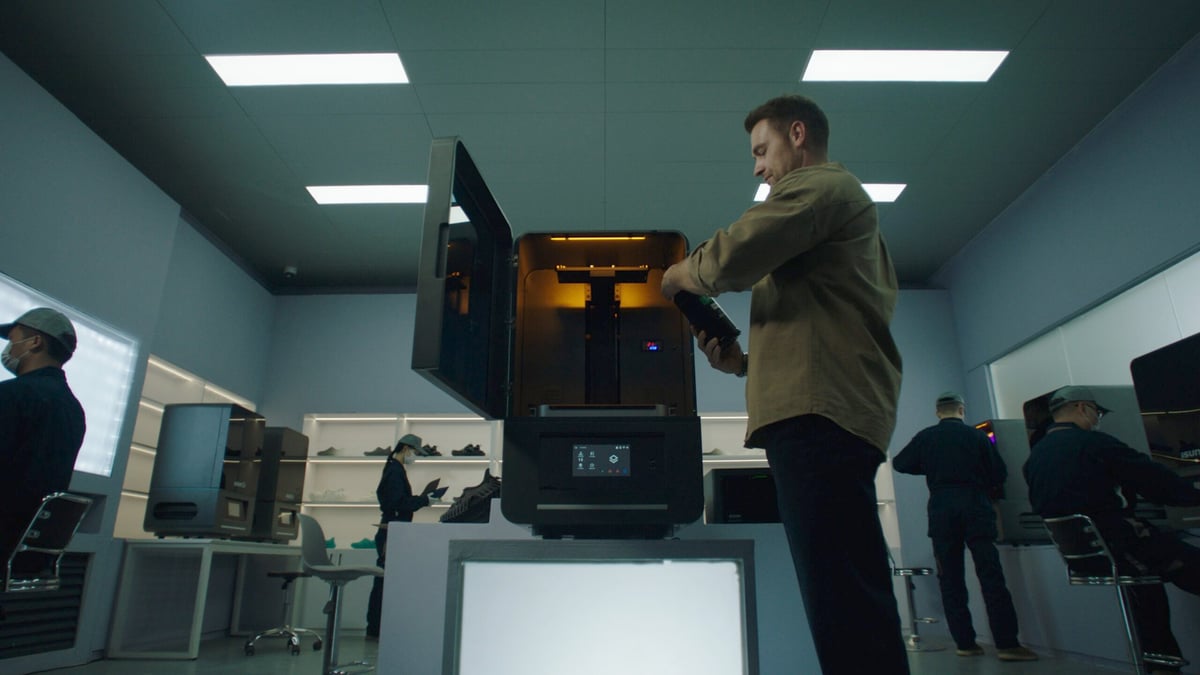
iSUN3D’s HSL 100 and 100MAX printers are designed specifically for large-format elastic resin production.
- Large-format printing: 14/16-inch options, 40 cm Z-height, capable of printing two pairs of shoes simultaneously.
- High-speed printing: 100 mm/h print speed, producing two pairs of shoes in just 3 hours.
- Excellent stability: Ball screws boost transmission efficiency and stability; COB light source with over 90% uniformity guarantees consistent print quality.
This synergy between printer and resin guarantees consistent printing accuracy and part quality.
4. Reference Application: Monolithic 3D Printed Footwear
The solution demonstrates the efficiency and flexibility of soft-elastic manufacturing through an optimized workflow:
- Design: Intelligent field-driven software with parametric design enables rapid customization.
- Production: Synergy between single-component resin and high-speed printers, enhanced by a triple-curing process for superior durability.
- Post-processing: Efficient centrifugal + ultrasonic cleaning with resin recycling; simple, odor-free dip-dyeing.
The full-process implementation achieves significant cost reduction, efficiency gains, and quality assurance.
5. Industrial Track Record
Since 2017, iSUN3D has produced over 3,000 customized 3D printed orthotic insoles per month and operates over 150 retail partner stores. The company led the drafting of the Additive Manufacturing Customized Orthotic Insole standard, and its digital insole system has been recognized by China’s Ministry of Industry and Information Technology as a “Typical Additive Manufacturing Application.”
This expansion into monolithic 3D printed footwear not only enriches product options for existing channels but also enables integration with our mature foot-scan customization system, truly enabling personalized shoe printing.
6. Invitation to Formnext 2025
iSUN3D welcomed journalists, analysts, designers, and manufacturing partners to experience the solution at Formnext 2025.