How This New High-Strength Nylon Filament is Born From Industrial MJF Powder Waste

By reclaiming industrial waste into a high-performance rPA12 with 46 MPa tensile strength, this "loop-closing" filament aims to prove that sustainable manufacturing doesn't have to sacrifice engineering performance.
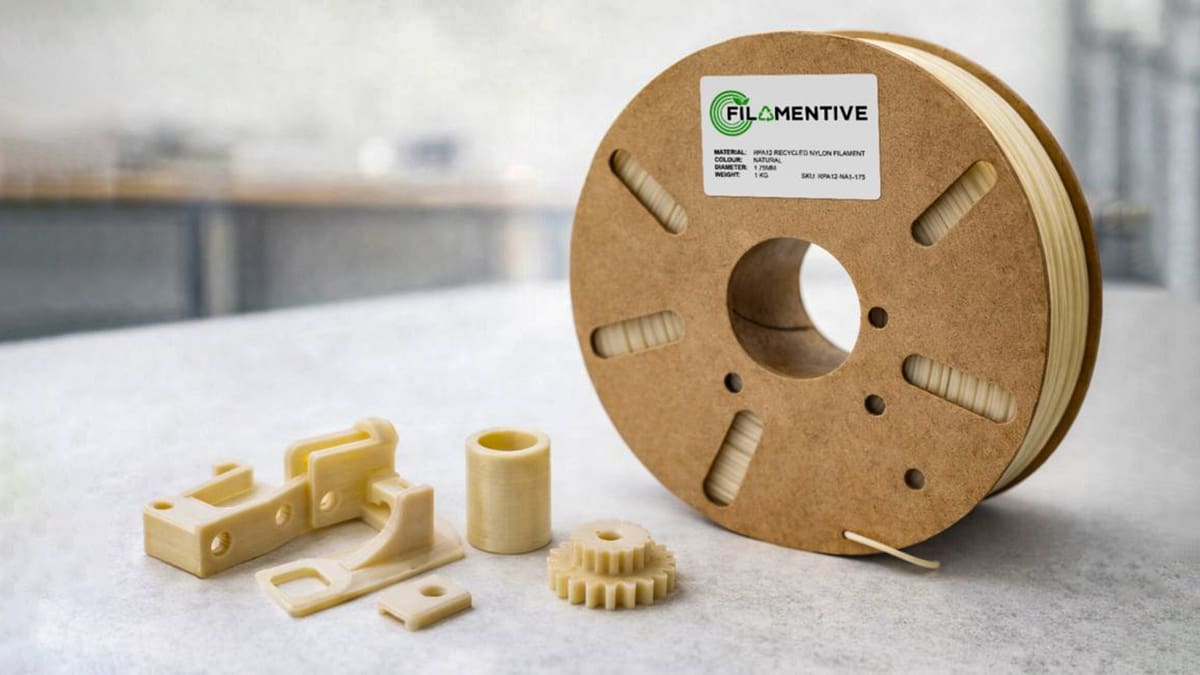
In a move that underscores the growing push toward circular manufacturing in additive production, UK-based materials specialist Filamentive has introduced rPA12, a 100% recycled nylon filament derived entirely from industrial Multi Jet Fusion (MJF) waste powder engineered for sustainability and mechanical performance.
Filamentive’s rPA12 (roughly $68 per kg) is not the only recycled nylon filament available on the market, but it does stand apart in terms of its feedstock origin. Made entirely from waste PA12 powder from MJF processes, it “closes the loop” in the additive manufacturing ecosystem itself by converting surplus powder into FDM-ready filament, the company says.
In effect, the waste of one additive process becomes the feedstock of another. rPA12 represents a new category focused specifically on reclaiming waste generated within the additive manufacturing sector itself, as opposed to other recycled nylon, which are often partially recycled blends from post-consumer plastic waste.
What’s Actually Recycled?
The unused PA 12 powder used in the MJF process is collected and used for the next print run, but powder cannot be reused indefinitely. Over time, a percentage of PA12 powder—still technically viable material—must be removed from the process loop. Traditionally, this surplus becomes waste.
According to Filamentive, rPA12 addresses exactly that inefficiency. Produced in collaboration with extrusion technology specialist 3devo, a company that has been producing filament from SLS and MJF waste for years, the filament uses 100% recovered PA12 feedstock sourced from industrial MJF operations, no virgin nylon (a fossil-fuel derived plastic) is added, which reduces demand for virgin PA12 overall.
You May Also Like:


Engineering-Grade Properties?
Nylon 12 is widely selected in engineering applications for its balanced mechanical and chemical characteristics. Filamentive claims that rPA12 retains the core attributes engineers rely on when using PA12 in general for brackets, snap-fits, housings, jigs, fixtures, and mechanically loaded components, including:
- Toughness with functional flexibility
- Heat and wear resistance, suitable for functional end-use parts
- Lower moisture absorption compared to Nylon 6
- Resistance to oils, greases, and fuels
Yet, Filamentive’s technical data sheet on the material is sparse. According to its TDS, Filamentive tested rPA12 using ASTM D638-14 tensile testing procedures. Test specimens were printed on a Prusa Core 1L and tested in multiple build orientations — XZ (edge), ZX (upright), and XY (flat). The reported results include only stress at yield, strain at yield, and strain at break for each orientation.
While comparing Filamentive’s recycled rPA12 to a tightly controlled, machine-locked industrial PA12 filament like Stratasys PA12 running on a Stratasys F900 is useful for context, it isn’t exactly a level playing field, of course. Even so, Filamentive’s rPA12 posts tensile yield strength up to 46 MPa in the flat orientation, which is solidly within the range most engineers expect from functional PA12 parts.
In practical terms, Filamentive rPA12 still delivers the toughness and structural reliability nylon 12 is known for, making it perfectly viable for brackets, housings, fixtures, snap-fits, and other mechanically loaded components. Rather than a token eco-material, it’s a legitimately strong engineering polymer that just happens to come with a much better sustainability story.
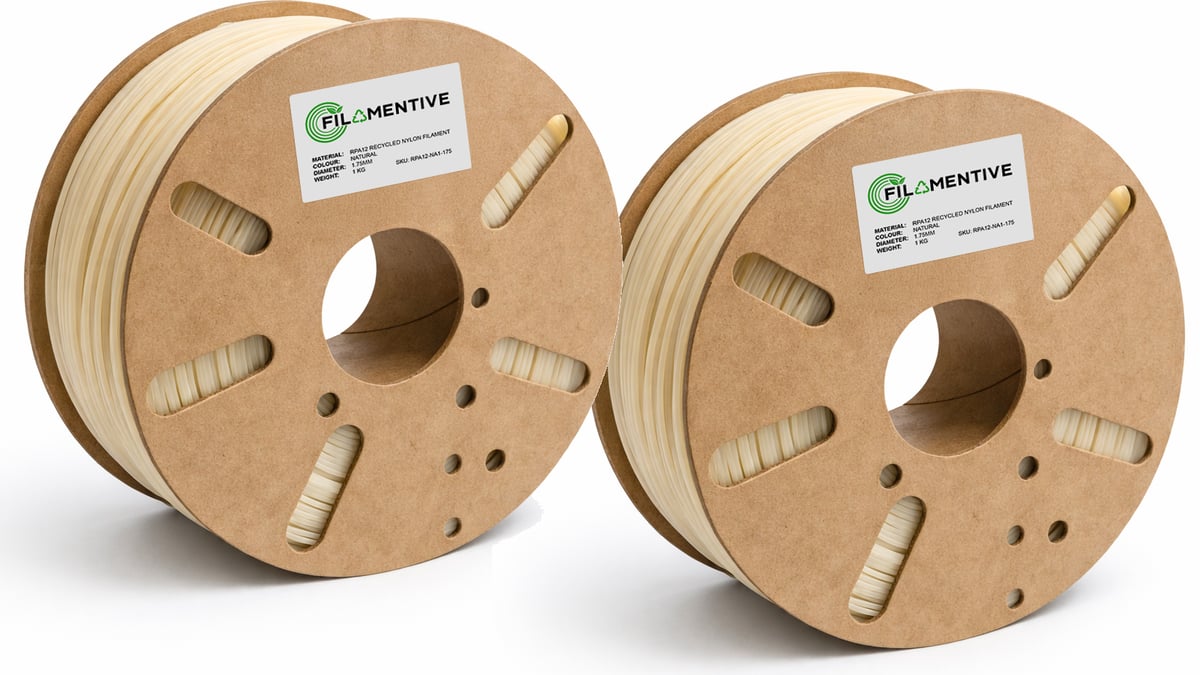
The filament is available in 1.75 mm diameter on 1 kg spools in a natural finish. Filamentive also provides a dedicated Material Sustainability Profile outlining the environmental credentials and sourcing transparency of rPA12, reinforcing the company’s emphasis on traceability.
License: The text of "How This New High-Strength Nylon Filament is Born From Industrial MJF Powder Waste" by All3DP Pro is licensed under a Creative Commons Attribution 4.0 International License.