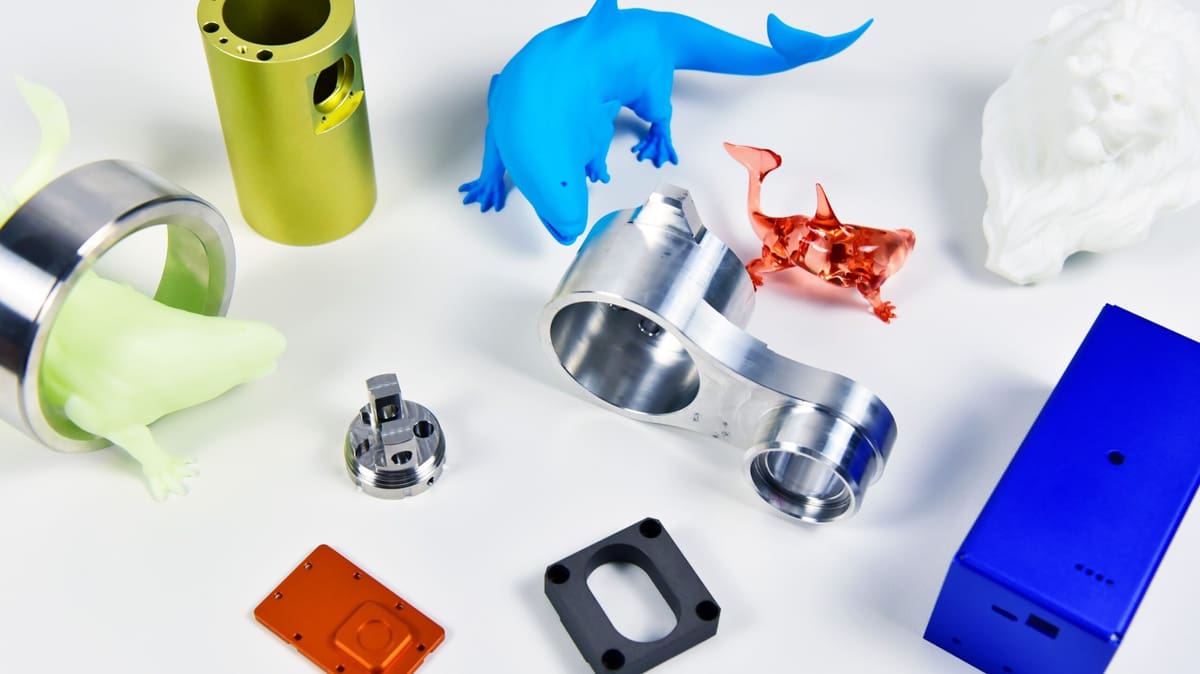
From PLA to Aerospace Titanium: How PCBWay’s Material Catalog Solves Complex Part Demands

Choose the ideal alloy or polymer for high-heat exposure, chemical resistance, and tight tolerances using PCBWay's comprehensive material catalog.
Material selection is often the first constraint an engineer runs into when moving a design from CAD file to physical part. A mounting bracket destined for a saltwater environment, for instance, demands a completely different alloy than a frame built for a lightweight drone. Yet hardware designers are often forced to compromise because their vendor’s catalog stops at materials like standard ABS and basic aluminum.
Whether you need high-temperature PEEK for functional testing or powder-bed titanium for complex internal channels, matching exact material properties to environmental stress is where physical design succeeds or fails. That match, though, isn’t just about the material itself, it’s also about which process can actually produce it in the geometry and tolerance you need. Here’s a breakdown of how PCBWay’s expansive material catalog balances engineering polymers and metal alloys across both 3D printing and CNC workflows.
3D Printing Materials: Unlocking Additive Capabilities in Metal and Plastic
Because 3D printing builds parts layer by layer, it opens up material behavior and geometry that subtractive processes can’t easily replicate. On the plastics side, PCBWay’s range covers both general-purpose and application-specific materials. PLA remains a common starting point for early-stage prototypes, while creators and engineers typically choose ABS and PETG when a part needs more toughness or better temperature resistance for functional testing. TPU adds flexibility for parts that need to bend or absorb impact, and photosensitive resin is used where fine detail and dimensional accuracy matter more than mechanical strength.
On the higher-performance end, PC, ASA, PEEK, and PPS are suited to parts that need to hold up under UV exposure, elevated temperatures, or repeated mechanical stress. PEEK in particular is common in applications where chemical resistance and heat tolerance both matter, such as certain medical and aerospace components.
Metal 3D printing covers aluminum, stainless steel, titanium, and tool steel. Aluminum is typically chosen for its balance of strength and low weight, stainless steel for corrosion resistance, titanium for its strength-to-weight ratio and biocompatibility (which is why it shows up often in medical and aerospace parts), and tool steel where wear resistance under repeated contact matters more than weight. These parts are printed from powder rather than machined from solid stock, which means that they can be created with internal channels and lattice structures that would be difficult to produce any other way.
CNC Machining: Bypassing Layer-by-Layer Constraints with Solid Stock
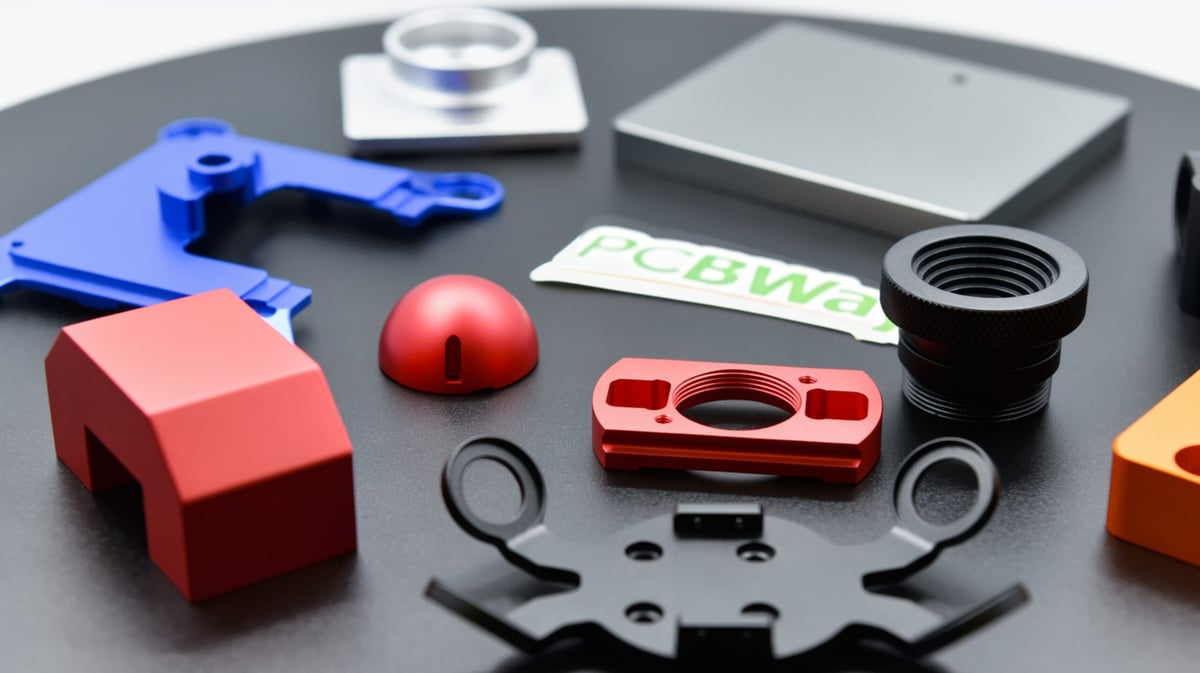
Once a design calls for tighter tolerances or a finer finish than printing can reliably deliver, the process, not just the material, has to change. CNC machining, being a subtractive process working from solid stock, naturally supports an even broader material range, since it isn’t constrained by what can be reliably printed layer by layer. PCBWay’s catalog spans commodity materials like ABS and polypropylene, as well as higher-performance options such as polycarbonate, POM, PTFE (Teflon), PMMA (acrylic), and PEEK.
Metal options extend from general-purpose aluminum and mild steel to stainless steel, brass, copper, titanium, alloy steel, and spring steel. These are materials chosen as much for their finishing compatibility, such as anodizing, bead blasting, and plating, as they are for their raw mechanical properties.
A Closer Look at PEEK and Titanium
Across both processes, two materials keep resurfacing. There’s PEEK on the polymer side and titanium on the metal side. They sit at the top of what each material class can do, which is why we’ll examine them on their own. PEEK and titanium do the most work once a project moves past basic prototyping. Engineers often choose them when they need a part that can perform in hardworking conditions.
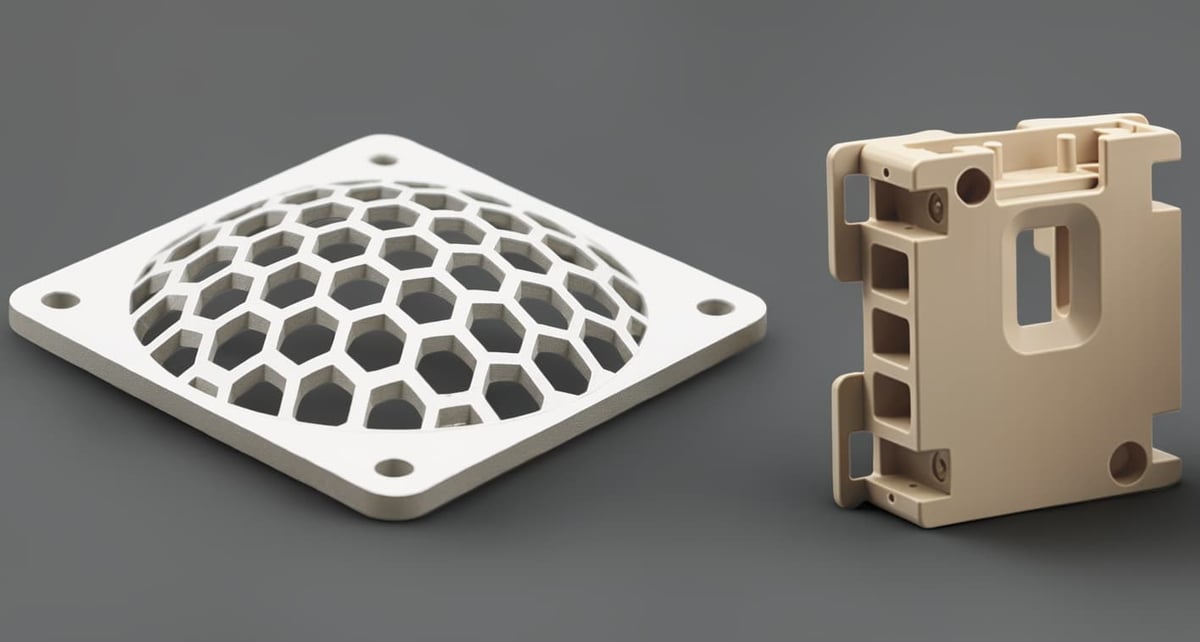
PEEK holds its mechanical properties at high sustained temperatures and resists chemicals and sterilization cycles that would degrade standard plastics, hence its use in surgical instruments, semiconductor tooling, and aerospace brackets near heat sources. It costs more to source and machine, so it’s reserved for parts where cheaper polymers would fail.
Titanium offers a strength-to-weight ratio that beats aluminum and steel, resists corrosion without coatings, and is biocompatible enough for implants. It’s available via both metal 3D printing (for complex geometry) and CNC machining (for tighter tolerances), though it’s slower and more expensive to machine than aluminum.
3D Printing or CNC Machining: Which One Fits Your Project?
3D printing suits designs with internal channels, lattices, or organic shapes a cutting tool can’t reach, and it’s typically cheaper for early prototypes and low-volume runs, with no tooling setup required.
CNC machining suits parts needing tighter tolerances, finer surface finish, or wrought-material mechanical properties. It also scales better with volume and supports more finishing options.
Many teams use both, going with 3D printing to validate form early, then moving on to CNC machining once the design is locked in.
Why Material Range Matters
For a hobbyist project, one or two go-to materials are usually enough. However, for anyone iterating through a real product development cycle, in which they are moving from a rough prototype to a functional test part to something closer to production-representative, having plastics and metals with meaningfully different properties available from one vendor, removes a layer of friction that otherwise falls on the designer to manage manually. It’s a less visible part of the prototyping process than lead time or price, but often just as decisive in whether a part performs the way it was designed to.
For more information or to get started with your project, visit PCBWay’s website.