Formlabs’ New $85K Fuse X1 Boasts 3x SLS Throughput, 50% Lower Part Cost

Inside the launch: All3DP spoke with Formlabs’ SLS product manager to examine the engineering behind the Fuse X1, its innovations, and its substantial performance claims.
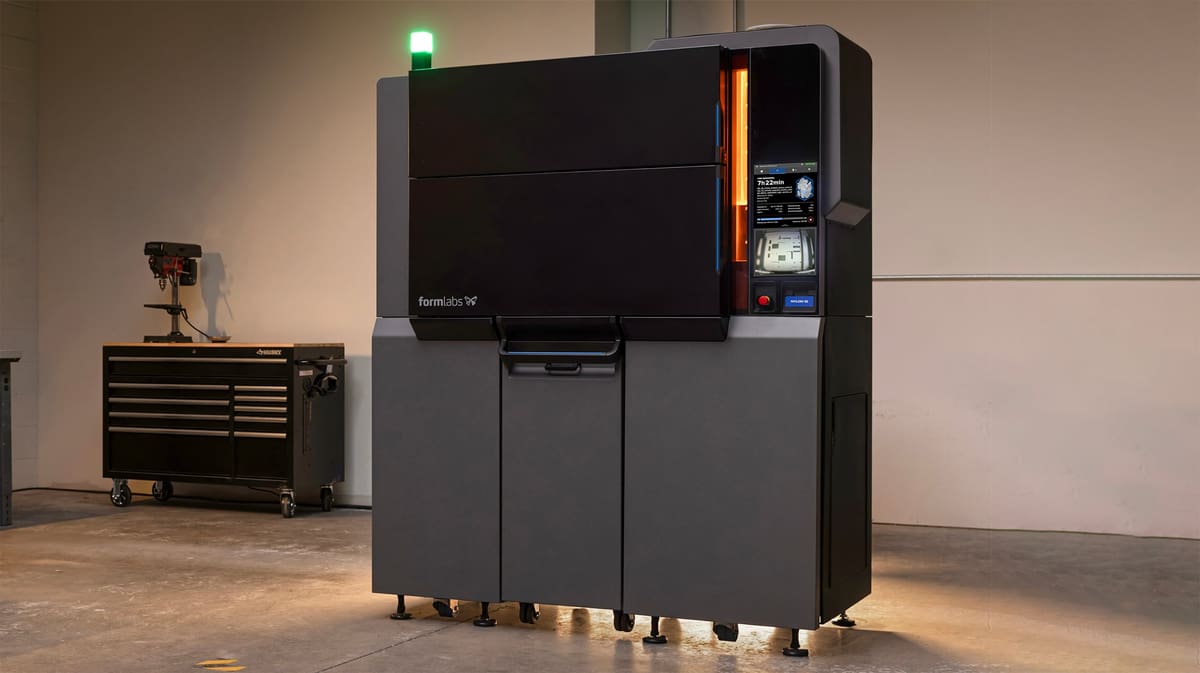
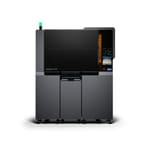
Formlabs just supersized its popular selective laser sintering (SLS) 3D printer, Fuse 1+, into a new industrial large-format machine called the Fuse X1 with roughly 7.5 times the build volume of 1+.
At less than half the price of similarly sized SLS 3D printers, Formlabs is trying to address several barriers to making SLS printing more accessible to more manufacturers at once. By offering a large build volume, high packing density, lower powder refresh, automated powder handling, AI failure monitoring, standard power, and ease-of-use, the company aims to enable more SLS production in-house instead of outsourcing, waiting on tooling, or buying a much more expensive systems.
All3DP spoke to Formlab’s Head of Product for SLS Matthew Ewertowski about who this machine is for and how Formlabs is, again, on a mission to bring SLS to the manufacturing masses.
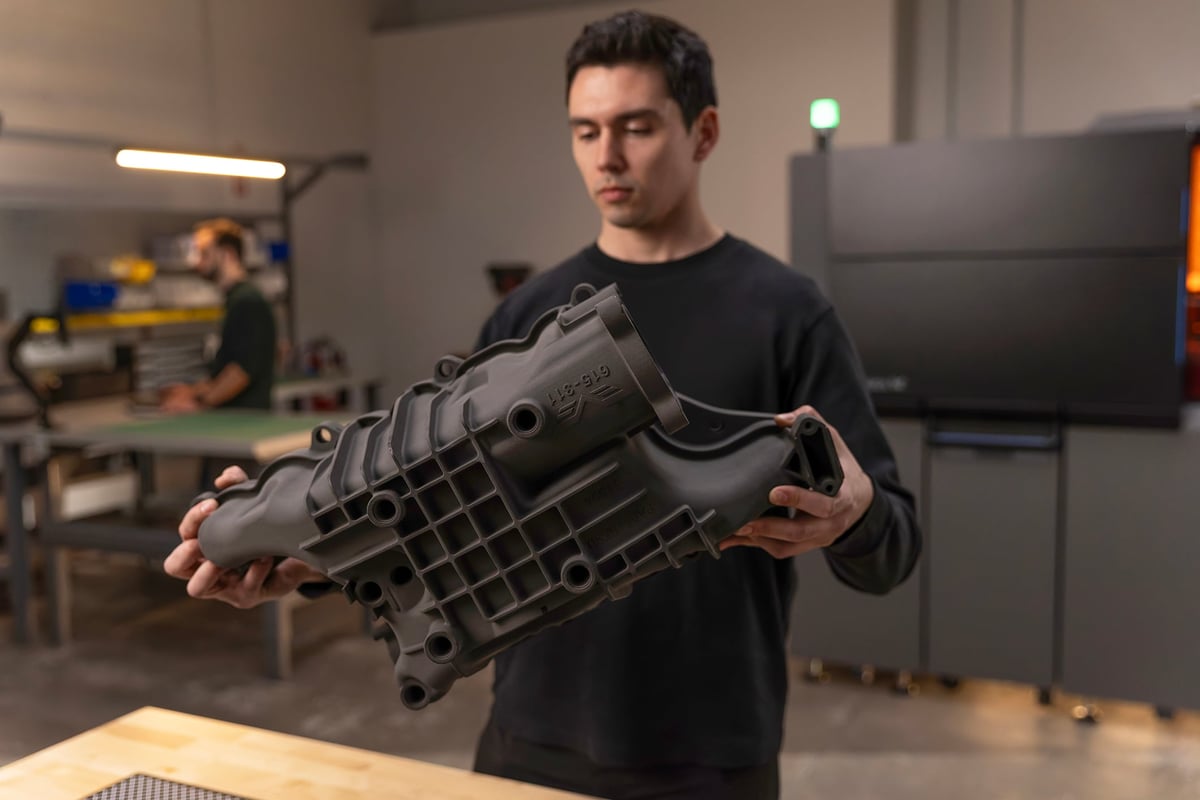
“With the original Fuse we transformed how people use SLS and created a new class of product,” says Ewertowski. “We found that 95% of Fuse users had never used SLS technology before.” Today, a lot of those customers are looking to transition to a larger industrial system.
Ewertowski says Formlabs looked at the large-format SLS market leaders and aimed to bring an “industrial system that was not only less expansive, but could also produce extremely cost-effective parts” to even compete with injection molding.
Designed for manufacturers, engineering teams, product developers, and service bureaus, the Fuse X1 takes aim at SLS machines from EOS, 3D Systems, and Farsoon, (along with MJF from HP) coming in at a much lower price. But how does it stack up when it comes to features?
Lower Cost Per Part?
According to Formlabs, the Fuse X1 is designed to deliver production-quality parts while offering “50% lower part cost versus legacy industrial SLS and MJF printers.” How exactly, is nuanced.
Comparison of Similar Size SLS Printers
Comparing throughput across SLS systems is difficult because manufacturers don’t report performance in a consistent way, and some don’t publish key figures at all. One company may cite kilograms of material printed per hour, another liters of build volume per hour, while others emphasize scan speed, productivity gains, or machine availability without providing a directly comparable benchmark.
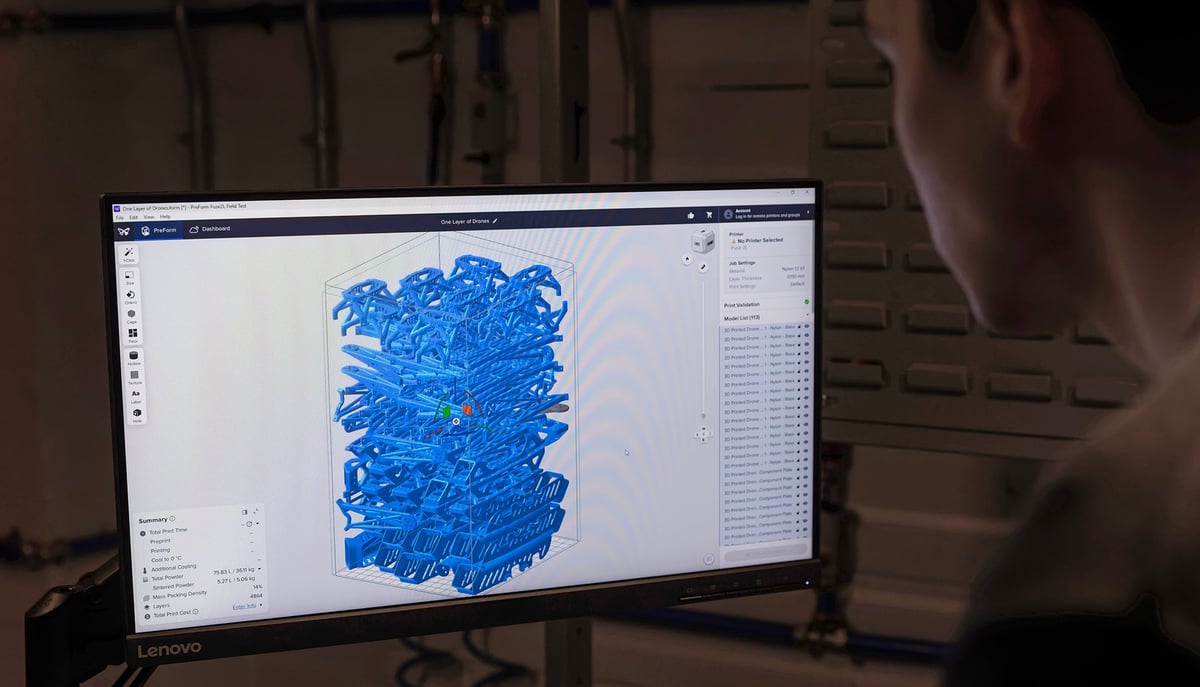
Real output also depends on factors beyond the laser, including build volume, packing density, layer thickness, material refresh rate, cooldown time, powder handling, changeover time, nesting software, depowdering workflow, and failure rate. As a result, any claim of higher throughput needs context: the material, part geometry, packing assumptions, full build-cycle time, and post-processing workflow must be known before one SLS system can be fairly compared with another.
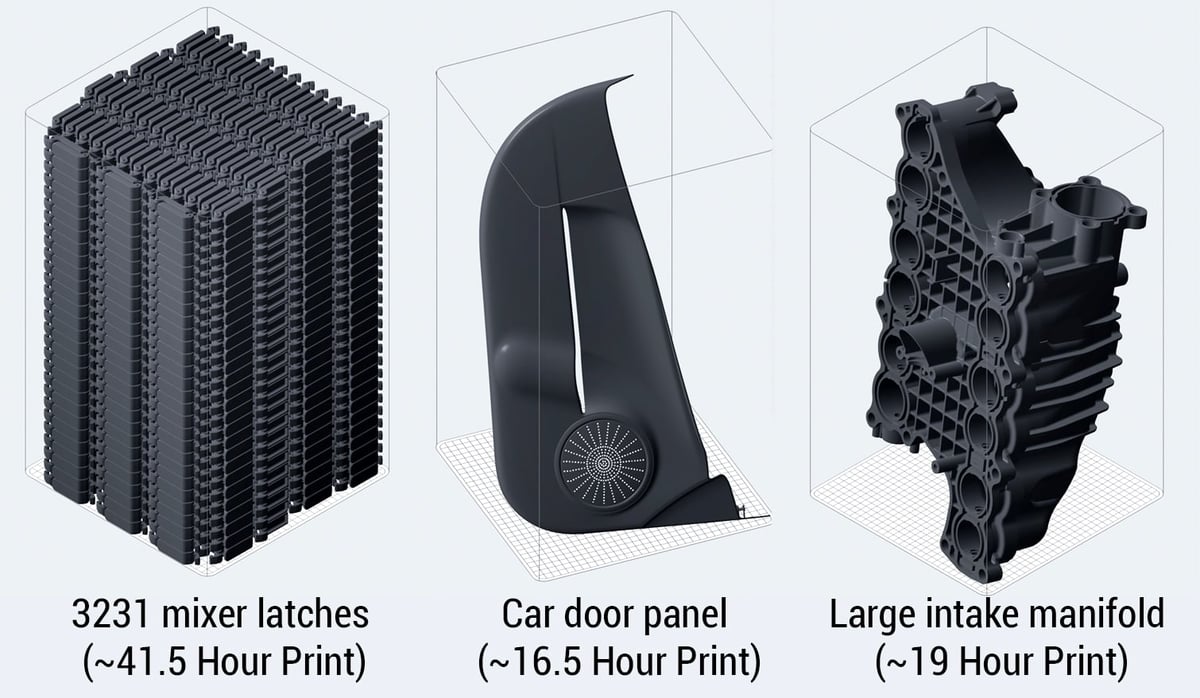
The Fuse X1 has a slightly slower print speed per processed volume than the EOS P3, but Ewertowski says “overall, when you account for the packing gains, overall time to change prints, and the ease of doing that, you can get significantly higher throughput than basically anybody else out there on the market.”
Formlabs’ core pitch for the Fuse X1 is not really that it beats every industrial SLS or MJF machine on every specification, but that it brings a large-format, production-oriented powder bed fusion workflow into a price and facilities range that more companies can actually adopt.
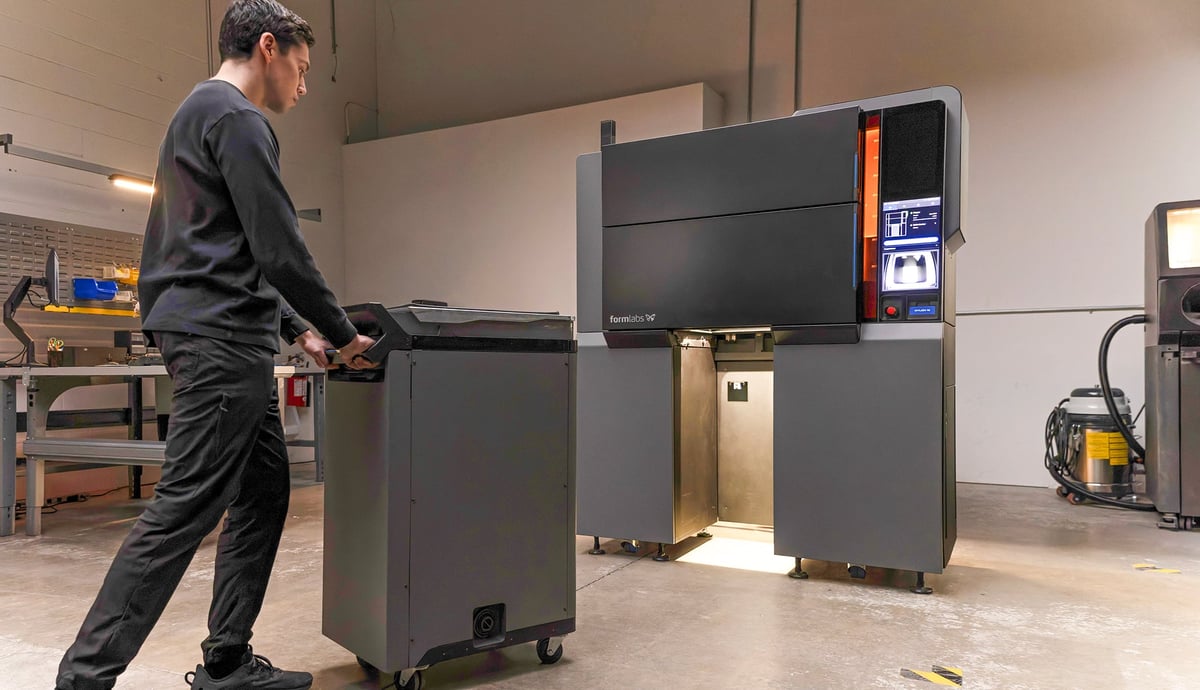
Although the Fuse X1 is not just a bigger Fuse, it has new and improved technology, Formlabs says it’s as easy to use, or easier, than the original benchtop-size Fuse.
“You get it set up, put in the powder, and hit start, and you’ll be printing,” says Ewertowski.
Bringing Something New to Fuse
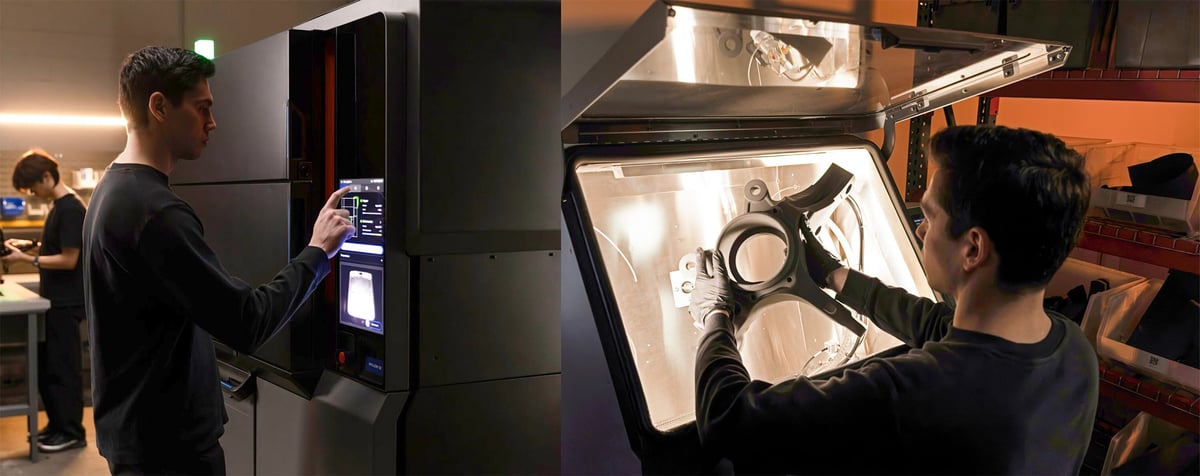
New tech on the Fuse X1 is the Adaptive Thermal Control and AI-powered Print Intelligence.
Adaptive Thermal Control is described as a new thermal architecture that maintains stable print conditions across the build chamber. While EOS and 3D systems also have real-time thermal control, Formlabs says its system collects and processes 700 times more thermal data per second than its Fuse 1+ 30W, using 13 independent thermal zones to maintain precise powder temperature throughout a build.
Print Intelligence uses computer vision and real-time thermal imaging to monitor every layer of a print. These are also found on other industrial SLS units but Formlabs says its system can not only detect anomalies before a build fails, but selectively remove affected parts from subsequent layers, so the build can continue, reducing wasted material and time.
There are are practical amenities like the modular build unit and the fact that the Fuse X1 fits through a standard door, runs on standard single-phase power, and does not require specialized HVAC. It still requires a nitrogen atmosphere for operation. Formlabs says the unit can be installed in around one hour.
One notable technical choice is the 120 W ytterbium fiber laser, rather than the CO₂ lasers common in larger polymer SLS systems. Formlabs says the fiber laser reduces cost, maintenance, and alignment complexity, but also acknowledged that nylon naturally absorbs CO₂ laser wavelengths, while fiber-laser SLS requires an absorbing element in the proprietary powder. The company says the Fuse X1 uses the same nylon 12 material as the Fuse 1+ 30W.
At launch, the system will support only Formlabs nylon 12 powder, with a stated refresh rate of 30% fresh powder to 70% reused powder. Formlabs says additional materials are planned, including nylon 11 by the end of 2026, and nylon 12 glass fiber, and TPU by summer 2027 with an open material mode also to be available. The immediate advantage is strongest for teams printing lots of PA12 prototypes, tooling, fixtures, housings, production aids, and end-use polymer parts, rather than those needing a mature multi-material industrial SLS platform on day one.
Other Fuse X1 specifications include:
- 330 µm laser spot size
- 110 µm default layer thickness
- minimum feature size of 0.6 mm (PA12)
Dimensional accuracy testing is still in progress, according to the company.
Upsizing the Whole Ecosystem
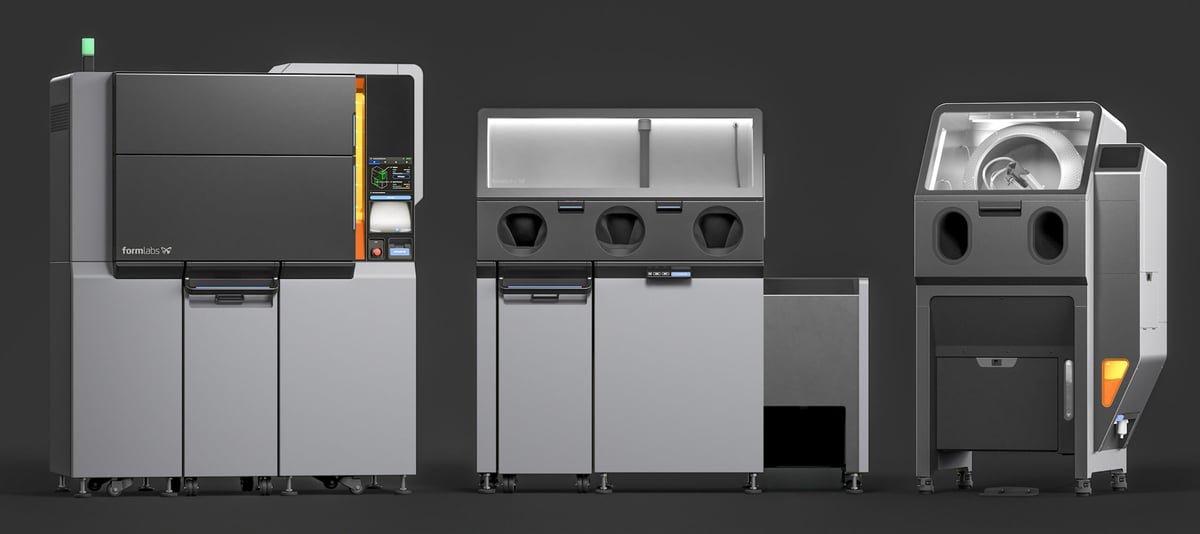
Fuse X1 printer is compatible with the new Fuse Sift X1 for powder recovery, Fuse X1 Vacuum Conveyor for automated powder transport, and a new high-capacity configuration for Fuse Blast for media blasting and polishing.
The Sift X1 holds 3 to 5 full builds of used powder and has optional compressed air to recover used powder faster and reduce manual brushing and part cleaning.
Formlabs says it’s dedicated to delivery the full end-to-end ecosystem, but isn’t releasing prices on these units yet.
What Early Customers Have to Say
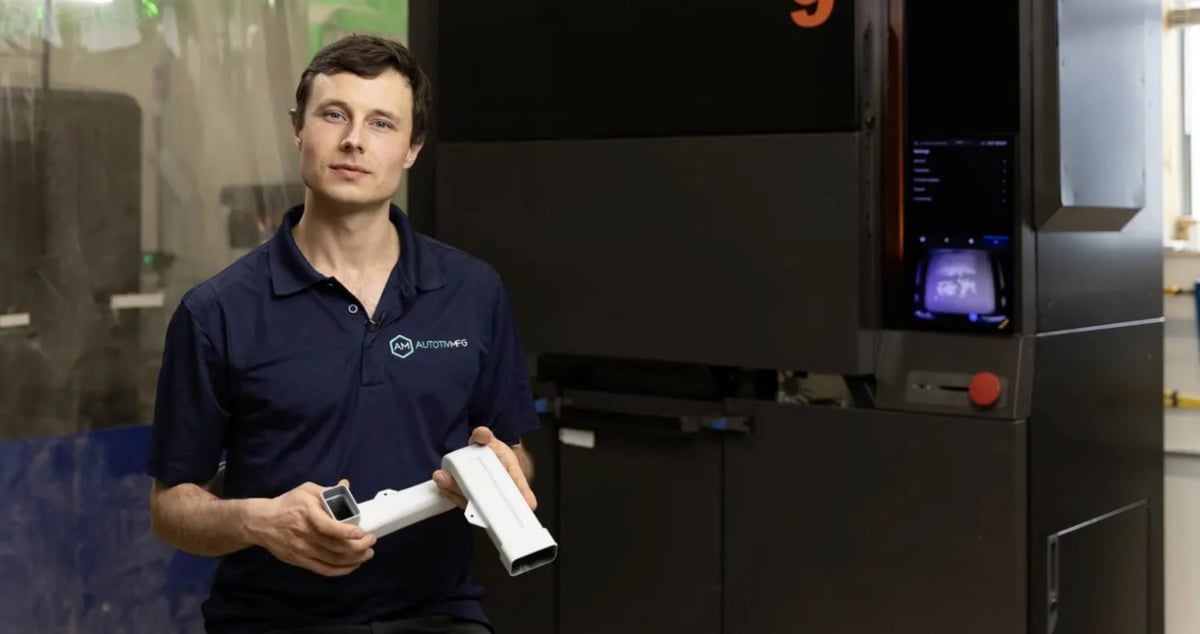
Formlabs says early access customers, including Tesla, Radio Flyer, and Autotiv Manufacturing, have already used the Fuse X1 for product development and production, printing more than 30,000 parts in the past four months.
Of course, all three companies have glowing reports of their experience with the machine available in case studies on the Formlabs website, but what is actually useful is what they printed and how long it took, along with the direct comparisons they could offer to their existing SLS systems.
“On the Farsoon [SS403P], running the full build volume takes about 70 hours,” says Evan LaBelle, CEO of Autotiv Manufacturing, a New Hampshire-based service bureau. “The Fuse X1 … is able to cycle every 24 hours, so you can effectively run about triple the throughput.”
Radio Flyer already had a Formlabs Fuse 1+ SLS for prototypes, but still needed to outsource larger builds to a service, which took weeks. The volume of iterations wasn’t enough to justify getting a larger SLS at around $200K in-house. “With the Fuse X1, I can iterate three times as often with nine times less labor,” says Agostino LoBello, Radio Flyer’s product development engineer, “that’s a super appealing value proposition.”
When Can You Buy One?
The company says the system is available to order now, and is expected to begin shipping in Q4 2026. If you want to check out the quality of Fuse X1 parts, you can order some (in the U.S.) through Formlabs new online 3D printing service, Form Now.
License: The text of "Formlabs’ New $85K Fuse X1 Boasts 3x SLS Throughput, 50% Lower Part Cost" by All3DP Pro is licensed under a Creative Commons Attribution 4.0 International License.
CERTAIN CONTENT THAT APPEARS ON THIS SITE COMES FROM AMAZON. THIS CONTENT IS PROVIDED ‘AS IS’ AND IS SUBJECT TO CHANGE OR REMOVAL AT ANY TIME.