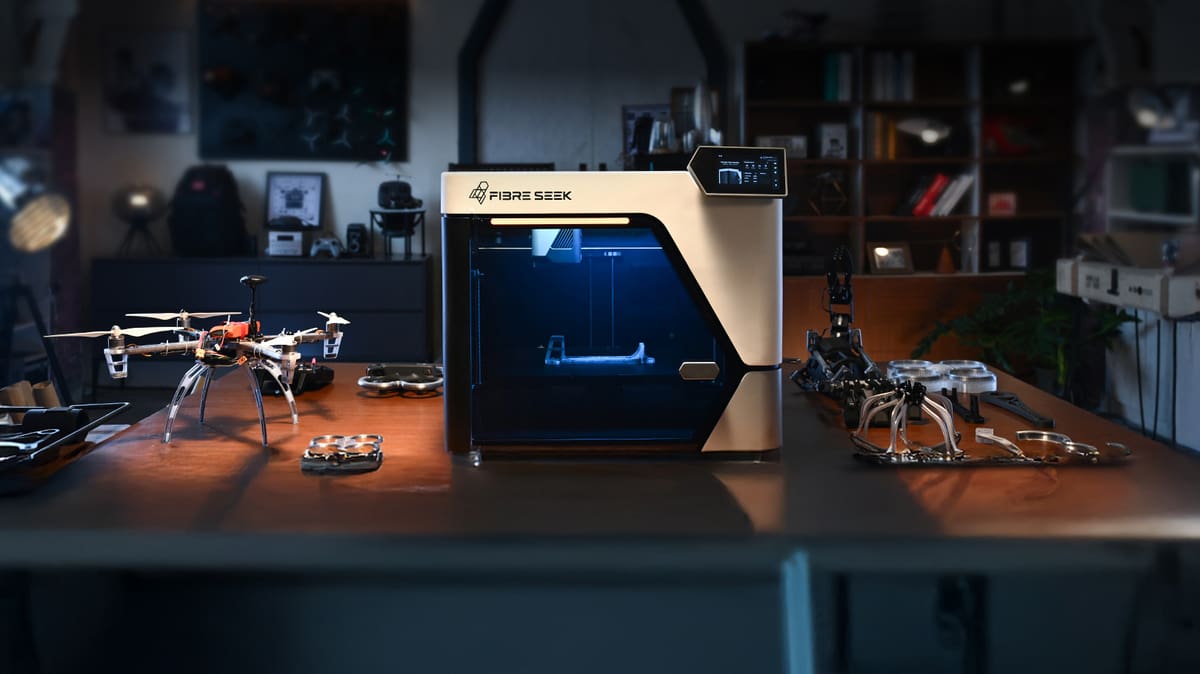
FibreSeeker 3: Bringing Industrial-Grade Continuous Composite Manufacturing to the Desktop

FibreSeek's FibreSeeker 3 gives engineers and makers access to CFC parts with tensile strength up to 900 MPa.
As 3D printing pushes deeper into functional, load-bearing parts, demand for materials that pair real strength with low weight keeps climbing. Continuous fiber composites have long delivered that combination, but producing them has mostly stayed locked inside industrial workshops, out of reach for individual engineers and small teams. FibreSeek built the FibreSeeker 3 to change that, putting Composite Fibre Co-extrusion (CFC) fabrication directly onto the desktop.
FibreSeeker 3 units are now stocked in overseas warehouses and ready to ship upon order. FibreSeek is also preparing for a limited global sales launch in September.
Industrial Capability Meets Desktop Reality
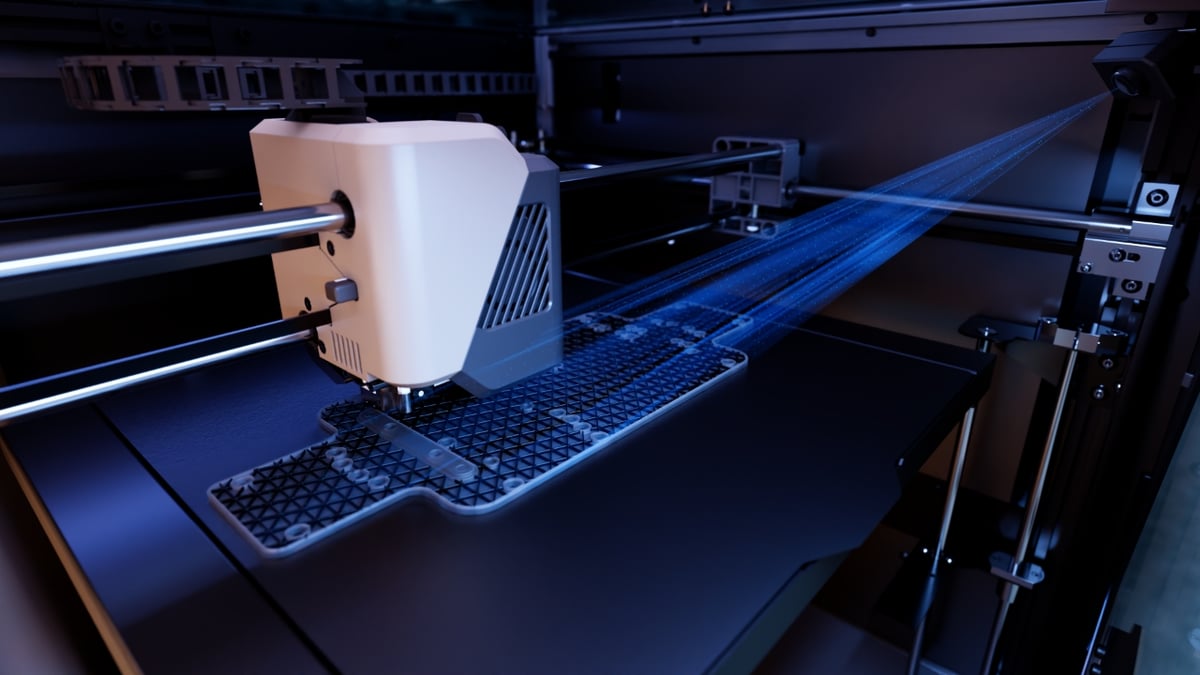
FibreSeek built the FibreSeeker 3 with its own CFC technology, which lays continuous fiber strands directly within the printed structure instead of relying on chopped-fiber-filled filament. CFC works by co-extruding a continuous fiber strand alongside molten thermoplastic through a dedicated nozzle, embedding unbroken fiber paths directly into each layer rather than chopping fiber into the filament itself. Because the fiber stays continuous along the print path, it can carry load much more efficiently than short, randomly oriented fiber fragments, which is what allows CFC parts to approach the strength-to-weight profile of machined metal.
The result is tensile strength of up to 900 MPa measured along the continuous fiber direction, which is strong enough to produce functional, load-bearing parts rather than just visual prototypes. As with other continuous fiber-reinforced composites, mechanical properties measured perpendicular to the fiber direction differ from those along it, and real-world part performance also depends on fiber orientation, fiber placement strategy, and testing conditions.
That strength translates into real engineering use cases. For example, drone frames need to be light yet rigid enough to survive repeated impacts. Conventional FFF parts may struggle to deliver the stiffness, impact resistance, and strength-to-weight ratio required for demanding drone applications, while machined aluminum solves the strength problem but adds weight the airframe can’t afford. Continuous fiber reinforcement lets makers print frames that hold their shape under stress without that weight penalty.
Robotic components face the same trade-off between stiffness and mass, but CFC printing lets engineers reinforce only the load paths that need it, keeping arms and joints rigid without over-building the part. The same fiber-placement approach extends to structural brackets, tooling, and assembly jigs that would otherwise need metal fabrication.
One Machine for Different Manufacturing Needs
Rather than locking users into one process, the FibreSeeker 3 offers three print modes, balancing speed, strength, and material cost:
- Green (High-Speed Mode), which uses the FFF nozzle for rapid prototyping with standard filament.
- Orange (High-Strength Mode), which combines the CFC and FFF nozzles to blend filament with targeted fiber reinforcement.
- Purple (Hyper-Strength Mode), which uses the CFC nozzle for full continuous-fiber composite performance.
This gives engineers a way to move from concept to production on one machine, choosing the mode that matches each part’s material needs and end-use requirements. Switching between modes means one machine can cover everything from quick concept prints to end-use structural components.
Materials and Build Capability
The FibreSeeker 3 supports a broad range of FFF materials, including PLA, PETG, PC, PA, PACF, and PETGF, alongside FibreSeek’s proprietary continuous fibre materials, X-CCF and X-CGF.
A 300 x 300 x 245 mm build volume and dual-print-head design give engineers room to produce functional parts and assemblies while switching materials as needed.
Built for Ease of Use
The FibreSeeker 3 pairs its hardware with FibreSeek’s Rocket Slicer software and automated setup features, simplifying the path from CAD model to finished composite parts, so engineers spend less time configuring and more time producing.
Pricing and Availability
FibreSeek has set the suggested retail price of the FibreSeeker 3 at $3,499, offering significantly more accessible entry point into CFC manufacturing than traditional industrial systems. X-CCF ($49 per roll) and X-CGF ($39 per roll) filaments help keep ongoing production costs manageable for teams producing functional parts. For more information, visit FibreSeek’s website.