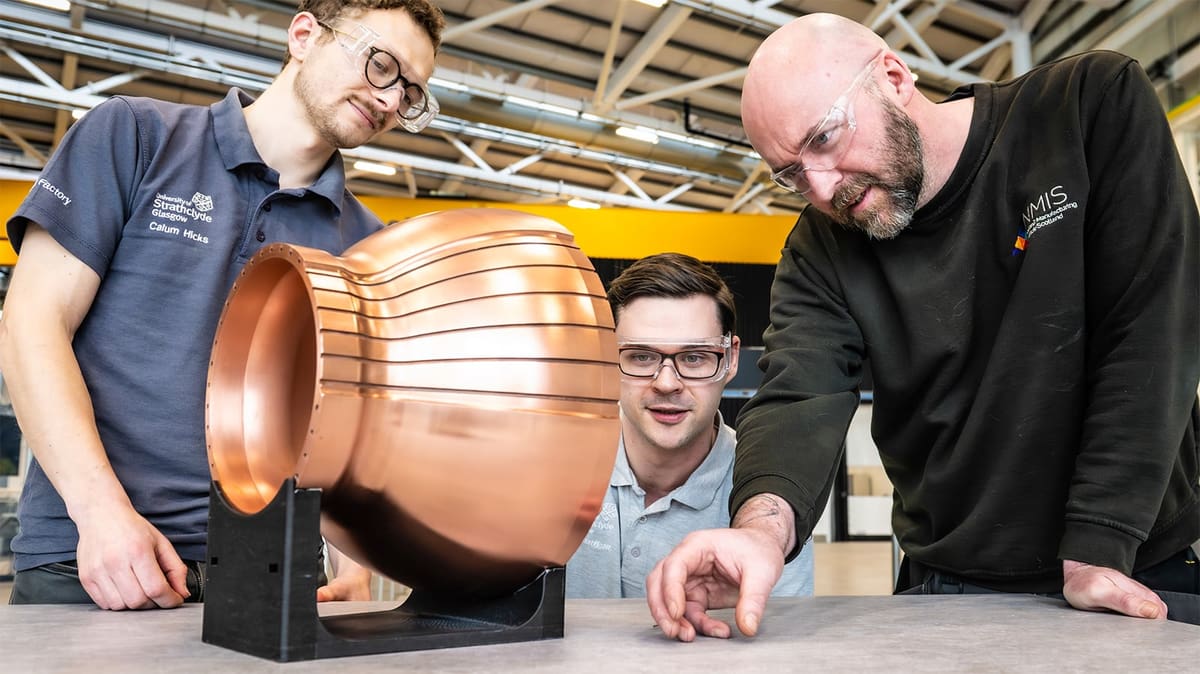
Cold Spray Could Cut Copper Rocket Nozzle Production From Months to Days

This hybrid solid-state manufacturing method bypasses laser-melting limitations to slash production lead times for complex aerospace components.
SpaceX, Launcher, Ursa Major, and other rocket engine makers use metal powder bed fusion for component production, but researchers have just demonstrated that another additive manufacturing method, cold spray, may be faster and more consistent.
Engineers at the National Manufacturing Institute Scotland (NMIS) developed a hybrid manufacturing route centered on high-pressure cold spray. Unlike fusion-based processes, cold spray deposits material in a solid state, avoiding melting and reducing the risk of thermal distortion or material degradation associated with traditional welding approaches, they say.
Cold spray is a manufacturing technology that sprays metal powders at supersonic speeds to bond them without melting them, which produces almost no thermal stress. The core technology was first developed in the 1990s as a coating method and later extended to build and repair free-standing parts.
This hybrid manufacturing route — cold spray to rapidly build the bulk copper structure, then use machining or other processes to finish critical surfaces — could reduce the long lead times and material waste associated with conventional fabrication or heavy machining, while avoiding the size limits and time-constraints of powder bed fusion. NMIS describes its cold-sprayed copper rocket nozzle as a proof point for high-rate deposition, improved material efficiency, and large-scale components with internal features.
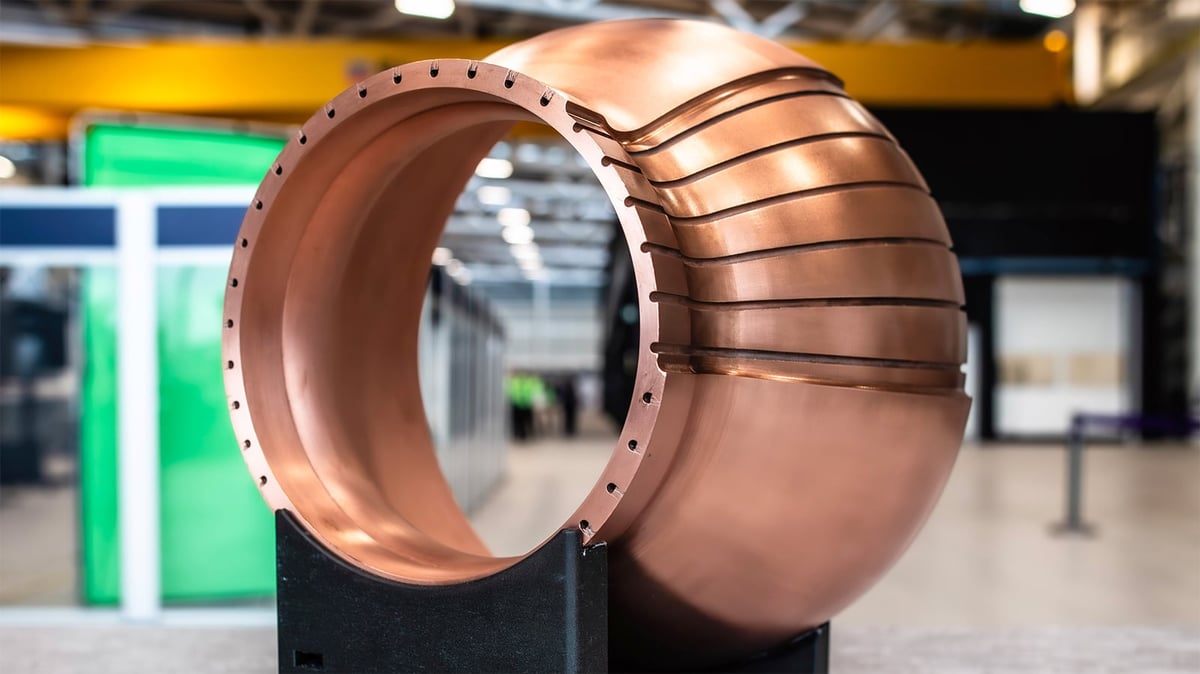
“This project marks an important milestone in demonstrating how advanced manufacturing can be applied to complex rocket engine components,” says Calum Hicks, senior technologist at the Digital Factory, NMIS. “Developing the copper rocket nozzle allowed us to explore new approaches to producing high-performing thermal management structures, reducing development times and improving production efficiency. This work strengthens the UK’s capabilities in the space sector and beyond.”
Copper components, particularly those with intricate internal cooling channels, are critical in rocket combustion chambers and nozzles, which operate in extreme thermal environments where temperatures can exceed the melting point of the structural materials.
Producing such components has long posed a manufacturing challenge. Traditional methods can involve multiple fabrication stages, extensive machining, and long production lead times. Although additive manufacturing processes can offer greater design freedom, they are often limited by build size, while copper adds another layer of difficulty.
At NMIS, the main nozzle structure was built layer by layer with cold spray through rapid copper deposition. According to NMIS, the process can achieve deposition rates of up to 10 kg per hour, potentially reducing production lead times from months to days while cutting material waste compared with conventional machining.
The facility did not say which printer brand it used to create the nozzle but has publicly stated that its cold spray facility is equipped with an Impact Innovations 6/11 system. This cold spray manufacturer has previously describe how it’s able to create internal channels using this method: First, it prints a copper-alloy combustion chamber around a removable mandrel. The mandrel, often made from an aluminum alloy, defines the internal shape of the chamber. Once enough material has been deposited, the process pauses so the surface can be machined and the regenerative cooling-channel grooves milled into the copper deposit. The open channels are then temporarily filled with a dissolvable material, then cold spray deposition resumes to close the channels and build the chamber to its final wall thickness. Finally, the mandrel is removed by machining or chemical dissolution, and the filler inside the channels is chemically etched away, leaving open passages for coolant flow.
In effect, the process combines rapid solid-state copper deposition with subtractive machining and sacrificial filling to create complex, regeneratively cooled rocket combustion chambers without relying on laser melting.
Although the nozzle has not yet been validated through full rocket engine testing, NMIS says the demonstrator shows that large-scale, high-performance copper components can be produced using high-pressure cold spray.
This project focused on a space application, but NMIS sees broader potential for the technology across sectors including aerospace, energy, and shipbuilding, where robust and corrosion-resistant materials are required. The process could also be used for repair and remanufacturing, helping extend the life of existing components.
You May Also Like:



License: The text of "Cold Spray Could Cut Copper Rocket Nozzle Production From Months to Days" by All3DP Pro is licensed under a Creative Commons Attribution 4.0 International License.