Bambu Lab’s New “Trust Center” Lists Everything It’s Doing to Secure Your 3D Printer

In an industry that’s often quiet about security, Bambu Lab is making its entire playbook public. Here's what this new level of transparency means for you and every other 3D printer owner.
China-based Bambu Lab is tackling the question of data security and privacy on desktop3D printers with a radically transparent stance: a new online “Trust Center.” This public hub details the full breadth and depth of Bambu Lab’s security architecture — from hardware-level encryption to third-party data storage — though not all measures are active on every printer yet.
While other prosumer 3D printer manufacturers implement security protocols, they rarely make them this public. This is where Bambu Lab’s approach sets a new benchmark. By openly detailing its measures, backing them with prestigious ISO and TRUSTe certifications, and providing granular user-centric privacy controls, the company is raising the bar for security and transparency across the entire 3D printing market.
As All3DP reported in our feature last week, “Is Your 3D Printer a Security Risk? You Might Be Surprised,” security has surfaced as a hot topic in the desktop 3D printer space, not because there’s a tidal wave of new 3D printer hacks out there (yet), but because industries already under constant cyberattack — like aerospace, defense, and big multinationals — are increasingly relying on these desktop 3D printers for prototyping, factory tools, and even final parts.
These users are looking for more robust security in their machines, especially if they sit on the company network.
“Users deserve to understand exactly how their printers and data are secured,” says Ye Tao, CEO of Bambu Lab. “The Trust Center removes the mystery. We’re making our security practices, certifications, and ongoing efforts completely transparent so users can make informed decisions about their equipment.”
Hardware-Level Security as a Foundation
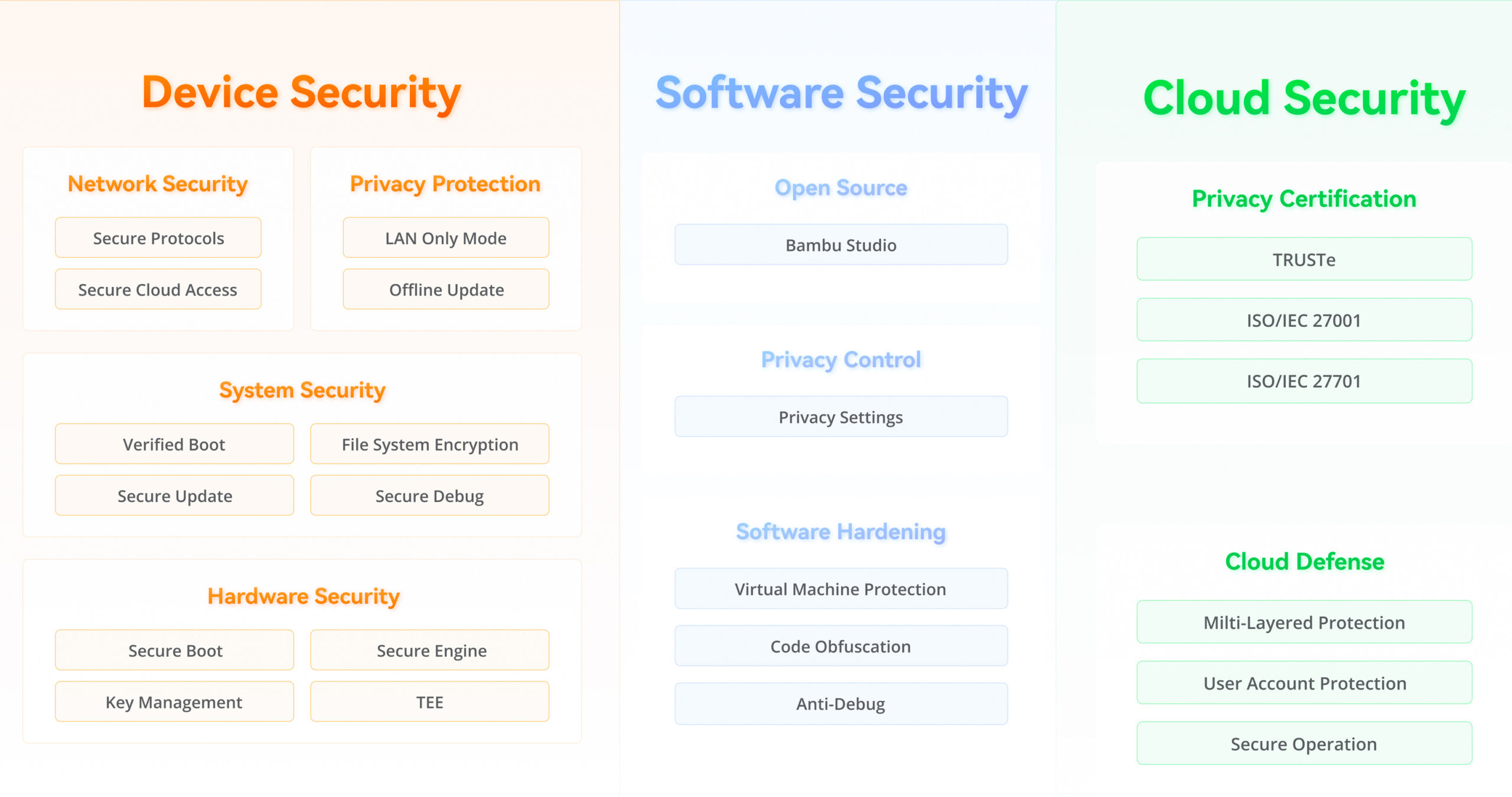
We detail the Bambu Lab security features below, yet, it’s likely too much detail for the majority of consumer users. Bambu Lab couldn’t confirm that any of the security features were actually new, just that they’d never been detailed in such depth before.
The top-level news is that your Bambu Lab 3D printer (depending on the model) has about the same security features as your mobile phone or your laptop, with data from all customers outside of China residing in Amazon Web Service servers located in the U.S.
Instead of using general terms, the new Bambu Lab 38-page white paper on its security development, details specific, enterprise-grade security technologies at both the hardware and software levels. There’s also disclosures on how your data is used, by whome, and how you can contact the company with data deletion requests.
“We firmly believe that only by fully respecting and protecting user data security and privacy can we earn lasting user trust,” Bambu Lab says in its white paper. “We will continue to increase our investment in this area, collaborate with the security community in an open and cooperative manner to enhance the security of our products and services, and listen to user feedback with a mindset of respect.”
Hardware Security
The most significant aspect of the publication is its focus on security that is built directly into the silicon, a practice common in smartphones and enterprise devices but less so in consumer 3D printers.
- Trusted Execution Environment (TEE): The use of ARM TrustZone technology in the X1 and H2 series printers is a major differentiator from other desktop FDM 3D printers. It creates a hardware-isolated “Secure World” on the processor to handle the most sensitive operations, such as key management and firmware decryption. This ensures that even if the main operating system is compromised, the printer’s most critical security functions remain protected.
- Secure Boot and Verified Boot: All Bambu Lab printers support Secure Boot, a process that uses a hardware “root of trust” to verify the authenticity of the printer’s software in a chain, from the moment it’s turned on. The higher-end X and H series also add Verified Boot, which checks the file system for tampering. This is crucial for preventing persistent malware or unauthorized firmware from being installed.
- Encrypted Storage with Hardware Keys: Storage is encrypted using keys that are protected by the hardware itself. In the P1 and A1 series, the key is stored in Efuse, making it readable only by the hardware security engine. This prevents attackers from physically removing the memory chip and reading its data.
Advanced System & Kernel Hardening
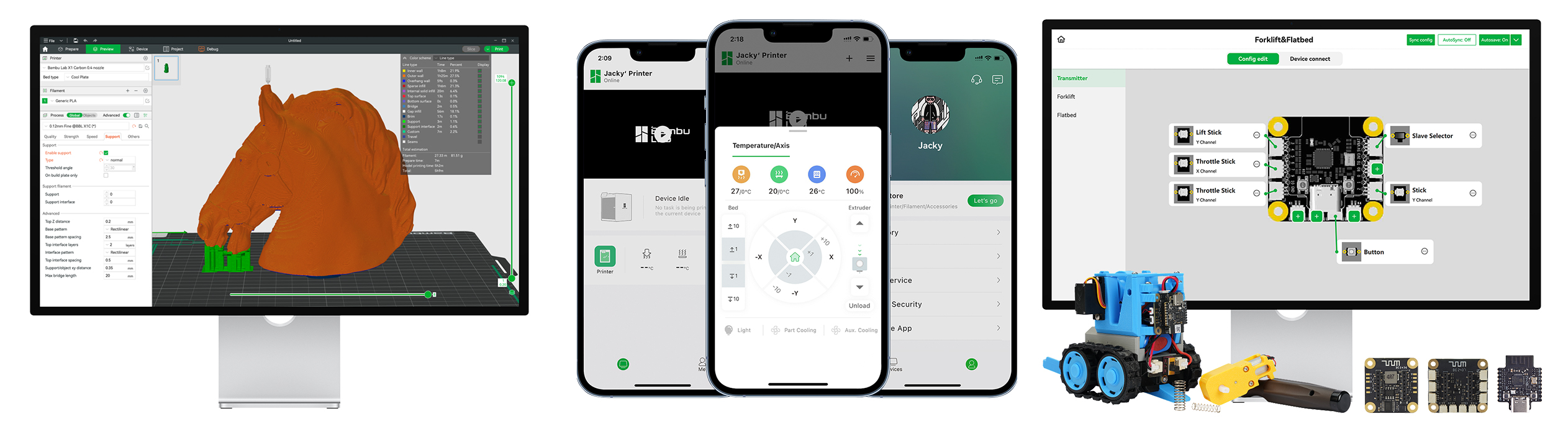
Beyond the hardware, Bambu Lab details specific, advanced software defenses to protect the printer’s operating system during runtime.
- Mandatory Access Control (MAC): The use of AppArmor on high-end models (currently the H2C, planned for all X/H2 series) confines applications to a strict set of rules, limiting the damage an exploited application can cause.
- Kernel Randomization (KASLR): This feature, also on high-end models, randomizes where the printer’s core software is located in memory each time it boots. This makes it significantly harder for attackers to execute common types of exploits that rely on knowing the kernel’s precise location in memory.
Direct Privacy Controls for Users
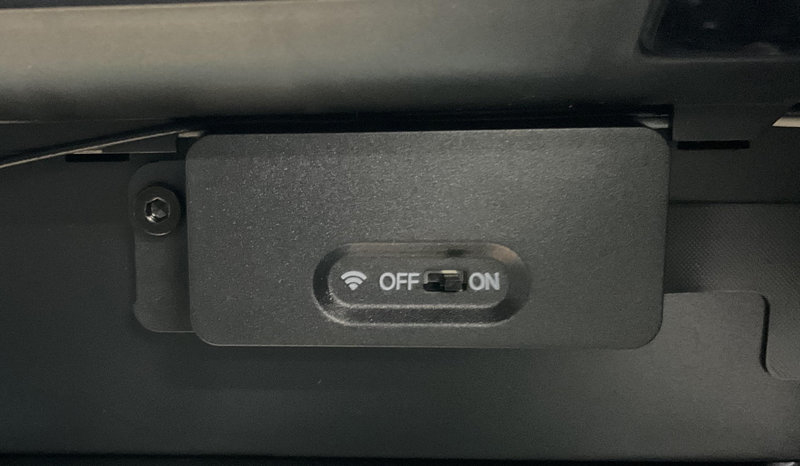
With all of the security measures above, still, the most secure 3D printer is one that does not communicate at all. Bambu Lab X1E and H2C have physical network switches to completely cut the machines off from local and Wi-Fi networks.
- LAN Only Mode: Some Bambu Lab printers (X1E and soon on the H2C) offer a “LAN Only Mode” where the printer does not initiate any external connections, and all communication happens securely on the local network. This directly serves users who have stringent privacy or security requirements.
- Offline Updates: Critically, the company provides a method for users in LAN Only Mode to perform secure firmware updates using an SD card. This allows users to maintain a complete air gap from the internet without sacrificing access to new features and security patches.
- Developer Mode for Print Farms: In a direct response to feedback from commercial users, Bambu Lab added a “Developer Mode” to LAN Only Mode. This allows third-party management software, common in print farms, to continue functioning normally by bypassing certain new authorization controls, demonstrating a willingness to adapt to the needs of professional users.
Independent Certifications Awarded
Bambu Lab also announced it has obtained three internationally recognized certifications in 2025 following extensive third-party audits.
- ISO/IEC 27001 (Information Security Management): Certified on April 11, 2025, this standard confirms the company meets rigorous international requirements for protecting information assets.
- ISO/IEC 27701 (Privacy Information Management): Also certified on April 11, 2025, this demonstrates alignment with global privacy protection frameworks.
- TRUSTe Enterprise Privacy: Certified in July 2025, this validates the company’s privacy management system against established international standards.
Find a Bambu Lab Bug, Win a Bounty
The company’s ongoing security efforts include a Bug Bounty Program that has been active since 2023. To date, 51 security researchers have participated in the program, helping to identify and address potential vulnerabilities.
The Bambu Lab Bug Bounty Program invites security researchers to find and report vulnerabilities in the company’s products and services in exchange for rewards. Participants can discover potential security issues and submit a detailed report via email to security@bambulab.com. The company’s team will then validate the submission, and if the report is legitimate, a reward based on the severity of the vulnerability is issued.
The program’s scope covers web applications like bambulab.com and makerworld.com, the Bambu Handy mobile app, PC software including Bambu Studio, and firmware for the X1, P1, H2, and A1 series printers. Vulnerabilities are categorized from low to critical, with the most severe threats including remote device control or bypassing secure boot mechanisms. The response time and monetary reward are determined by this severity level.
All participants are required to follow strict rules of engagement, which include respecting user privacy, not disrupting services, and responsibly disclosing vulnerabilities only after they have been remediated by the Bambu Lab team.
The new Trust Center is now live on the Bambu Lab website and includes the downloadable white paper, certification documents, and details on the Bug Bounty Program.
You May Also Like:



License: The text of "Bambu Lab’s New “Trust Center” Lists Everything It’s Doing to Secure Your 3D Printer" by All3DP Pro is licensed under a Creative Commons Attribution 4.0 International License.