3D Printed Contact Lenses Customized in Just 20 Minutes

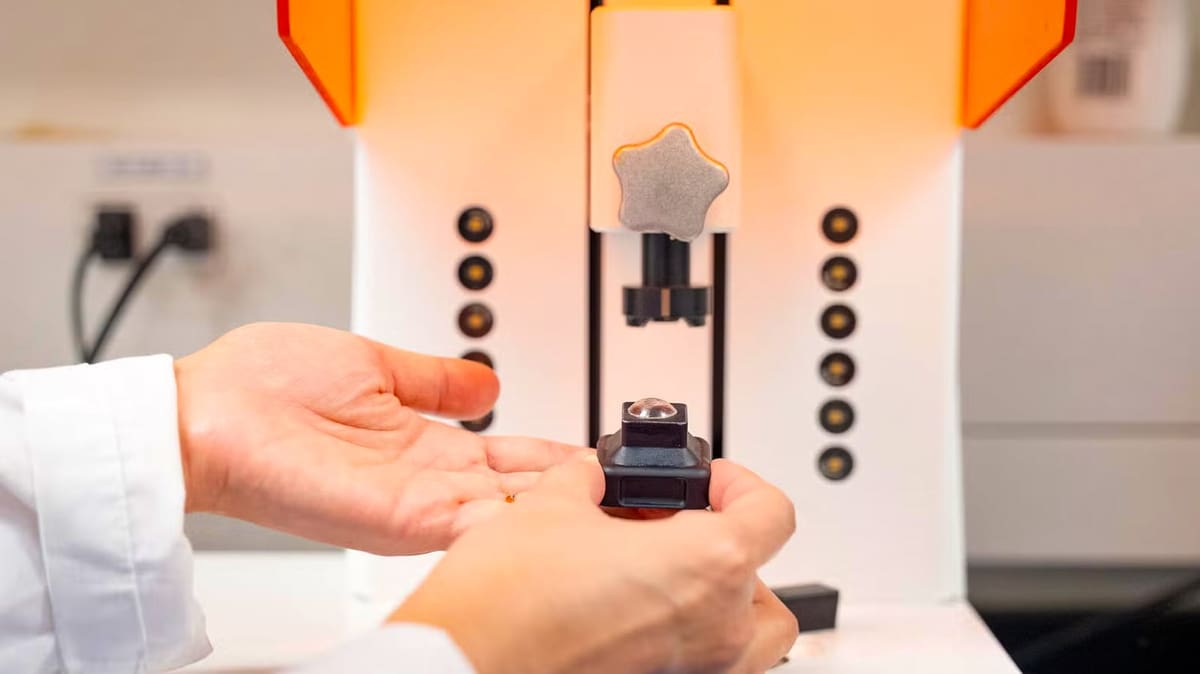
Researchers have developed an end-to-end digital manufacturing workflow that turns a patient's corneal scan into a customized contact lens with a post-processing technique that smooths printed optics without ever touching them.
Researchers at Canada’s University of Waterloo just unveiled a 3D printing platform capable of producing customized rigid contact lenses in as little as 20 minutes. The team says the technology could eventually allow patients to receive personalized lenses in a single appointment, eliminating the weeks or months often required to achieve a proper fit.
Unlike conventional contact lenses, which are manufactured in a limited range of standard sizes, the new approach is designed for patient-specific geometries. This is particularly relevant for people with irregularly shaped corneas, who frequently require rigid contact lenses and may need multiple fitting sessions before finding a suitable match.
The platform combines a newly developed silicone material with additive manufacturing. According to the researchers, conventional contact lens silicones are generally incompatible with 3D printing, prompting the team to formulate a new hydrophilic silicone specifically for the process.
DLP printing takes about 12 minutes per lens, while washing and the new coating process brings the total to 15-20 minutes. Multiple lenses can be printed simultaneously in one build, and the coating process can also be batched.
Could 3D Printed Contact Lenses Become the Next Dental-Aligner Success Story?
The University of Waterloo’s 3D printed contact-lens platform has the ingredients of a significant additive-manufacturing application: every part can be personalized, conventional manufacturing struggles with unusual geometries, and the researchers claim a lens can be produced in about 20 minutes. But its commercial prospects differ sharply from those of dental aligners and veneers.
The closest comparison is the dental aligner. Both products are thin, patient-specific polymer devices generated from a scan, and both could theoretically be manufactured inside or near a clinic. Yet aligners have a considerable head start. Dentistry already has mature scanning, design, printing, washing, curing, and traceability workflows, while the Waterloo lenses have so far undergone laboratory testing only and are being prepared for testing in actual eyes.
The researchers also addressed one of additive manufacturing’s common challenges: layer-induced surface artifacts. Because contact lenses require extremely smooth optical surfaces, the team developed an ultra-thin, non-contact coating process that removes the characteristic “stair-step” texture created during 3D printing while preserving the customized lens geometry and optical performance. The coating reduces the stair-step texture from roughly 5 µm to roughly 1.2 µm, or about a 75% to 80% reduction.
“Our technology produces lenses with patient-specific surfaces for a precise fit while delivering the optical clarity and mechanical performance expected of commercial contact lenses,” says Shirley Tang, a professor in the University of Waterloo’s Department of Chemistry, in the university’s announcement.
According to the researchers, the inner surface of each lens is tailored to match an individual patient’s cornea, while the outer surface is designed to provide the required vision correction.
In the team’s recently published research study, the 3D printed lenses, repeatedly benchmarked against commercial rigid gas-permeable lenses showed:
- similar transparency
- similar mechanical performance
- comparable oxygen permeability
- lower protein adsorption
- comparable cytocompatibility
The work has so far been demonstrated in laboratory testing. Working with the Centre for Vision and Eye Research (CEVR), a joint research institute of the University of Waterloo and the Hong Kong Polytechnic University, the researchers are advancing the technology toward commercialization. The team has filed a provisional patent covering its hydrophilic silicone material.
The Waterloo development could establish optometry as a new point-of-care additive-manufacturing market, similar to the way intraoral scanning and desktop resin printers changed dental laboratories and clinics.
However, success will depend on more than printing speed. The technology must demonstrate that customized lenses remain optically accurate, comfortable, dimensionally stable, biocompatible, and reproducible after the complete production and sterilization process. Human-eye testing will therefore be a much more consequential milestone than the reported 20-minute manufacturing time.
You May Also Like:


License: The text of "3D Printed Contact Lenses Customized in Just 20 Minutes" by All3DP Pro is licensed under a Creative Commons Attribution 4.0 International License.