Handheld Skin 3D Printer Can Help Burn Victims

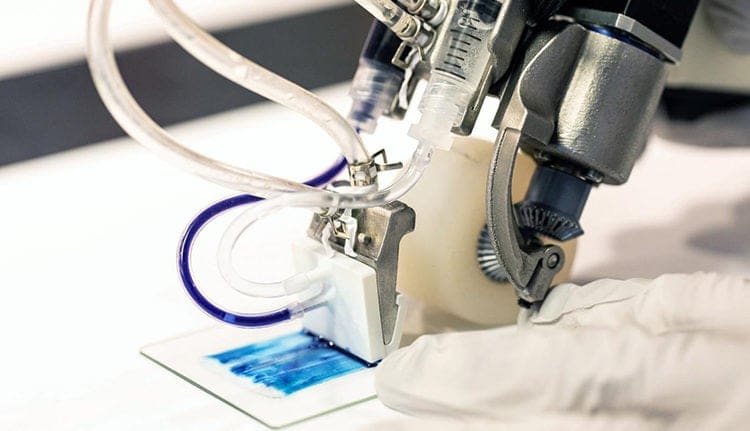
This handheld 3D printer deposits layers of skin tissue, and could one day help to heal deep wounds. Instead of waiting for skin patches to grow in a Petri dish, you apply it directly.
A team of Canadian scientists has successfully applied skin tissue to burn wounds using a handheld 3D printer. This technology may become a game-changer in the way severe burn victims are treated.
The handheld skin 3D printer, the work of scientists at the University of Toronto Engineering and Sunnybrook Hospital, was first shown back in 2018. Since then it has undergone a major redesign that improves upon the initial model’s functionality.
Where a cellular patch – a current method of treating deep burns – may take days to grow in a Petri dish, doctors using the device can apply sheets of skin to cover large and deep burn wounds instantly.
The roller dispenses stem cells (mesenchymal stroma cells, to be precise) as it ‘prints.’ These cells are known to adapt to their environment and, in this case, promote skin regeneration. A benefit of doing this, in addition to acting instantly to heal the wound, is to reduce the amount of scarring.
Marc Jeschke, medical director of the Ross Tilley Burn Centre at Sunnybrook Health Sciences Centre in Toronto, said: “Our results showed that the MSC-treated wounds healed extremely well, with a reduction in inflammation, scarring, and contraction compared with both the untreated wounds and those treated with a collagen scaffold.” The staff, so far, is extremely pleased with the successful tests. Further study is required, but according to the team, the signs are promising. Potential clinical applications for the device extend well beyond full-thickness burn injuries.
(Source: University of Toronto).
License: The text of "Handheld Skin 3D Printer Can Help Burn Victims" by All3DP is licensed under a Creative Commons Attribution 4.0 International License.